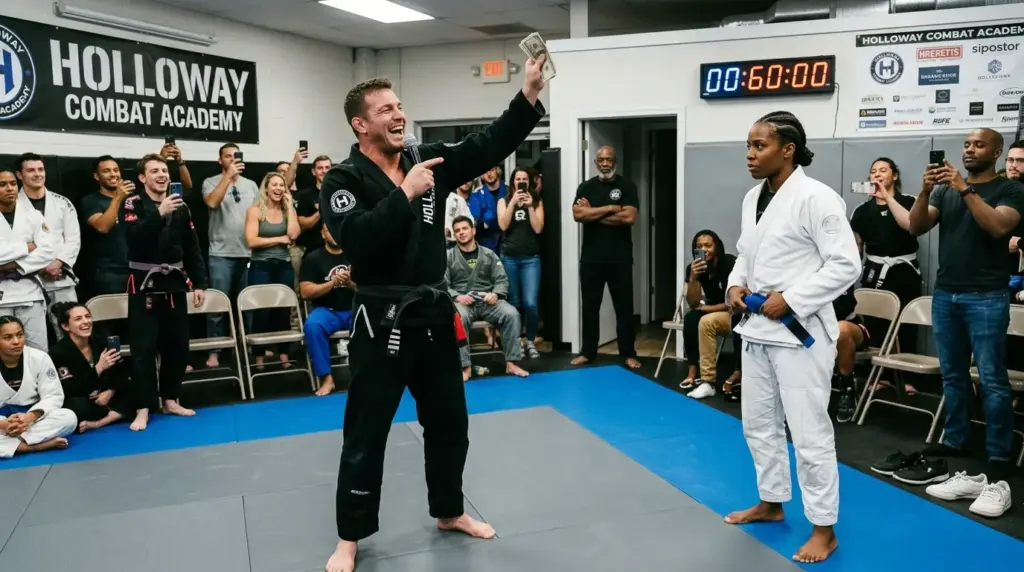
“Get off my mat,” Travis Holloway said. “I don’t train animals.”
The entire gym went still.
Bianca Whitfield stood at the edge of the blue mat, one hand resting lightly on the shoulder of a fifteen-year-old boy who had fresh purple bruises across his ribs.
Her face did not change.
“Call me that one more time,” she said.
Travis smiled.
“You deaf too? Your kind never belonged here.”
A few people shifted uncomfortably in the bleachers. Parents looked away. Teenagers stared at the floor. No one spoke.
Bianca held his gaze.
“I’m here about the kids you’re hurting.”
“Kids?” Travis laughed. “You don’t tell me how to run my gym.”
Then he shoved her.
Hard.
Bianca hit the mat on one hip, catching herself with a palm before her head struck the floor. The room gasped, but still no one moved. Travis grabbed a white belt from a nearby rack, raised it like a whip, and snapped it across her face.
The sound cracked through Holloway Combat Academy.
Bianca’s cheek burned instantly.
Her hands began to shake.
Travis stood above her, chest heaving, feeding on the stunned attention around him.
“A thousand bucks says you don’t last sixty seconds with me,” he said.
Bianca slowly rose.
She touched her cheek.
Then looked at him.
“Sixty?” she said quietly. “That’s way too generous.”
Fourteen seconds.
Triangle choke.
That was all Bianca Whitfield needed.
Nobody was laughing fourteen seconds later.
But this story is not really about those fourteen seconds.
It is about what a man with power, money, cameras, followers, and lawyers did when the whole world watched him lose to the woman he called an animal.
Before that night, nobody knew Bianca Whitfield could fight.
Nobody was supposed to.
She lived in Durham, North Carolina, in a small apartment with old hardwood floors, a stubborn kitchen sink, and one narrow window that looked out over a parking lot behind a grocery store.
She had no social media presence.
No flashy life.
No carefully edited clips.
She woke up at six every morning, made coffee in a chipped mug her father had given her years earlier, and drove to the Durham County Youth Services office.
Bianca was thirty-two years old.
A social worker.
Her specialty was at-risk teens — the kids the system had already started giving up on. The ones moving between foster homes, court hearings, school suspensions, probation meetings, and case files thick enough to break a desk drawer.
She carried fifteen kids on her caseload.
Some were in foster care.
Some were one bad night away from juvenile detention.
Some had parents who loved them but could not protect them.
Some had parents who had vanished entirely.
Bianca was often the only person who showed up consistently.
Not because the job required it.
Because she knew what it felt like when nobody did.
That was the Bianca the world saw.
Quiet.
Patient.
Professional.
The Bianca the world did not see trained every Tuesday and Thursday night in a garage gym on the east side of Durham.
Coach Raymond Ellis ran that gym.
Seventy-one years old.
Coral belt in Brazilian Jiu-Jitsu.
Forty-six years on the mat.
He had trained military operators, law enforcement officers, UFC fighters, quiet fathers, angry teenagers, battered women, and men who had learned too late that violence was not the same thing as strength.
His gym had no sign on the door.
No website.
No mirrors.
Just mats, a timer, old fans, and the smell of sweat that had soaked into the walls over decades.
Bianca had trained under Ellis since she was six years old.
Before Ellis, her father had trained her.
Darnell Whitfield.
Army combatives instructor.
Twenty-two years of service.
He started drilling her before she could ride a bike. Not because he wanted her to become violent, but because he understood the world made softer rules for some people and sharper ones for others.
By twenty, Bianca was competing at brown belt level.
Fast.
Technical.
Ruthless on the ground.
Coaches around the state called her “The Whisper” because opponents never heard her coming until they were already trapped.
Then her father died.
Heart attack.
Right there in the arena during the Carolina Open.
Bianca was on the mat, halfway through the second round of a semifinal match, when she heard the commotion near the bleachers. She turned her head just long enough to see people standing, waving for help, clearing space.
Then she saw her father on the floor.
By the time she reached him, his eyes were closed.
She never competed again.
Five years.
No tournaments.
No public training.
No photographs on podiums.
No belts tied for applause.
She told herself she was done.
But every Tuesday and Thursday, she still showed up at Ellis’s garage.
Still drilled.
Still rolled.
Still sharpened what grief had not been able to dull.
Muscle memory does not forget.
Neither does grief.
Ellis never pushed her.
He simply kept the mat clean and the door open.
He understood that some wounds close on their own schedule.
Travis Holloway was the opposite of quiet.
If Bianca was a whisper, Travis was a loudspeaker.
He owned Holloway Combat Academy, the biggest martial arts gym in Durham. Flashy storefront. Bright banners. Eighty thousand followers on Instagram. Sponsorship deals. Weekend seminars at two hundred dollars a seat.
His black belt hung framed behind the front desk like a diploma.
But inside the Jiu-Jitsu community, people talked.
His lineage was murky.
His promotion was too fast.
Too clean.
Too convenient.
Real black belts spend years grinding through rooms where nobody cares about their brand. Travis seemed to have skipped the parts that build humility.
None of that mattered to his followers.
Travis sold confidence.
He sold dominance.
His slogan was printed on every shirt in his merch line:
Weakness leaves or gets left.
His gym culture matched the slogan.
Beginners got hazed.
Smaller students got smashed by upper belts in sparring.
Kids were told fear was weakness.





