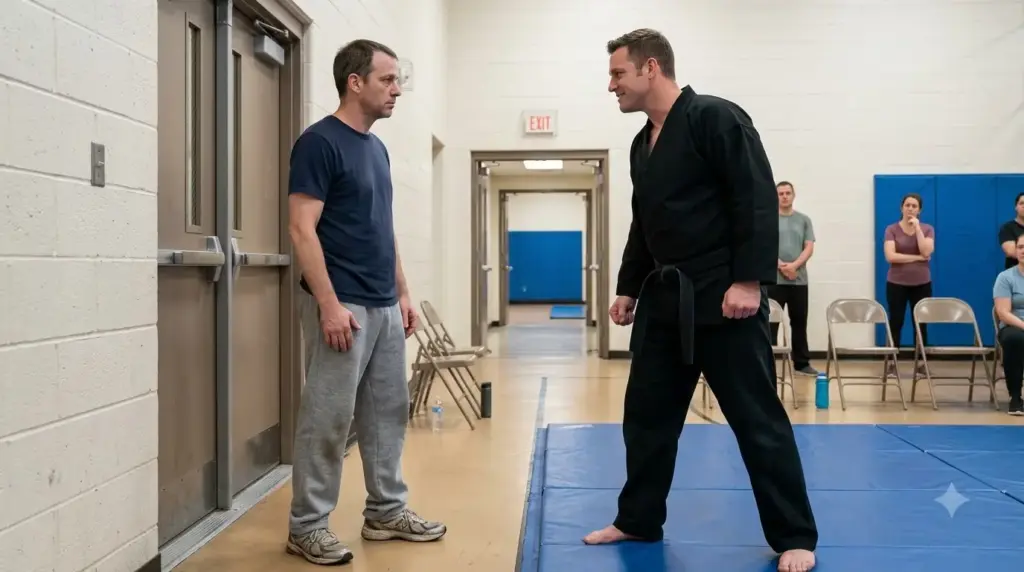
He walked with a limp.
That was the first thing Derek noticed.
Not the tired eyes.
Not the quiet way the man stood near the double doors.
Not the fact that he was minding his own business, waiting for his daughter to finish volleyball practice in the gym next door.
Just the limp.
To Derek, the limp looked like weakness.
And weakness, in Derek’s world, was an invitation.
The Oak Creek Community Center smelled exactly the way every old community center smells.
Floor wax.
Old chlorine from the pool down the hall.
Dust trapped in cinder block walls.
And the sharp, sour tang of sweat rising from worn vinyl mats spread across the middle of the gymnasium floor.
It was a Tuesday evening.
Fluorescent lights hummed overhead, flickering just enough to make the room feel harsher than it needed to be.
Fifteen adults sat around the edge of the mats on folding chairs, water bottles beside their feet, eyes fixed on the man standing in the center.
Derek Kane.
Head instructor of the adult self-defense class.
Local black belt.
Local legend, at least in his own mind.
He was big, around two hundred twenty pounds, most of it packed into a broad chest and thick shoulders. He wore a crisp jet-black gi that looked like it had never seen the wrong side of a washing machine. Around his waist was a thick, faded black belt, tied with perfect precision.
Everything about him was arranged for effect.
The posture.
The voice.
The pauses.
The smirk.
Derek did not teach martial arts as discipline.
He taught it as theater.
To him, self-defense was not about control, humility, or responsibility.
It was about dominance.
It was about making the room look at him.
“You have to dominate the space,” Derek barked, his voice bouncing off the cinder block walls. “If you show weakness, the street eats you alive.”
He grabbed his demonstration partner, a lanky accountant named Paul, and jerked him forward.
Paul looked like he would rather be anywhere else.
Derek smiled.
“Predators look for the limp, the slouch, the guy who avoids eye contact. That’s who they pick.”
Then he swept Paul’s leg.
The accountant hit the mat with a heavy, awkward thud.
The air left his lungs in a pained cough.
Derek stepped back.
“Sorry, Paul.”
But he did not sound sorry.
He did not offer a hand to help him up either.
“But the pavement doesn’t apologize,” Derek continued, turning back to his students. “You have to be rigid. Unbreakable. You show the world you’re not a victim.”
Near the double doors, leaning against the cold painted brick, Thomas Reed watched the clock above the bleachers.
He was not watching Derek.
He was not there for the class.
He was waiting for his fifteen-year-old daughter, Sarah, to finish volleyball practice in the adjacent gym so he could drive her home.
Thomas was forty-two.
He wore faded gray sweatpants, a plain navy T-shirt, and weathered running shoes that had carried him through more hospital parking lots than jogging trails.
His hair had begun thinning slightly at the crown.
Deep, exhausted lines sat around his eyes.
If you looked closely, you could see the way he stood.
All his weight shifted onto his left leg.
His right leg planted a little too deliberately, a little too straight, as if every inch of balance had to be negotiated before he trusted it.
Thomas hated crowds.
He hated echoes.
He hated rooms where people moved unpredictably.
Since coming back from Helmand Province six years earlier, his brain had permanently rewired itself.
Scan the exits.
Track every hand.
Measure distance to cover.
Count the people between you and the door.
Note who is angry.
Note who is too quiet.
Note where the sound changed.
It was exhausting.
Most days, all Thomas wanted was to be invisible.
A boring father.
A quiet man.
Someone no one needed to notice.
Unfortunately for Thomas, Derek was actively searching for someone to notice.
Someone smaller.
Someone weaker.
Someone he could use as contrast for his own greatness.
During a five-minute water break, Derek paced near the edge of the mats, rolling his shoulders, still riding the energy of his own performance.
His eyes swept across the room.
Parents waiting for kids.
Locals reading magazines.
A couple of teenagers leaning against the bleachers.
Then his gaze landed on Thomas.
The shifted weight.
The slight slump.
The avoidance of the spotlight.
To a bully, it looked like prey.
“Hey,” Derek called.
His voice cut through the low chatter.
“Buddy by the door.”
Thomas did not react at first.
He assumed Derek was talking to someone else.
He checked his watch.
Ten more minutes.
“Yeah, you,” Derek said. “The guy holding up the wall.”
Thomas slowly turned his head.
His expression was completely blank.
Not angry.
Not scared.
Not annoyed.
Just tired.
“Can I help you?”
“Come over here for a second,” Derek said, curling two fingers in a lazy command. “I need a fresh body. Paul’s tapped out.”
Thomas shook his head slightly.
“I’m just waiting for my daughter. Thanks, though.”
It was polite.
Normal.
Final.
A normal person would have nodded and moved on.
Derek was not operating like a normal person.
In front of his students, a refusal was not just a no.
It was resistance.
A challenge to his authority in the room he believed he owned.
Derek chuckled loudly, making sure the resting class heard it.
“Come on, man. It’s a community center. Get involved. I just need to demonstrate a wrist release. It won’t hurt.”
He paused.
Then smirked.
“Much.”
“I’m fine,” Thomas said.
His voice was quieter now, but the tone had changed.
Flat.
Final.
Derek’s smile tightened.
He stepped off the mat, bare feet slapping against the polished hardwood floor as he walked toward the doors.
The room began to quiet.
Water bottles stopped halfway to mouths.
Conversations died mid-sentence.
That awkward, heavy tension of an impending confrontation settled over the gym.





