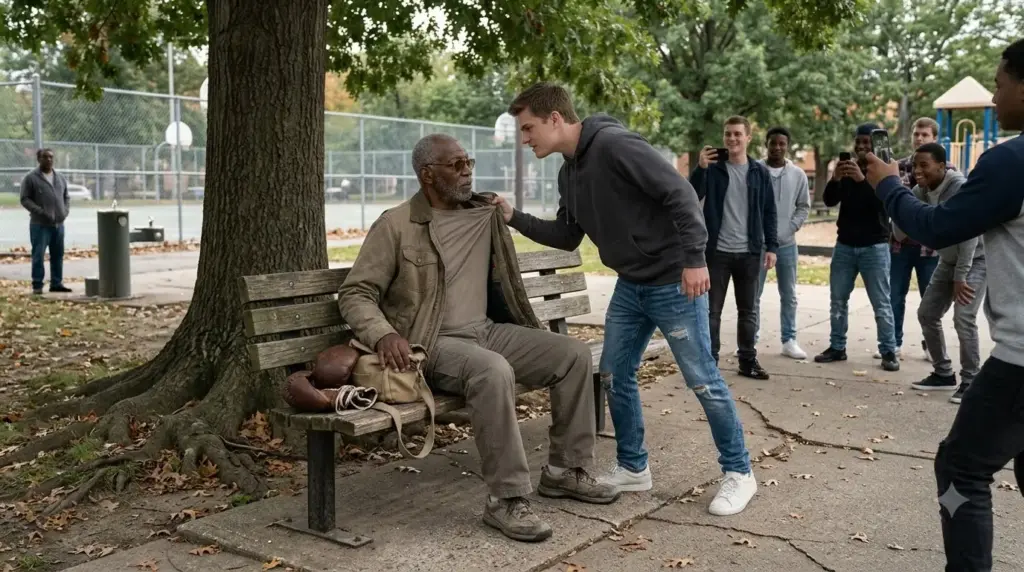
“Get off my bench, old man.”
Byron Ingram looked up slowly.
The morning sun sat low over Brandon Park, cutting through the oak trees and throwing long shadows across the cracked concrete near the basketball courts.
Byron was sitting on the same bench he had used for three years. A canvas bag rested at his feet. Inside were two pairs of boxing gloves, a jump rope, and hand wraps so old the elastic had given up.
He was seventy-four years old.
One good eye.
One dead eye.
A slow walk.
A quiet voice.
And a past almost nobody in the neighborhood knew about.
“I’m just sitting here, son,” Byron said.
The young man’s face twisted.
“Don’t call me son.”
His name was Brad Sawyer.
Twenty-two years old.
Rich.
Spoiled.
Protected.
Son of Councilman Garrett Sawyer, a man whose name opened doors, closed complaints, and made police reports disappear.
Brad grabbed Byron by the collar and yanked him forward.
“Who the hell are you to think you’re my father?” he hissed. “One-eyed old rat.”
Byron’s hands stayed down.
“Let go of my shirt, please.”
Brad slapped him across the face.
The sound cracked through the park.
A few people turned.
Nobody moved.
Brad grabbed Byron’s collar again.
“You’re driving me crazy, you stinking old man. Let me help you with the other eye so it matches.”
Byron’s jaw tightened.
“Don’t say that.”
Brad released him and turned to his friends.
“Teach him a lesson. This stinking old Black dog thinks he can talk back to me.”
They started to circle him.
Phones lifted.
A ring light blinked on.
Across the park, ten-year-old Caleb froze beside the water fountain, his taped hands hanging at his sides.
Byron stood up slowly.
Every joint protested.
Every muscle remembered.
He looked at Brad with his one good eye.
“You sure about that, son?”
Brad laughed.
He had no idea who the man he had just attacked really was.
He had no idea that before Byron became the quiet old man of Oakfield Road, before the dark glasses, before the limp in the mornings, before the silence, people in boxing gyms had whispered his name like a warning.
The Ghost.
Byron Ingram.
Twenty-three professional fights.
Twenty-three wins.
Fifteen knockouts.
Middleweight champion.
The man grown fighters crossed the gym to avoid.
And Brad Sawyer had just picked the wrong old man.
Byron had lived on Oakfield Road for forty-one years.
Same house.
Same porch.
Same cracked steps he never got around to fixing.
The neighborhood had changed around him.
New fences.
New faces.
New money creeping in from the east side.
Old families moving out because taxes rose faster than wages.
But Byron stayed.
He stayed because this was where Helen had planted her roses.
And even though Helen had been gone nine years, those roses still bloomed every April like she had only stepped inside for a glass of water and would be back any minute.
Byron was seventy-four now.
He moved slowly in the mornings.
His left eye saw the world just fine.
His right eye saw nothing at all.
It had not since 1984.
A detached retina.
A punch that should never have been thrown.
A fight that should never have happened.
A night nobody had ever been held responsible for.
When people asked about the eye, Byron said glaucoma.
It was easier that way.
Most people on Oakfield Road knew him as the quiet old man who swept the sidewalk at six in the morning and carried grocery bags for Mrs. Patterson on Tuesdays.
They did not know about the belt in the shoebox under his bed.
They did not know it was wrapped in Helen’s old scarf.
They did not know about the basement gym in Philadelphia where Curtis Holloway had taught him how to plant his feet, keep his chin tucked, and never throw a punch he did not mean.
They did not know because Byron did not talk about it.
Boxing had already taken enough from him.
Every morning at seven, Byron walked four blocks to Brandon Park.
He carried the canvas bag over one shoulder and set up near the basketball courts under an old oak tree whose roots had cracked the concrete into something that almost looked like a ring.
The kids started showing up three years earlier.
First Deshawn.
Twelve years old.
Angry at everything.
Then Kesha.
Ten years old.
Faster than any of them.
Then Caleb.
Caleb was the one who kept Byron coming back.
Ten years old.
Small for his age.
A stutter that turned simple words into obstacles.
A father in prison since Caleb was four.
A grandmother who brought him to the park before her shift at the hospital because she could not afford a babysitter, could not afford summer camp, could not afford much of anything except the hope that a safe public park might hold her grandson until she came back.
The first day, Caleb watched Byron from behind the water fountain.
The second day, he stood closer.
The third day, Byron held out a pair of gloves.
“You want to try?”
Caleb shook his head.
“That’s okay,” Byron said. “They’ll be here tomorrow.”
It took two weeks.
One morning, Caleb walked up, put his hands out, and let Byron wrap them.
His fingers were shaking.
Byron pretended not to notice.
“First thing,” Byron said, “plant your feet like this.”
He showed Caleb the stance.
Left foot forward.
Right foot back.
Weight balanced.
The same stance Curtis Holloway had drilled into him fifty years earlier.
“Now hands up. Protect what matters.”
Caleb raised his fists.
They barely reached his chin.
“Good,” Byron said. “Real good.”
Caleb smiled.
His grandmother later told Byron it was the first real smile she had seen from him in months.
After that, Caleb came six days a week.
He learned the jab first.
Then the cross.
Then how to slip a punch by moving his head two inches to the left.
No more.
No less.





