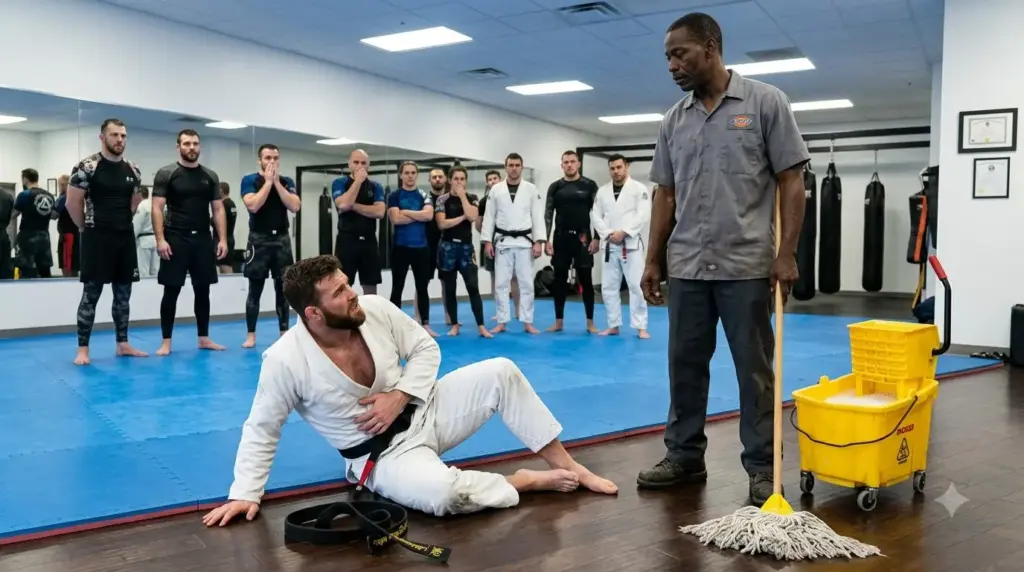
The fluorescent lights above Apex Striking and Grappling hummed with a thin, irritating sound that most people stopped noticing after five minutes.
Marcus Reed never stopped noticing it.
He noticed everything.
The buzz of the lights.
The squeak of bare feet on blue puzzle mats.
The click of the thermostat.
The front door opening.
The sudden change in breathing when an argument began.
At fifty years old, Marcus had learned that surviving difficult places depended on noticing small things before they became large things.
So he kept his head down and pushed his mop in slow, even arcs around the hardwood border of the training floor.
He wore a faded gray work shirt.
Dark work pants.
Heavy rubber-soled shoes.
His skin was dark, his hair closely cropped and turning gray, and a faint scar ran along the side of his jaw.
Most members at Apex barely knew his name.
That was exactly how Marcus wanted it.
He earned fourteen dollars an hour cleaning footprints, disinfecting mats, emptying garbage cans, wiping mirrors, and picking up athletic tape left behind by people paying more than two hundred dollars a month to feel dangerous.
He liked cleaning.
Dirt made sense.
A floor was dirty.
Then you cleaned it.
Afterward, it was less dirty.
Simple.
Predictable.
Safe.
Thirty feet away, Derek Lawson was teaching the advanced adult class.
Derek was in his early thirties, heavily built through the shoulders, with a perfectly trimmed beard and a custom black belt tied over a spotless white uniform.
He owned Apex.
He also treated the place like a kingdom.
His students called him Coach Lawson.
Some called him Sensei because Derek enjoyed the sound of it.
Derek had competed in regional tournaments and won enough medals to become impressive to people who did not know how small the competitive world could be.
He was skilled.
Nobody could honestly deny that.
He was also addicted to being watched.
That afternoon, about twenty students sat along the edge of the mats while Derek demonstrated what he called “real-world violence.”
“In the street,” he said, pacing slowly, “nobody cares about your rank.”
The students listened.
“They’re unpredictable. Chaotic. You don’t survive by remembering choreography. You survive through dominance.”
Marcus pushed the mop toward the far wall.
The wringer on his yellow bucket squealed when he pressed the handle.
Derek stopped speaking.
His jaw tightened.
He looked toward Marcus.
Marcus never looked up.
After a moment Derek continued.
“Jason.”
A skinny college student stood.
“Yes, Coach?”
“Come here.”
Jason stepped onto the mat.
“Grab my uniform.”
Jason hesitated.
“Like this?”
“Commit.”
Jason reached.
Derek moved explosively.
He slapped the grip aside, turned sharply, and swept the younger man to the floor.
Jason landed with a hard thump.
Several students murmured approvingly.
Derek looked around.
He loved that sound.
“See?”
He yanked Jason back to his feet.
“But Jason knows me.”
Derek resumed pacing.
“He knows there are mats underneath him. He knows I’m not actually going to hurt him.”
Marcus moved toward another section of hardwood.
“To demonstrate reality,” Derek continued, “you need an unpredictable body.”
One student laughed.
Derek smiled.
“Somebody who doesn’t know the rhythm.”
Then his eyes settled on Marcus.
Marcus felt the room shift before Derek said a word.
Twenty years inside a maximum-security state facility had trained certain instincts into him that ordinary life never removed.
A prison yard could change temperature without the weather moving.
Men could decide something violent was about to happen without speaking.
Attention had weight.
Marcus could feel twenty people suddenly looking at him.
He kept mopping.
Three more hours, he thought.
Then bus.
Then home.
“Hey.”
Marcus continued working.
Derek raised his voice.
“You. Buddy.”
The mop stopped.
Marcus rested both hands on the wooden handle but did not turn.
Derek stepped off the mat onto the hardwood.
“Come here a second.”
Marcus slowly looked over.
“I’m working, sir.”
His voice was low and rough.
“Mirrors have to be finished before closing.”
Derek smiled.
“Management works for me.”
He moved closer.
“And right now I need you for a demonstration.”
Marcus looked at the blue mat.
Then back at Derek.
“I don’t know anything about fighting.”
It was a lie.
A very useful lie.
“I just clean.”
Derek’s smile widened.
“Perfect.”
Several students shifted uncomfortably.
Derek pointed toward the mat.
“That’s exactly what I need. An untrained reaction.”
Marcus said nothing.
“Take your shoes off. Ten seconds.”
Marcus looked at Derek’s uniform.
The black belt.
The expensive embroidery.
Then the face above it.
He did not see cruelty exactly.
He saw something smaller.
Need.
Derek needed the people in the room to believe he was dangerous.
Marcus had known men like that before.
They were often more exhausting than genuinely dangerous men.
“I respectfully decline.”
He turned back to his bucket.
“Have a good class.”
The room went silent.
Derek remained where he was.
His face reddened.
For Marcus, the refusal had been nothing.
For Derek, it happened in front of students who paid him for authority.
That made it unbearable.
He crossed the distance quickly and grabbed the mop handle.
Marcus stopped.
“I wasn’t asking,” Derek said.
Marcus kept both hands on the wood.
Students looked at one another.
Jason took one uncertain step forward, then stopped.
Derek tugged on the mop.
It did not move.
He frowned.
Pulled harder.
Still nothing.
Marcus had not visibly changed posture.
He simply stood balanced over his feet, holding the handle as though it were attached to the building.
For one brief second, something instinctive appeared in Derek’s face.
Confusion.
Maybe even caution.
Then pride covered it.
“Let go.”
Marcus looked at Derek’s hand.
“No.”
Derek leaned closer.
“Get on the mat.”
Marcus’s voice became quieter.
“Let go of the mop.”
“You’re being a bad sport.”
“I’m working.”
Derek released the handle with one hand.
Then he grabbed Marcus by the upper arm.
The students saw Marcus’s face change.
Not emotionally.
That was what frightened several of them later when they tried to describe it.





