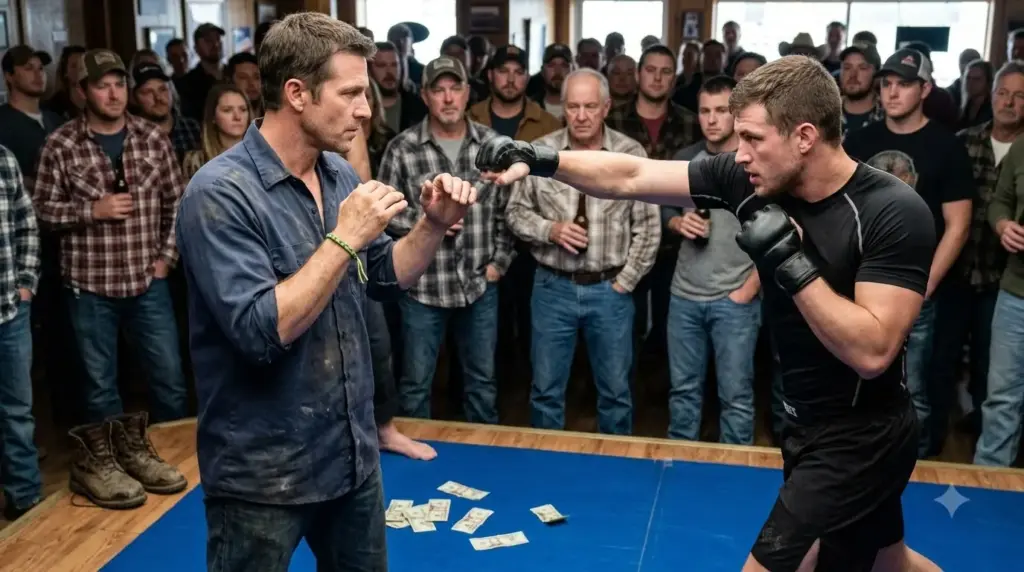
“Easy money.”
Derek Voss looked across the makeshift mat and grinned.
“This man won’t last sixty seconds.”
Thirty people packed into the back room of the Iron Horse bar laughed with him.
Someone near the pool tables shouted that Dean should walk away.
Another man reminded everyone that Derek had put two challengers in the hospital that month.
Then somebody pointed toward the folded stack of cash sitting beside the mat.
Five hundred dollars.
Dean Carver said nothing.
He stood at the edge of the mat in a worn work shirt, mud-crusted jeans, and a pair of heavy farm boots. A streak of engine grease ran across one thigh. Around his right wrist was a loose bracelet braided from green and yellow yarn.
It looked like something a child had made.
Because it was.
Derek looked him over and laughed again.
“You serious right now?”
Dean sat down.
Removed one boot.
Then the other.
He placed them neatly beside the mat.
Derek mistook the deliberate movement for nervousness.
The crowd mistook Dean’s silence for fear.
Only Rusty Cobb, the owner of the Iron Horse, looked worried.
He had known Dean for years.
Not well enough to know everything.
But well enough to know that a man who worked that hard to remain quiet usually had a reason.
Dean stood.
Looked at the five hundred dollars.
Then at Derek.
“Start the clock.”
That morning had begun before sunrise.
Like most mornings on the Carver property.
Dean did not use an alarm anymore.
Years of habit had taught his body to recognize a certain quality of darkness and wake on its own.
By the time the first pale light appeared over the tree line, he was already in the barn.
He checked the water lines.
Walked the machinery.
Ran one hand beneath the harvester’s engine housing.
Then did the same arithmetic he had been doing every morning for three weeks.
How much wheat remained standing?
How many days remained in the growing season?
How much would this harvest bring if the yield held?
How far behind was the mortgage?
The numbers never finished where he needed them to.
Inside the farmhouse, his daughter Tessa was still asleep.
Ten years old.
Dark hair across the pillow.
Blanket twisted around one leg.
She had inherited her mother’s ability to sleep deeply, completely, as if rest were a debt the world owed her.
Dean had learned to move quietly through the kitchen.
He made oatmeal.
Put her bowl on the table.
Laid the spoon across the top the way she liked it.
Then wrote on the chalkboard beside the door.
BACK FOR LUNCH.
FEED THE DOG.
He had written some version of the same message almost every morning for four years.
It had become one of the most reliable forms of communication in their house.
People in town sometimes asked Dean whether raising a daughter alone was difficult.
He never knew how to answer.
Difficult was too simple a word.
He did not wake every morning feeling sorry for himself.
He did not spend his evenings listing everything they had lost.
The responsibility was more constant than that.
It sat inside the house like part of the foundation.
Always there.
Always carrying weight.
Four years earlier, after the funeral, the casseroles eventually stopped appearing.
Relatives returned to their own families.
Friends stopped checking every day.
And Dean found himself standing in a kitchen with a six-year-old girl who had already learned that some questions did not have answers.
Her mother’s coffee mug was still beside the sink.
The house still smelled faintly like her shampoo.
Dean remembered looking at Tessa and understanding that there was only one useful direction.
Forward.
Not heroically.
Not all at once.
One breakfast.
One school day.
One grocery bill.
One bedtime.
One morning at a time.
What Tessa did not know was that before her father became a farmer and mechanic, he had spent eight years in a completely different life.
Dean Carver had served as a Navy SEAL.
Three deployments.
Team leadership.
Years in places where decisions were made quickly and consequences arrived faster.
He came home from his final deployment with a permanent ringing in his left ear, an old injury in his lower back, trouble in one knee, and instincts that had been trained so deeply he sometimes felt them before he consciously understood what he was seeing.
The farm had become the answer to a question Dean had not known how to ask.
He needed silence.
Space.
Machinery.
Soil.
Problems that could be solved with tools.
He wanted mornings where the most urgent decision involved weather, fuel, or a broken irrigation line.
Most of all, he wanted Tessa to grow up believing her father was the man who made oatmeal and fixed things.
Not the man he had once been trained to become.
Most days, the farm kept that older part of him quiet.
Then, shortly before noon, the generator inside the harvester failed.
Dean heard the problem before he saw it.
A grinding mechanical shriek.
Then silence.
The kind of silence that immediately sounded expensive.
He opened the housing.
Removed the damaged component.
Stared at it.
Then did the arithmetic again.
Replacement cost: roughly five hundred dollars.
Money in his checking account: eighty-three dollars and change.
Mortgage: already one month behind.
Electric bill: due at the end of the week.
Emergency savings: mostly gone after paying Tessa’s school expenses in September.
Ordinarily, Dean might have waited.
This time, waiting was impossible.
A storm system was moving north.
Weather reports had been warning about it for three days.
Heavy rain.
Strong sustained wind.
The kind that could flatten standing grain and turn dry fields into mud.
Dean probably had thirty hours before conditions deteriorated.
Without the harvester, he would lose the window.
If he lost the crop, the late mortgage payment would become the smallest problem he had.
Tessa found him sitting on the barn workbench that afternoon with the broken generator component resting in his hands.





