The Fighter Laughed, “You’ll Never Catch Me” — Seconds Later, He Was Trapped in Her Grip
“You’ll never catch me.”
Derek Vance laughed as he said it.
Then he bounced backward on the balls of his feet, light, fast, smiling for the people gathered around the mat.
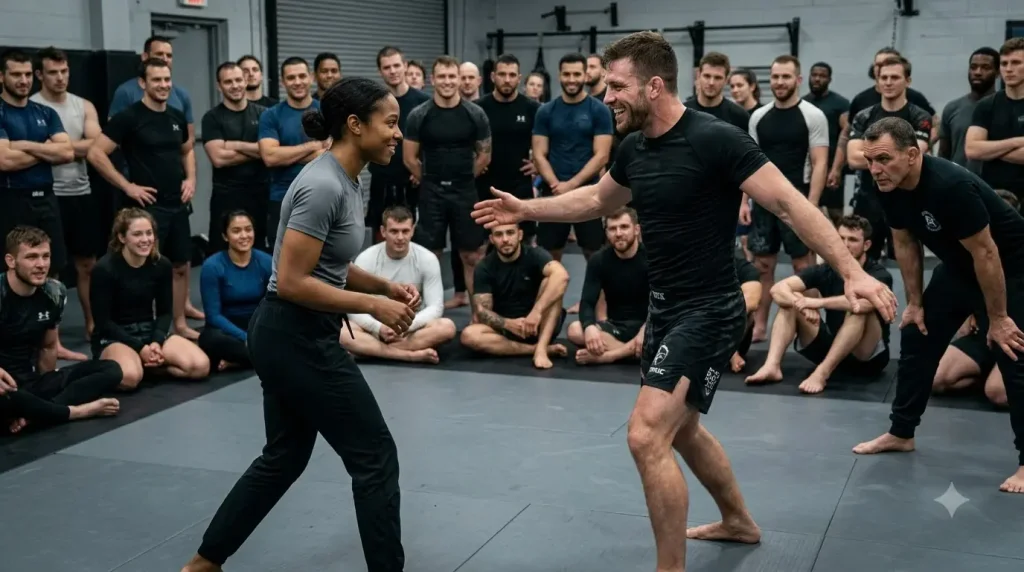
Across from him stood Maya Carter.
Twenty-seven years old.
Five foot five.
One hundred twenty-eight pounds.
Black.
Hair tied back.
Plain gray rash guard.
Black training pants.
No expensive patches.
No sponsor logos.
No championship belt hanging nearby.
Nothing about her looked dramatic.
That was exactly why Derek had chosen her.
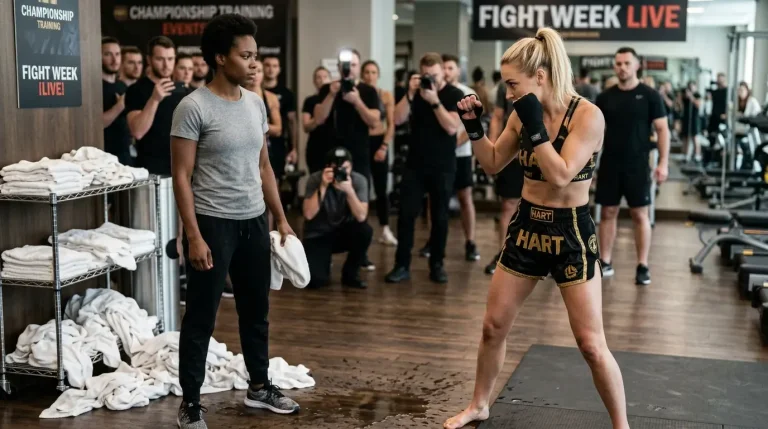
Saturday open mat at Harbor Point Combat Academy was crowded.
Competitors.
Beginners.
Parents.
Teenagers.
A few visitors from another gym.
And Derek loved an audience.
At thirty-two, he was one of the best-known fighters in the room.
Professional MMA experience.
Regional submission-grappling champion.
Brazilian jiu-jitsu black belt.
Former collegiate wrestler.
Fast enough to frustrate heavier men.
Technical enough to make smaller ones feel helpless.
And lately, confident enough to confuse skill with permission.
He circled Maya again.
“Come on.”
She did not chase.
Derek smiled.
“What happened?”
“You said you wanted to work takedowns.”
“I do.”
“Then take me down.”
Maya watched his hips.
Derek feinted left.
She did nothing.
Feinted right.
Nothing.
He laughed.
“See?”
Then louder, for the people listening:
“You’ll never catch me.”
Maya finally smiled.
“Okay.”
Derek frowned.
“Okay what?”
She stepped forward.
Not fast.
Not dramatically.
Just one step.
Then another.
Derek expected the shot.
It never came.
He shifted backward.
Maya reached with her left hand.
Derek slapped it away and pivoted.
Exactly what she wanted.
Her right hand caught his wrist.
Her left arm wrapped above his elbow.
She stepped across his line.
Derek tried to pull free.
Too late.
Maya closed the distance.
His arm folded against his own body.
Her head pressed beneath his jaw.
Her hips blocked his escape.
Derek turned.
Maya followed.
One second he was laughing.
The next he was trapped.
Not thrown.
Not slammed.
Trapped.
His right arm pinned.
His posture broken.
His weight shifted onto the wrong foot.
Maya’s grip tightened just enough to remove options.
The room went silent.
Derek tried to circle.
Nothing.
He tried to pull.
Nothing.
Then Maya whispered:
“Caught you.”
Someone near the wall laughed.
Derek did not.
He tried to muscle out.
Maya changed angle.
His shoulder turned.
His balance disappeared.
Then his knee touched the mat.
Maya followed him down without force.
Controlled the arm.
Moved behind.
Seat belt grip.
One hook.
Then two.
Derek’s smile was gone.
“Okay.”
Maya said nothing.
He hand-fought.
She adjusted.
His chin tucked.
She did not force the choke.
Instead she trapped one wrist.
Then the other.
Derek’s hands disappeared from the defense.
For the first time that morning, he looked worried.
Coach Samuel Bennett stood from his chair.
Not because Maya was doing anything illegal.
Because Derek had a history of becoming reckless whenever embarrassment entered the room.
Maya felt him tense.
She loosened slightly.
Derek exploded.
Tried to turn.
She followed.
He rolled.
She stayed attached.
And seconds after telling her she would never catch him, Derek Vance found himself flat on his back with Maya controlling both his wrists and his hips.
The room stayed quiet.
Maya released.
Immediately.
Then stood.
No celebration.
No raised arms.
No smile toward the crowd.
She simply said:
“Reset?”
Derek stared up at her.
That should have ended the moment.
It did not.
Because the real problem had started thirty minutes earlier.
Maya Carter had been training at Harbor Point for almost two years.
She was not famous.
Not undefeated.
Not a secret world champion.
She had won a few local grappling tournaments.
Lost others.
Placed second at one regional event.
Was submitted in under ninety seconds at another.
She worked full-time as a physical therapist specializing in orthopedic rehabilitation.
Three evenings a week, she trained.
Sometimes four.
She liked grappling because it demanded honesty.
You could believe your balance was good.
Then somebody moved you.
You could believe your defense was improving.
Then somebody found the opening.
The mat did not care about confidence.
Only position.
Maya had grown up in athletics.
Track first.
Then wrestling in a small high-school girls’ program.
Later judo.
Then Brazilian jiu-jitsu.
She was good.
Not magical.
That mattered.
She did not walk into Harbor Point hiding an Olympic medal.
She had simply accumulated years of understanding movement.
Derek Vance had more experience than she did.
More competition wins.
More strength.
More status inside the gym.
On most days, in most rounds, he probably could have controlled her.
That also mattered.
The story was not:
Secret genius destroys arrogant champion.
The story was about what happened when Derek decided one successful athlete in the room was allowed to turn everyone else into part of his performance.
Derek had not always been like that.
Samuel Bennett remembered when he first joined Harbor Point.
Twenty-three years old.
Hungry.
Polite.
The kind of athlete who stayed after class to wipe mats.
If Samuel corrected him, Derek said:
“Yes, Coach.”
If a white belt tapped, Derek released before the second tap.
If somebody declined a round, he nodded and found someone else.
Then Derek started winning.
A regional no-gi championship.
Another.
Amateur MMA fights.
Social-media clips.
Seminars.
Followers.
People asking him to demonstrate techniques.
Nothing wrong with any of that.
But somewhere along the way, Derek discovered an audience could reward behavior a good training room should discourage.
He began filming challenge rounds.
Wrestler versus bodybuilder.
Black belt versus football player.
Can a beginner survive sixty seconds?
At first, participants agreed.
Then the boundaries blurred.
Derek would pressure reluctant people.
“Come on.”
“It’s just fun.”
“Don’t be scared.”
People sometimes agreed because saying no in front of twenty others felt harder than accepting the round.
Samuel noticed.
He warned him.
“One invitation.”
“I know.”
“One answer.”
“I know.”
“No making students prove courage for your camera.”
Derek always agreed.
Then found another version of the same behavior.