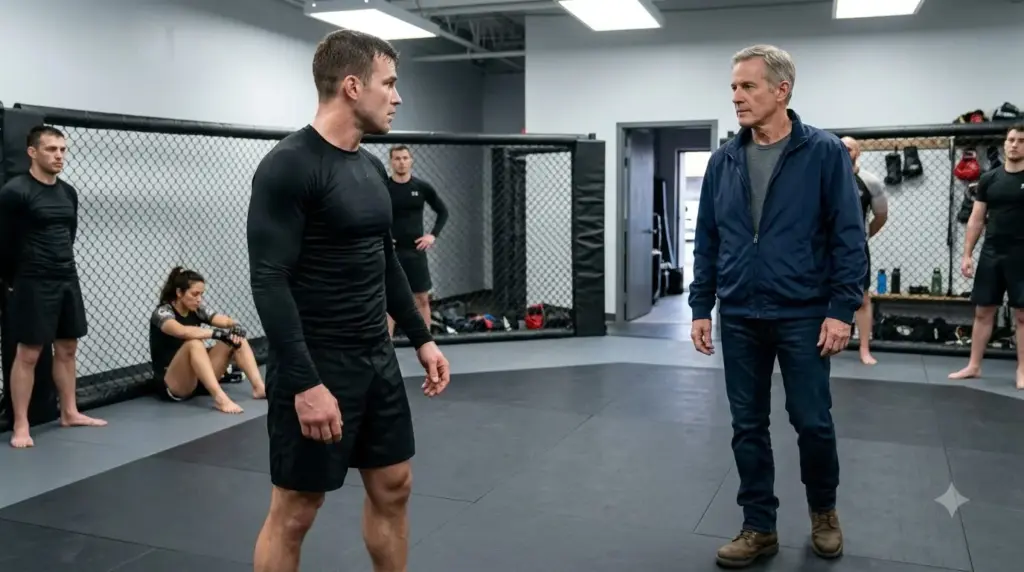
The first time Natalie Carter tapped, Connor Blake did not let go.
The second time, she slapped the mat hard enough for the sound to echo across the entire gym.
Still, Connor held the choke.
By the third tap, the laughter around the cage had disappeared.
Natalie’s face was red.
Her legs were kicking weakly against the mat.
And the thirty-one-year-old regional grappling champion above her was smiling.
“Come on,” Connor said. “You wanted to train with the advanced class.”
Natalie tried to speak.
She could not.
“Connor.”
Coach Eric Mason’s voice came from across the room.
“Release her.”
Connor waited another second.
Then finally opened his arms.
Natalie rolled onto her side and coughed.
The twenty or so people around the training floor became strangely interested in their water bottles.
Connor stood.
Adjusted his black rash guard.
Then looked around the room with the satisfied expression of a man who believed he had just taught everyone something important.
“She’s fine.”
Natalie sat up slowly.
Her throat burned.
Her eyes watered.
Not because she wanted to cry.
Because her body had been deprived of air long enough to make the choice for her.
Connor looked down at her.
“You can’t panic every time someone touches your neck.”
Natalie stared at him.
“I tapped.”
“You tapped early.”
“I tapped three times.”
Connor shrugged.
“You’re alive.”
That was when a voice came from near the front door.
“Now try that with me.”
Every head turned.
A man stood beside the shoe rack.
Nobody had noticed him enter.
He looked about fifty-five.
Maybe fifty-eight.
Tall, but not unusually large.
Lean.
Silver beginning at his temples.
Dark jeans.
Brown work boots.
A navy windbreaker zipped halfway up over a plain gray T-shirt.
No gym bag.
No uniform.
No belt.
Nothing about him suggested he belonged on the mat.
Connor looked him over.
“Who are you?”
The stranger stepped closer.
“Someone who watched her tap.”
Connor laughed.
A few people did too.
Mostly out of nervous habit.
The stranger did not smile.
“You heard her.”
Connor’s expression hardened.
“This is a private gym.”
“Then your standards should be higher.”
Silence.
Natalie pushed herself to her feet.
“Sir, it’s okay.”
The man looked at her.
“No.”
His voice was calm.
“It isn’t.”
Twenty minutes earlier, Connor Blake had been the most important person in Mason Combat Club.
At least in his own mind.
He had earned reasons to feel important.
Connor was talented.
Fast.
Strong.
A nationally ranked submission grappler at twenty-six, then a successful regional professional competitor in his late twenties.
He had won enough tournaments that his photographs covered one entire wall.
Young students wanted to train with him.
Older students paid for private lessons.
Sponsors gave him equipment.
Local fight promoters knew his name.
And Connor loved being known.
He loved the moment he walked into a room and people looked up.
The problem began when he started believing attention and respect were the same thing.
Natalie Carter had joined Mason Combat Club only six weeks earlier.
She was thirty-four.
Five foot five.
Black hair usually tied in a simple ponytail.
An emergency-room nurse at St. Anne’s Hospital.
She had no competitive background.
No hidden championship past.
No secret military training.
She really was a beginner.
That was important.
Natalie came to the gym because she wanted to become less afraid of physical contact.
Two years earlier, she had ended a relationship with a man who became controlling long before he became violent.
The final incident involved his hands around her throat against a kitchen wall.
Natalie escaped.
The relationship ended.
The criminal case did not go the way she hoped.
Life continued.
But sometimes when somebody stood too close behind her, Natalie’s body returned to that kitchen before her mind could stop it.
A therapist suggested controlled training.
A place where pressure had rules.
Where “stop” meant stop.
Where Natalie could gradually teach her nervous system that contact did not always mean danger.
The first month at Mason Combat Club had helped.
Coach Eric Mason knew only part of the story.
Natalie told him she had anxiety around neck contact and needed patient partners.
Eric understood.
He paired her carefully.
Until Connor noticed her.
It started as teasing.
“You’re too tense.”
Then unsolicited advice.
“You’re wasting everyone’s time if you don’t commit.”
Then demonstrations Natalie had not requested.
Connor enjoyed beginners because beginners made him look extraordinary.
Natalie especially bothered him because she would not perform admiration correctly.
She listened politely.
Then trained with someone else.
That Saturday, the advanced class was preparing for an in-house competition.
Natalie was practicing nearby when Connor called her over.
“Come here.”
She looked at Eric.
“He needs someone for the demonstration,” Eric said.
Natalie stepped onto the mat reluctantly.
Connor demonstrated a basic rear-control position.
He wrapped one arm around her neck.
Natalie immediately stiffened.
“Relax.”
“I’m trying.”
“You’re safe.”
The words should have helped.
Instead, Connor said them like an accusation.
He adjusted.
Natalie’s breathing changed.
“Can we reset?”
Connor released her.
A few younger students smiled.
Natalie saw them.
Connor saw her see them.
Something petty awakened in him.
“Again.”
He positioned himself behind her.
“Connor,” Eric said, “keep it technical.”
“Obviously.”
Connor applied the choke slowly.
Natalie tapped almost immediately.
He loosened it.
Then smirked.
“See? Panic.”
Natalie turned.
“I told you neck stuff is difficult for me.”
“That’s why you need it.”
“Not like that.”
Connor heard challenge.
And Connor did not tolerate challenge well.
“You want to get over fear?”
Natalie stared at him.
“Then stop treating every uncomfortable second like an emergency.”
A few people shifted.
Eric began walking toward them.
Connor said,
“Again.”
Natalie should have walked away.
Later, she would ask herself why she did not.
The answer was complicated.
Because she was embarrassed.
Because everyone was watching.
Because Connor was the expert.
Because women spend years being taught not to seem difficult.
Because part of her thought maybe he was right.
So she turned.





