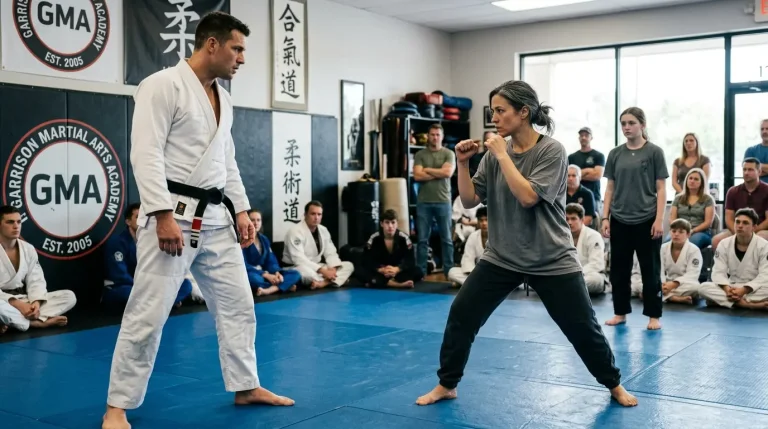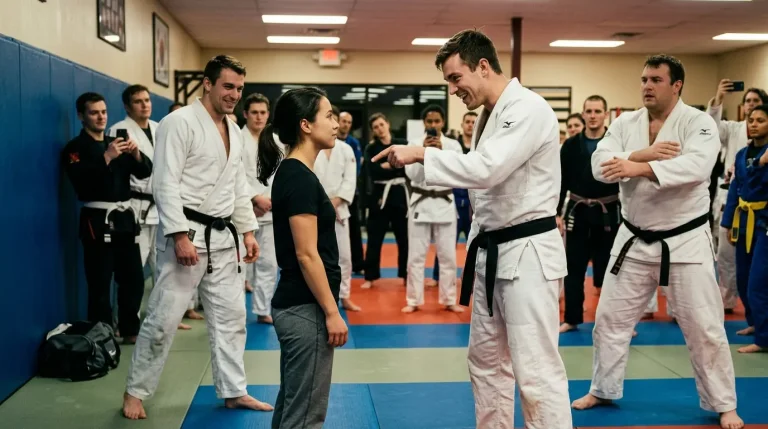
“You don’t belong here, you filthy Black rat.”
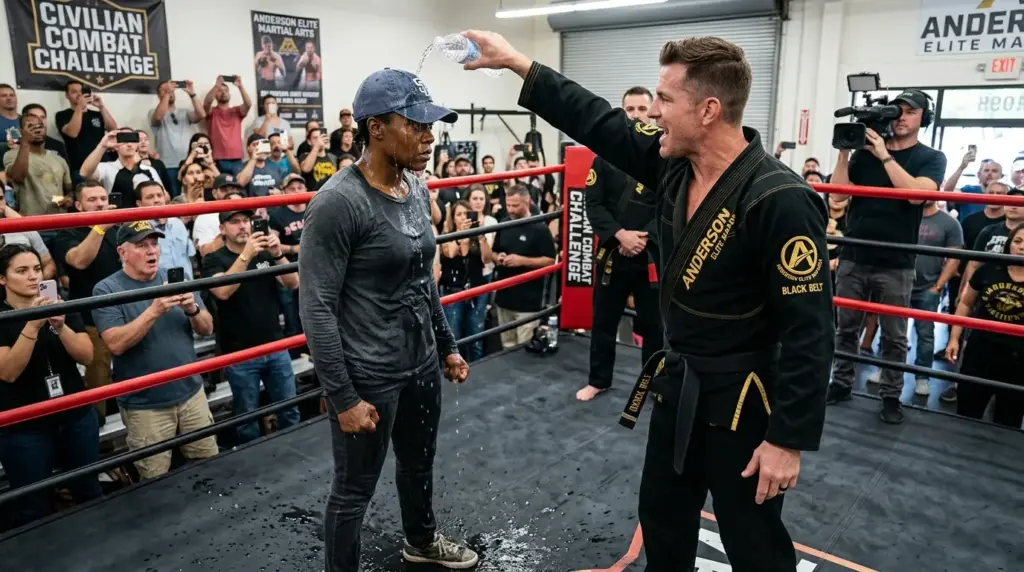
Tyler Anderson laughed as he poured a bottle of water over Whitney Williams’s head.
The water ran down her face, into her collar, and soaked through the gray cotton of her long-sleeved shirt.
Six hundred people watched from the bleachers inside Anderson Elite Martial Arts.
Some laughed.
Some lifted their phones higher.
Some shifted uncomfortably but stayed seated.
Two of Tyler’s senior students stood behind Whitney, holding her arms back, their grips locked around her biceps and wrists. They were both larger than her, both trained, both grinning like men who thought obedience to a bully was the same thing as loyalty.
Tyler turned toward the crowd and spread his arms wide.
“Look, everyone,” he shouted into the microphone. “The little rat is in the ring.”
Whitney said nothing.
Her Padres cap lay on the mat near her feet, crushed beneath Tyler’s heel. He had snatched it from her head and stomped on it three times while the crowd cheered.
“You’re just a weak Black woman,” Tyler said, circling her slowly. “Too frail to fight.”
He leaned closer.
“Are you scared, little rat?”
Whitney’s face did not move.
But something in her eyes changed.
A thin line had been crossed.
Not the first line.
Not even the tenth.
But the final one.
Tyler did not know that.
He did not know who she had been.
He did not know what she had survived.
He did not know what was hidden beneath the sleeves of the quiet woman he had dragged onto his stage.
And when that sleeve tore open, revealing the long crescent-shaped scar running from shoulder to elbow, the room would learn what Tyler Anderson should have learned before he ever put his hands on her.
Some people are quiet because they are weak.
Some people are quiet because they have nothing left to prove.
Coral Bay, California, was a small coastal town two hours north of San Diego.
It was the kind of place where everybody knew everybody and nobody asked too many questions.
Whitney Williams lived in a one-bedroom rental above the laundromat on Magnolia Street. She was thirty-eight years old, quiet, polite to her neighbors, but never one to linger for small talk.
She paid her rent in cash on the first of every month.
Always on time.
Always exact.
Five days a week, she worked at the Coral Bay Veterans Outreach Center. She helped former service members file disability claims, search for housing, apply for benefits, and navigate paperwork that seemed designed to exhaust the very people it was supposed to serve.
Her coworkers knew she was a veteran.
They did not know much else.
She wore long sleeves year-round.
Even in August.
Even when the kitchen at the center hit ninety degrees and everyone else rolled up their sleeves, Whitney would simply dab sweat from her forehead and keep typing.
Once, the receptionist asked her about it.
Whitney smiled faintly and said, “I get cold easy.”
That was the end of the conversation.
What nobody in Coral Bay knew was this.
Eight years earlier, Whitney Williams had been Staff Sergeant Williams of the United States Marine Corps.
She had been a Level Four instructor in the Marine Corps Martial Arts Program, the youngest woman to ever reach that rank in Corps history.
She had won the All-Marine Combatives Championship three times.
Gold medals every time.
In the close-combat community, she had a nickname.
They called her The Sickle because of the way she moved on the mat.
And because of what happened in the 2016 final.
That final had been written up in Marine Corps Times, a two-page spread with photographs. The headline read:
The Scar That Won Gold.
Her opponent had broken the rules.
He pulled a tactical knife mid-match and slashed Whitney’s right arm from shoulder to elbow before the referees could stop him.
Whitney finished the match anyway.
One arm bleeding through her white gi.
And she won.
The scar was crescent-shaped, long and pale against her dark skin.
Anyone who had served in the Marine Corps Martial Arts Program knew exactly what that scar meant.
Anyone who had followed the championship circuit knew exactly whose arm it belonged to.
That was why Whitney kept it covered.
She had retired in 2018.
The first time Maya Williams saw water running uphill, she thought her eyes had made a mistake.
It was late August in Ashford Ridge, North Carolina, and a thunderstorm had just passed over the neighborhood outside Raleigh. She had gone down Willowbend Drive to return a borrowed ladder to her neighbor, Mrs. Carter. The rain had softened to scattered drops, and the air smelled of cut grass and hot pavement cooling too quickly. Beyond the community mailboxes, a thin stream was moving across the sidewalk. Instead of entering the grated drain at the curb, it was curling around a pile of earth and flowing back toward a row of townhomes below the South Creek retaining wall.
Maya stood with the ladder against her shoulder and watched it for a full minute. The slope was wrong for that much standing water. The sediment was wrong, too. Fresh brown silt had collected against a section of concrete whose surface was older and almost white. Somewhere uphill, water had been diverted from the route it was supposed to take.
She took two photographs and carried the ladder home.
That was all she intended to do.
Maya was a fifty-four-year-old Black woman who had spent much of her working life asking why official records and lived experience failed to match. Six years earlier, she had left a career investigating housing compliance because her daughter had asked her a question she could not answer: When was the last time you came home without bringing somebody else’s trouble through the door? Naomi had been an adult by then, already building a life in Charlotte, but she still recognized the signs. Maya would stay awake reading inspection reports, remember a family trapped in a leaking apartment, and spend Saturday afternoon working out which agency had jurisdiction to intervene. A problem could become a whole world if she let it. There was always another discrepancy, another lost complaint, another resident who had done everything properly and still could not get anyone to answer a letter.