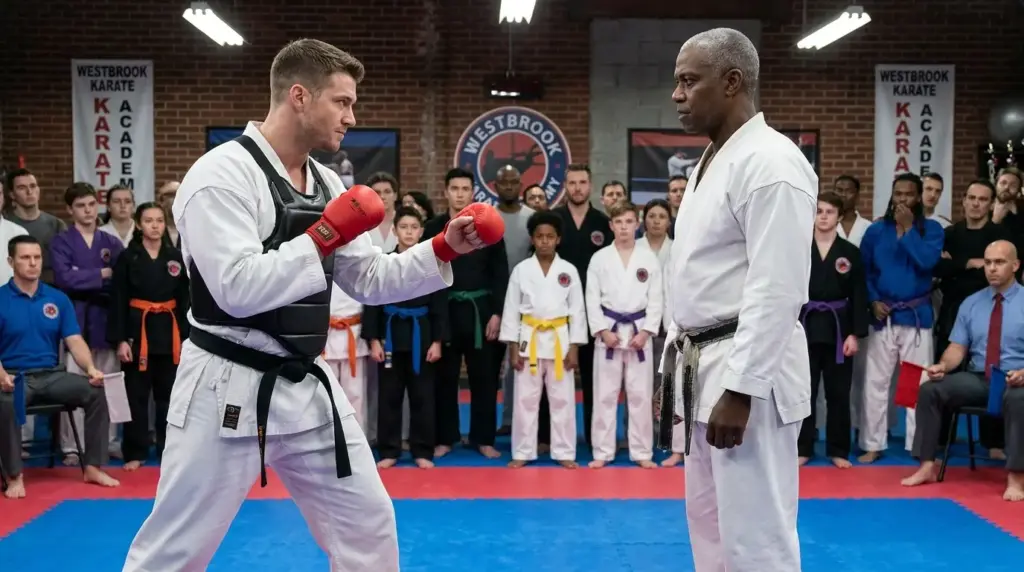
“You’re too old for this.”
The words were loud enough for everyone near the competition mat to hear.
Marcus Hale looked up.
The man speaking was twenty-eight years old.
Tall.
Lean.
Fast-looking even while standing still.
White gi.
Black belt.
Red gloves already strapped around his hands.
His name was Tyler Grant.
Three-time Georgia state kumite champion.
Current Southeast Open winner.
One of the most successful adult competitors at Westbrook Karate Academy in Atlanta.
Tyler was good.
Nobody needed to pretend otherwise.
He had trained since childhood.
His timing was sharp.
His conditioning excellent.
His confidence mostly earned.
Mostly.
Marcus stood twenty feet away near the registration table.
Fifty-two years old.
Black.
Five-foot-eleven.
About one hundred eighty pounds.
Close-cropped gray hair.
A quiet face.
Plain white gi with no embroidery except a small Westbrook patch sewn over the chest.
Black belt tied around his waist.
The belt was faded almost gray in several places.
That should have told Tyler something.
It did not.
Marcus had joined Westbrook only three weeks earlier.
He attended the early-morning adult class.
Never competition training.
Never open sparring.
Never told stories.
Never corrected anyone unless asked.
He bowed.
Trained.
Sweated.
Left.
Most people knew three facts about him.
He worked as a building inspector for the city.
He had a daughter in college.
And his right knee made a soft clicking sound when he stood after sitting too long.
Tyler had noticed all three.
Especially the knee.
Now Westbrook was hosting a regional charity karate event.
No professional rankings.
No national-team selections.
Just controlled adult kumite divisions, youth kata, demonstrations, and fundraising for a local children’s rehabilitation center.
Marcus had registered for the forty-five-and-over division.
There were supposed to be six competitors.
Two withdrew that morning.
One had the flu.
Another aggravated a hamstring warming up.
The bracket collapsed.
Then the event organizer announced that the remaining Masters competitors could either accept refunds or enter a special mixed-age exhibition bracket under modified safety rules.
Short matches.
Controlled contact.
No full-power head techniques.
Medical staff ringside.
No one was required to enter.
Marcus looked at the paper.
Then checked the box marked:
YES — EXHIBITION
Tyler saw his name.
That was how the conversation began.
“You’re actually doing it?”
Marcus looked over.
“Yes.”
Tyler smiled.
“Open-age?”
“Yes.”
“You know who’s in it?”
Marcus looked toward the bracket.
“You.”
Tyler laughed.
“And Devon Price.”
“Yes.”
“Chris Martin.”
“Yes.”
“All current competitors.”
Marcus nodded.
Tyler waited.
No reaction.
That bothered him slightly.
“So?”
Marcus asked.
“So you’re fifty-something.”
“Fifty-two.”
“Exactly.”
Marcus waited.
Tyler shook his head.
“I’m just saying.”
“What?”
“You’re too old for this.”
There it was.
Several younger students looked over.
Coach Elena Ruiz, Westbrook’s owner, heard it from across the warm-up area.
She started walking toward them.
Marcus did not look offended.
That made Tyler more uncomfortable than anger would have.
Marcus asked:
“How old should I be?”
Tyler laughed.
“That’s not what I mean.”
“What do you mean?”
“Competition pace.”
“Reaction time.”
“Explosiveness.”
Marcus nodded.
“All real.”
Tyler seemed surprised.
He had expected argument.
Marcus continued:
“You’re younger.”
“Yes.”
“Faster.”
“Yes.”
“Training harder than I am.”
“Definitely.”
Marcus smiled faintly.
“Probably true.”
Tyler grinned.
“So we agree.”
“On the facts.”
Tyler frowned.
Marcus looked toward the bracket.
Then back at him.
“You said I’m too old.”
“Yes.”
Marcus asked quietly:
“Are you sure?”
The laughter near the mat stopped.
Not because the sentence was threatening.
Because Marcus said it without ego.
Without challenge.
Without raising his chin.
Are you sure?
Nothing more.
Tyler’s smile tightened.
“I mean…”
He looked Marcus up and down.
“I’m pretty sure.”
Marcus nodded.
“Good.”
Then turned back to the registration table.
Tyler stared.
That was somehow worse.
No:
I’ll show you.
No:
You don’t know who I am.
No:
I used to be champion.
Just:
Good.
Coach Elena arrived.
“What happened?”
Tyler shrugged.
“Nothing.”
Marcus signed the form.
Elena looked between them.
Then at Tyler.
“What did you say?”
Tyler laughed.
“I told him open-age might be a bad idea.”
Marcus corrected:
“He said I’m too old.”
Elena closed her eyes.
“Tyler.”
“What?”
“He is fifty-two.”
“Yes.”
“And?”
Tyler looked confused.
Elena said:
“You can discuss physical advantages without deciding for somebody whether they belong in a voluntary competition.”
Tyler sighed.
“It was a joke.”
Marcus turned.
“No.”
Tyler looked at him.
Marcus continued:
“It was an assumption.”
Silence.
Then Marcus smiled slightly.
“Jokes are usually funnier.”
Several people laughed.
Even Elena.
Tyler’s face reddened.
Marcus walked away.
Nothing else.
At least not yet.
Marcus Hale had been hearing versions of “too old” for almost twenty years.
At thirty-five:
Too old to keep competing seriously.
At forty:
Too old to train hard with twenty-year-olds.
At forty-five:
Too old to restart after knee surgery.
At fifty:
Too old to return to a dojo after five years away.
Sometimes people were right about the underlying facts.
Age mattered.
Marcus knew that better than most.
He felt age every morning.
His left Achilles tendon tightened during cold weather.
His right knee had two small surgical scars.
His shoulders needed ten minutes of movement before they felt like his own.
Recovery that once took a night now took two days.
Sometimes three.
What Marcus objected to was not the existence of limits.
It was strangers announcing his limits before asking what he intended to do.
There was a difference between:
“You’re fifty-two, so recovery and speed may be different.”
And:
“You’re too old.”
The first was information.
The second was a verdict.
Marcus had spent most of his life learning not to confuse the two.
He started karate at eleven in Baltimore.
Not because he was bullied.
Not because he had a mystical teacher.
Because his mother worked late.
A community center offered after-school classes for fifteen dollars a month.
Karate was cheaper than childcare.
His first instructor was Sensei Harold Bennett.
Korean War veteran.
Shotokan practitioner.
Sixty-three years old when Marcus met him.
Bennett had a rule.





