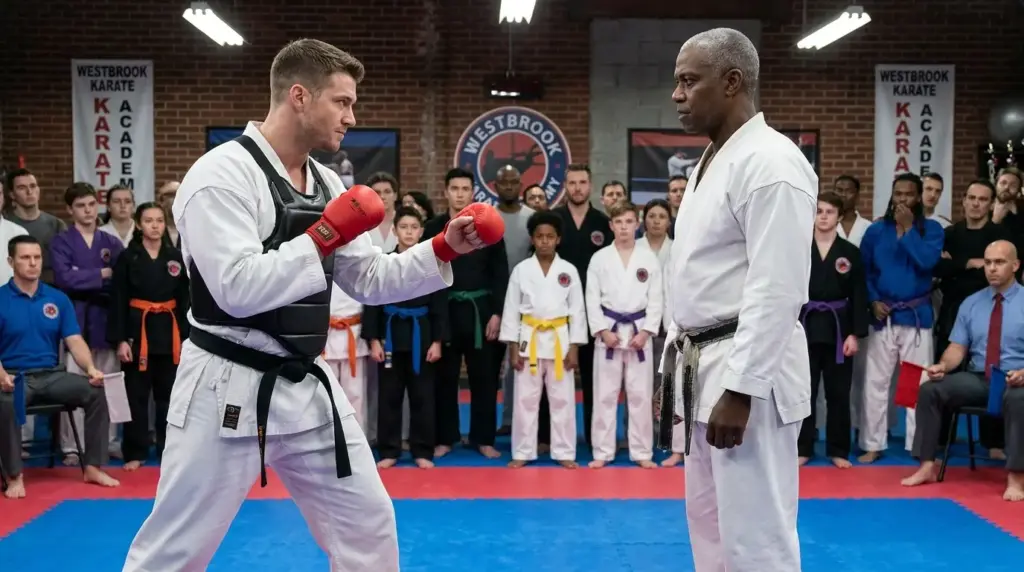
“No child calls themselves bad at something in this room.”
Marcus remembered laughing.
Then learning Bennett meant it.
If a student said:
“I’m bad at kicks.”
Bennett corrected:
“Your kick is bad today.”
If they said:
“I’m weak.”
Bennett corrected:
“You are tired.”
If they said:
“I’m stupid.”
Bennett stopped class.
“No.”
A child once asked why.
Bennett answered:
“Because if you turn a problem into your identity, you stop looking for a solution.”
Marcus was twelve.
He did not understand.
He understood later.
At seventeen, Marcus won his first state-level junior kumite tournament.
At nineteen, he lost his first senior national qualifier badly.
The opponent scored three times before Marcus understood the rhythm.
Marcus left angry.
Bennett drove him home.
“You embarrassed?”
“Yes.”
“Good.”
Marcus frowned.
“Why good?”
“Embarrassment means your image got hurt.”
“So?”
“You are not your image.”
Marcus looked out the window.
Bennett continued:
“Your timing was bad.”
“Fix timing.”
“Your distance was bad.”
“Fix distance.”
“You got impatient.”
“Fix patience.”
Then:
“Leave Marcus alone.”
That became another sentence Marcus carried for decades.
He improved.
At twenty-two, he won a major regional championship.
At twenty-four, national bronze.
At twenty-five, another national medal.
At twenty-seven, he made a national training squad.
Not the Olympic team.
Not world champion.
Never international superstar.
But elite enough that serious competitors knew his name.
His best weapon was not strength.
It was distance.
Marcus had an irritating gift for making opponents commit one inch too far.
One inch is almost nothing outside karate.
Inside kumite, it can be the entire exchange.
He became known for standing just close enough to invite an attack.
Then disappearing from the line.
Counter.
Score.
Reset.
No wasted motion.
People called him “Stillwater.”
Marcus hated the nickname.
It stayed.
At twenty-nine, he married Danielle Reed.
School teacher.
No interest in karate beyond whether Marcus remembered to wash his gi before putting it in the laundry hamper.
They had a daughter, Jasmine.
Marcus reduced competition.
Worked in construction management.
Eventually became a city building inspector.
Normal life.
He continued training.
At thirty-six, his right knee failed during a regional event.
Not dramatic.
No opponent destroyed him.
He planted.
Turned.
Felt something wrong.
Meniscus.
Surgery.
Rehab.
He returned.
Slower.
Still good.
Then at forty-one, Sensei Bennett died.
Stroke.
Marcus stepped away from tournaments entirely.
At forty-four, Danielle developed lupus.
Not immediately severe.
But unpredictable.
Fatigue.
Pain.
Appointments.
Periods where she was fine.
Periods where getting out of bed took everything.
Marcus became husband before athlete.
That was correct.
He trained less.
Then almost not at all.
At forty-seven, Danielle’s condition stabilized.
Marcus tried returning to his old dojo.
It had changed ownership.
New culture.
Competition-heavy.
Someone recognized him.
“Stillwater!”
Marcus nearly turned around.
Within twenty minutes, three younger black belts wanted rounds.
One said:
“Let’s see what the old timing looks like.”
Marcus smiled.
Then left.
He did not return.
For five years, karate became something he used alone.
Stretching in the basement.
Kata at half speed.
Footwork in socks.
No audience.
No rank politics.
No one asking if he still had it.
Then Jasmine left for college.
Danielle looked at him one morning.
“You’re annoying.”
Marcus looked up from coffee.
“What?”
“You’ve been walking around this house like someone canceled your purpose.”
“I’m fine.”
“Liar.”
He smiled.
She continued:
“Go train.”
“Where?”
“Somewhere.”
“I’m fifty-two.”
“And?”
Marcus stared.
Danielle laughed.
“You say that like a diagnosis.”
Good.
Two weeks later, Marcus joined Westbrook.
He did not tell anyone his old competition history.
Not because it was secret.
Because he wanted the present to arrive before the past.
Three weeks later, Tyler Grant told him:
“You’re too old for this.”
Marcus asked:
“Are you sure?”
And suddenly the past became relevant again.
Coach Elena Ruiz was forty-nine.
Fifth-degree black belt.
Former national kumite competitor.
She knew Marcus’ name.
She simply had not connected it yet.
Hale was common.
Marcus looked different at fifty-two than he had at twenty-seven.
Gray hair.
Heavier.
Glasses off the mat.
No photograph on his intake form.
Then Elena watched him warm up before the exhibition.
Not kicks.
Not punches.
Footwork.
That was what triggered memory.
He moved backward three steps.
Paused.
Changed angle.
No bounce.
No wasted shoulder movement.
Elena froze.
She walked toward the registration table.
Opened the member file.
Marcus Hale.
Baltimore.
Previous dojo:
Bennett Shotokan Association.
Elena stared.
Then laughed softly.
Assistant coach Daniel Price looked over.
“What?”
Elena turned the tablet.
Daniel read.
Then looked toward Marcus.
“No way.”
Elena nodded.
“Maybe.”
Daniel was forty-four.
He remembered karate magazines from the early 2000s.
“Stillwater?”
Elena smiled.
“Don’t call him that.”
“Is it really him?”
“Looks like.”
Daniel stared.
“Tyler just told Stillwater he’s too old?”
Elena closed her eyes.
“Yes.”
Daniel began laughing.
Elena pointed.
“Do not make this worse.”
“I’m trying.”
“You’re failing.”
They walked toward Marcus.
He was stretching his calf.
Elena stopped.
“Can I ask something?”
Marcus looked up.
“You already did during intake.”
She smiled.
“Harold Bennett?”
Marcus’ face changed.
“Yes.”
“You competed under him?”
“Yes.”
Daniel could not help himself.
“National bronze in 1999?”
Marcus sighed.
“There it is.”
Elena laughed.
“You could’ve said something.”
“About?”
“Your background.”
Marcus stood.
“My form says twenty-plus years.”
Elena checked.
It did.
She stared.
Daniel looked.
The field:
Previous experience: 25+ years Shotokan karate; former competition.
Elena looked at Marcus.
“We somehow turned that into recreational black belt.”
Marcus smiled.
“People read what they expect.”
Elena looked toward Tyler.
He was warming up with explosive kicks.
“Does he know?”
“No.”
“You want him to?”
Marcus thought.
“Before a match?”
“Yes.”
“No.”
Elena frowned.
“Why?”
“Because we’re not guaranteed to match.”
“The bracket isn’t set yet.”
“And if we do?”
Marcus shrugged.
“He knows I’m a black belt.”
“That is enough for consent.”
Elena considered.
Then:
“I don’t want this becoming a setup.”
Marcus nodded.
“Neither do I.”
“If he asks?”
“Tell him.”
“If he doesn’t?”
Marcus smiled.
“Let him read the bracket.”
Fair.
Then Elena asked:





