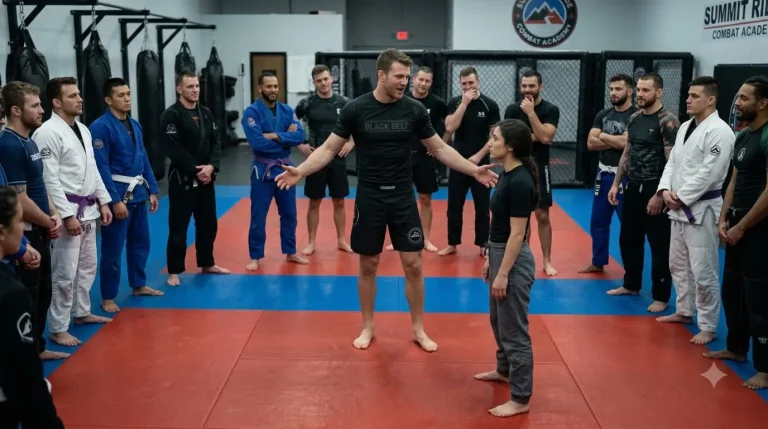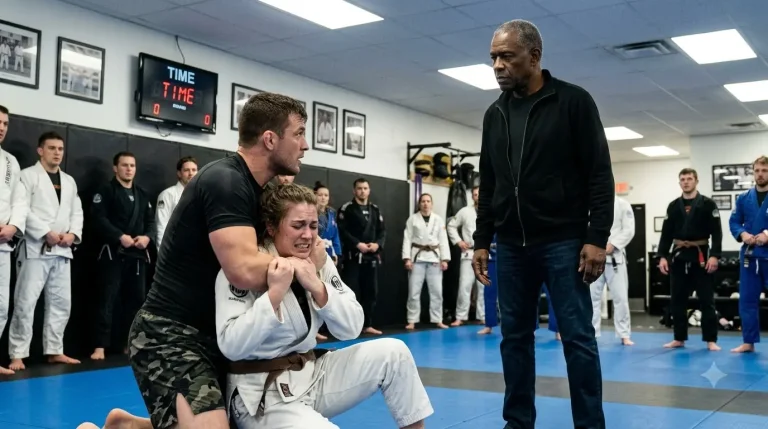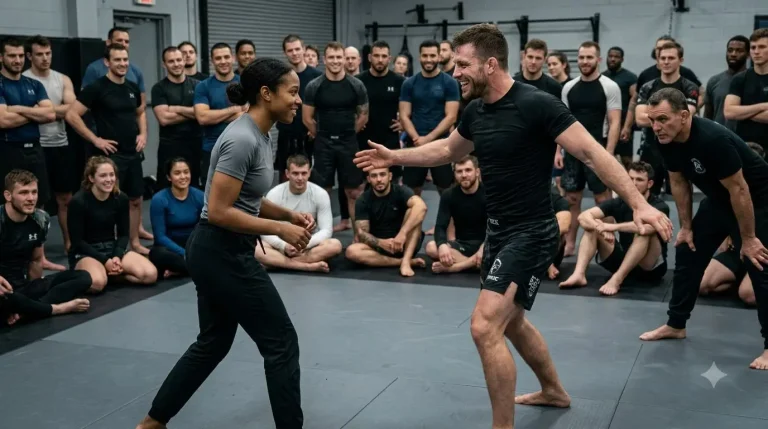
But beneath it now was something different.
Confusion.
Because he still didn’t understand the question that had been bothering him since Reeves said her name.
Who was she?
He found out twenty minutes later.
The police arrived because Raymond had called the moment Jake grabbed Maya.
No one was arrested.
Maya did not ask for that.
The officers took statements, documented the unwanted physical contact, and watched two different videos from customers.
Jake was identified.
So was Maya.
When one officer entered her name into his report, Coach Reeves quietly asked Maya:
“You still competing?”
“No.”
“Teaching?”
“Sometimes.”
“You should.”
Maya smiled.
“I’ve heard that before.”
Reeves looked toward the police officer finishing notes.
“You know, the students are going to find out eventually.”
Maya glanced toward Jake’s group.
Several were already searching something on their phones.
She sighed.
Too late.
A teenage green belt named Noah stared down at his screen.
Then slowly looked toward Maya.
“No way.”
Emily leaned over.
“What?”
Noah turned the screen.
An old photograph showed Maya at twenty-three, standing atop a national podium in a white gi with a medal around her neck.
Another search result appeared.
MAYA BROOKS — WOMEN’S KUMITE — U.S. OPEN CHAMPION
Then another.
A highlight video.
Tournament footage from Colorado Springs.
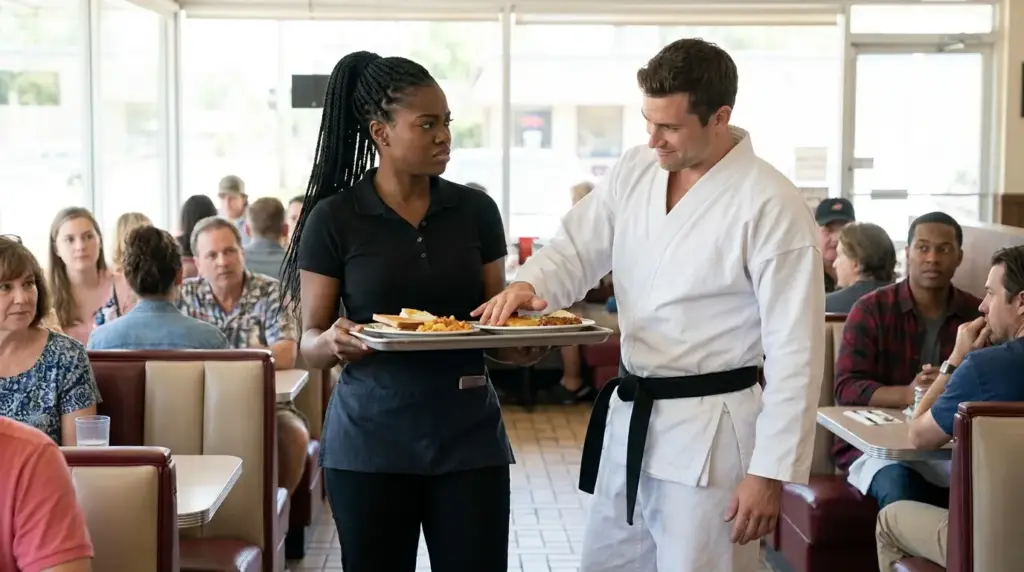
A younger Maya moving across a competition mat with the same compact stance she had taken between restaurant tables.
Jake’s friend Tyler stared.
“She was on the national team?”
Reeves corrected him.
“National development squad, then senior national team alternate. Three-time national medalist. U.S. Open champion twice.”
Maya gave him a look.
“You’re enjoying this.”
“A little.”
Emily stared at Maya.
“You could’ve destroyed him.”
Maya’s expression changed.
“No.”
Emily frowned.
Maya looked toward the door Jake had left through.
“I could have hurt him.”
“That’s what I meant.”
“It shouldn’t be.”
She picked up the apron from the table.
“The difference matters.”
Coach Reeves smiled faintly.
There was Malcolm Brooks in that sentence.
He remembered Maya’s father.
Everyone in their small competitive world did.
Reeves had refereed one of Maya’s early national matches. Later, he coached at seminars where she helped younger athletes. She had been fast, disciplined, almost impossible to provoke.
But what impressed him most now was that she had changed less than Jake had.
Reeves looked at the belt folded over his arm.
“I failed him somewhere.”
Maya shook her head.
“You didn’t shove anybody.”
“I promoted him.”
“That doesn’t mean you taught him this.”
“No.”
Reeves looked toward the empty doorway.
“But it means I need to ask what I rewarded before he became comfortable showing me only the version I wanted to see.”
Maya understood that too.
Bad behavior rarely grows entirely in darkness.
Sometimes people feed it with applause they don’t examine closely enough.
Jake did not return to Harrison Grill.
But the story followed him.
Not because Maya posted anything.
She didn’t.
Raymond refused requests from two local social media pages asking for security footage.
He had no interest in turning an employee’s humiliation into advertising.
Customers had their own videos, though.
One short clip spread through the local martial arts community.
Not the takedown.
Strangely, that wasn’t the part people focused on.
It was the moment before it.
Jake tapping his black belt.
Maya saying:
“You’re wearing that belt like it means you’re allowed to bully people.”
Then later:
“So let me teach you what martial arts was supposed to mean.”
That line moved faster than the fight.
Several instructors shared it privately.
One publicly.
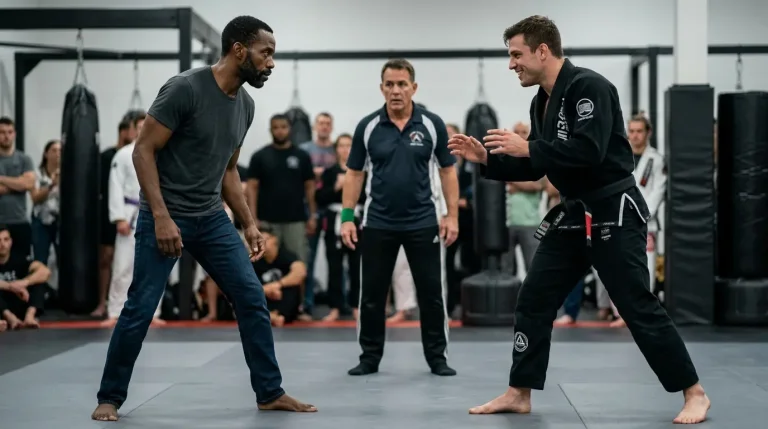
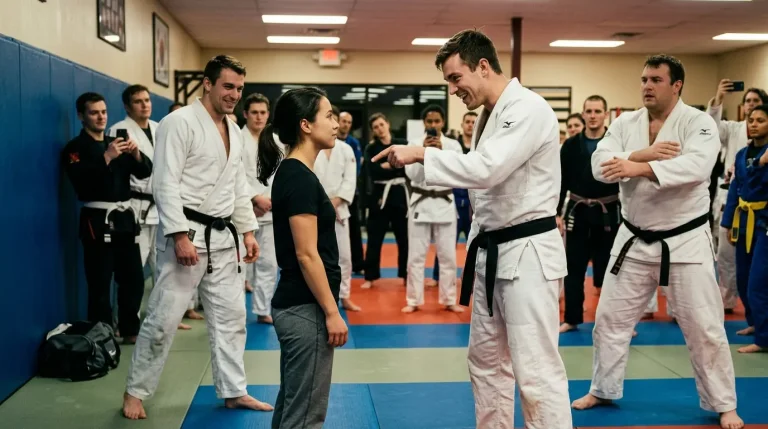
Reeves Combat Academy suspended Jake for three months, removed him from teaching duties indefinitely, and required him to return as a regular student if he wanted to continue training.
No black belt.
No assistant instructor title.
No special position.
Just class.
When Jake protested, Reeves gave him a simple answer.
“The belt stays with me until I believe the person wearing it understands what it represents.”
Jake nearly quit.
For two weeks, nobody saw him.
Then on a rainy Wednesday evening, he returned.
No gi.
Sweatpants.
T-shirt.
Sat on the bench during class.
Watched.
Reeves made him wait.
The following week, Jake began again with basics.
Not because his technique had disappeared.
Because something else had.
Humility.
That took longer to rebuild.
Maya’s life changed less dramatically.
She still worked at Harrison Grill.
Still complained about her knee when storms came.
Still attended classes and clinical rotations.
Still refused when Raymond joked that he should put a sign in the restaurant reading:
OUR WAITRESSES MAY BE NATIONAL CHAMPIONS. BE POLITE.
“You put that up,” she told him, “I quit.”
He believed her.
The incident did change one thing.
Three weeks later, Coach Reeves came back alone.
He sat in Maya’s section and ordered coffee.
When she brought it, he placed a folded flyer on the table.
“You’re going to say no.”
“Probably.”
“Read it first.”
Maya opened it.
Reeves Combat Academy was starting a free Saturday self-defense program for restaurant workers, nurses, hotel staff, and other people whose jobs required them to deal with strangers up close.
Maya looked at him.
“You did this because of Jake?”
“Partly.”
“And you want me to teach.”
“Yes.”
She folded the paper.
“No.”
Reeves smiled.
“Told you.”
Maya started walking away.
He called after her.
“Your father would say yes.”
She stopped.
“That’s cheating.”
“Effective cheating.”
She turned back.
Reeves’ face had softened.
“I’m not asking Maya Brooks the champion.”
“Good. She retired.”
“I’m asking Malcolm Brooks’s daughter.”
That one got her.
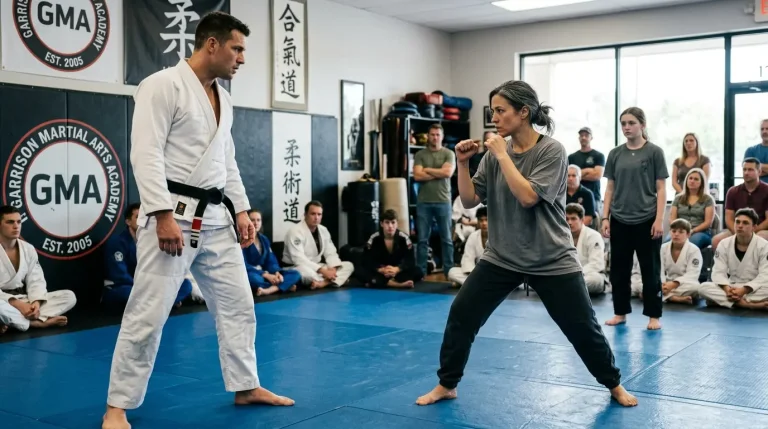
Saturday morning, Maya showed up.
No medals.
No old tournament jacket.
Plain black training pants and a gray T-shirt.
Twenty-two people attended the first class.
Half were restaurant workers.
Three nurses.
Two hotel employees.
One bartender.
Lena from Harrison Grill stood in the front row.
Maya began by teaching them how to create distance.
Then how to use a firm voice.
Then how to recognize the moment a joke becomes testing behavior.
Only near the end did she teach physical technique.
“Fighting is last,” she told them.