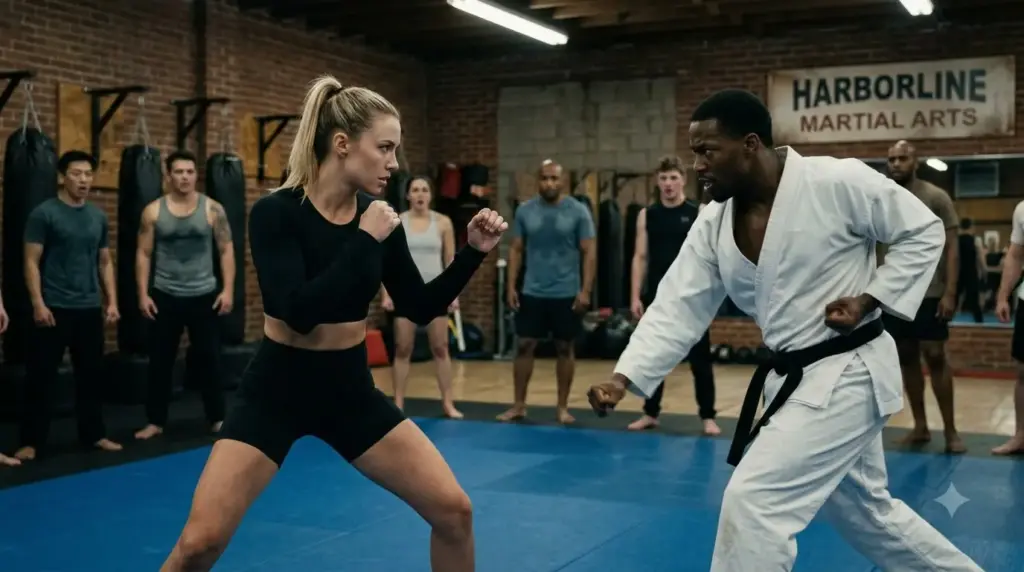
“Not competition. Winning. There’s a difference.”
Derek said nothing.
“I liked being the person nobody could solve. I liked the silence after someone realized they had underestimated me. I liked how clean a record looked compared with how complicated people were.”
Her eyes moved toward the center of the mat.
“So I stopped.”
“For five years?”
“Yes.”
“Why come back now?”
Lena’s answer came quickly.
“Because I missed training.”
Not winning.
Training.
Derek heard the difference.
He looked down at his hands.
“The first night,” he said, “when I asked you to roll…”
“You wanted to prove something.”
“Yes.”
“To me?”
He thought about it.
“No. To everyone else.”
Lena nodded.
“That’s more dangerous.”
He looked at her.
“Why?”
“Because if you only need to prove something to one person, you can walk away. If you need the room to see it, you keep going after the point has already been made.”
Derek thought about the hundreds of rounds where someone had tapped and he had held the position one extra beat, not enough to hurt them, just enough to make sure everyone understood.
He thought about beginners he had pressured after they stopped being useful training partners.
He thought about the phrase for fun.
Lena stood.
“That’s why I set terms before we rolled.”
Derek remained seated.
“You thought I’d ignore them?”
“I didn’t know you.”
“But you suspected.”
“I watched you for ten minutes.”
He gave a humorless laugh.
“That bad?”
“That obvious.”
Then she walked toward Priya.
Derek sat alone for another minute.
For the first time in years, he wondered how many people had known exactly what kind of round he would give them before he opened his mouth.
The next change came from a disagreement so ordinary that no one would have remembered it before Lena arrived.
A college student named Owen had been training at Harborline for three months. He worked hard, asked too many questions, and panicked whenever someone trapped one of his arms. Derek had rolled with him twice and considered him difficult in the way beginners often were: tense, unpredictable, exhausting without being technically dangerous.
During a Tuesday round, Owen tapped to pressure from side control.
His partner, Marcus Bell, released immediately.
Owen sat up and rubbed his shoulder.
“I’m done for tonight.”
Marcus nodded.
Derek, walking past, heard him.
“You’re fine,” he said.
Owen looked up.
“It hurts.”
“That’s training.”
Lena was several yards away.
She looked over but did not intervene.
Owen hesitated.
Derek continued.
“If you stop every time something feels uncomfortable, you’re never going to learn the difference between pain and panic.”
Marcus said, “He tapped.”
“I know.”
Owen stood.
“I can do another.”
Lena spoke from across the mat.
“Do you want to?”
The question was simple.
Everyone heard it.
Owen looked from her to Derek.
“I don’t know.”
Lena walked closer.
“That usually means no.”
Derek crossed his arms.
A Cocky Black Belt Challenged the Quiet Woman “for Fun” — One Move Later, Nobody Was Laughing
“He needs to build confidence.”
“Then let him make a decision and survive it.”
Derek’s irritation returned.
“You think stopping builds confidence?”
“I think choosing builds confidence.”
Owen looked embarrassed now, as if the whole room had become a courtroom for his shoulder.
Lena noticed.
She turned to him.
“You don’t owe us an explanation. If you’re done, you’re done.”
Owen nodded.
“I’m done.”
He stepped off the mat.
Derek waited until Owen was out of earshot.
“You undermined me.”
Lena looked at him.
“You’re not in charge of him.”
“I was trying to help.”
“I know.”
“That doesn’t sound like you know.”
“Intent and effect can be different.”
Derek exhaled sharply.
“Not everything is some deep ethical problem.”
“No.”
“Then why make this one?”
“Because a beginner said his shoulder hurt and you told him his own body was wrong.”
That stopped him.
Lena continued.
“You could ask him tomorrow whether it was fear, pain, or both. You could help him learn the difference. But in the moment, he told you something hurt. You decided your interpretation mattered more because you had more experience.”
Derek looked toward the locker room.
“He gets scared in bad positions.”
“Maybe.”
“He does.”
“Then teach him how to be scared without being ashamed.”
Derek stared at her.
Lena returned to training.
The next day, Owen texted the gym group chat.
Doctor says mild shoulder strain. Nothing major. Taking a few days off.
Derek read the message three times.
Nothing major.
That phrase should have made him feel vindicated.
Instead, he kept hearing Lena’s question.
Do you want to?
He had never thought of stopping as a skill.
He had treated it as the absence of courage.
On Friday, he sent Owen a private message.
How’s the shoulder?
Owen replied ten minutes later.
Better. Sorry I quit early.
Derek stared at the apology.
He typed, deleted, typed again.
You didn’t quit. You stopped when something hurt. That was the right call.
He almost deleted that too.
Then he sent it.
Owen answered with a thumbs-up.
The interaction lasted less than a minute.
Derek thought about it all day.
Harborline’s culture had never been officially cruel.
That was what made it difficult to examine.
There were rules against dangerous techniques. Rules against uncontrolled striking. Rules against training while intoxicated. Rules about hygiene, equipment, and conduct.
There was no rule about embarrassment.
No rule about making someone feel weak for tapping early.
No rule about calling a person soft until they trained through something they should have stopped for.
Most of the damage was too small to report.
One joke.
One round pushed too far.
One visitor who never returned.
One beginner who learned that saying no created more attention than enduring discomfort.
Individually, each event looked minor.
Together, they created the atmosphere people called culture.
Lena never used that word.
She did not need to.





