The second was the brick. A red brick came through her living room window Tuesday at 2:00 a.m. Wrapped around it with a rubber band was a piece of paper.
On the paper was the Anderson Elite Martial Arts logo. Nothing else. The logo was enough.
The third was the call from her boss at the Veterans Outreach Center. He sounded apologetic. He sounded scared. Whitney, listen.
The board called an emergency meeting last night. They want you to take administrative leave unpaid, just until this blows over. I am so sorry.
Whitney did not argue. She said, “Thank you.” She hung up. She sat in her apartment for one hour.
The brick was still on her living room floor. Glass was still scattered across the carpet. The cold October air was coming through the broken window. Then she did three things.
The first was she opened the shoe box under her bed. She took out the Bronze Star with Valor. She looked at it for 30 seconds. Then she put it in her pocket.
The second was she called Gunnery Sergeant Dwayne Brooks, her former squad leader from Helmand, the man who had been with her the night of the Humvee fire. Brooks, it’s Williams. I need a lawyer.
Brooks did not ask why. Brooks said he would be there in two hours. The third was she took the Padres cap off her head. She washed it in the sink, slowly, carefully.
She hung it on the towel rack to dry. Then she went to bed. Brooks arrived at 8:00 p.m. He brought a woman with him, 45 years old, Black, short natural hair, sharp gray suit.
She carried a leather briefcase. Her name was Diana Moore. She had been a civil rights attorney for 19 years. She had argued two cases before the Ninth Circuit Court of Appeals.
She specialized in cases where the system tried to bury people who looked like Whitney. She did not shake Whitney’s hand. She nodded once. Professional.
She sat down at Whitney’s kitchen table. She opened her briefcase. She pulled out a laptop. Show me everything you have.
Whitney showed her the brick, the note, the tire photos, the text from her boss, the doctored video circulating online. Diana watched the doctored video twice without speaking. Then she opened a separate file on her laptop.
She turned the screen toward Whitney. It was the full unedited footage from one of the three local news stations. The footage Tyler did not want anyone to see.
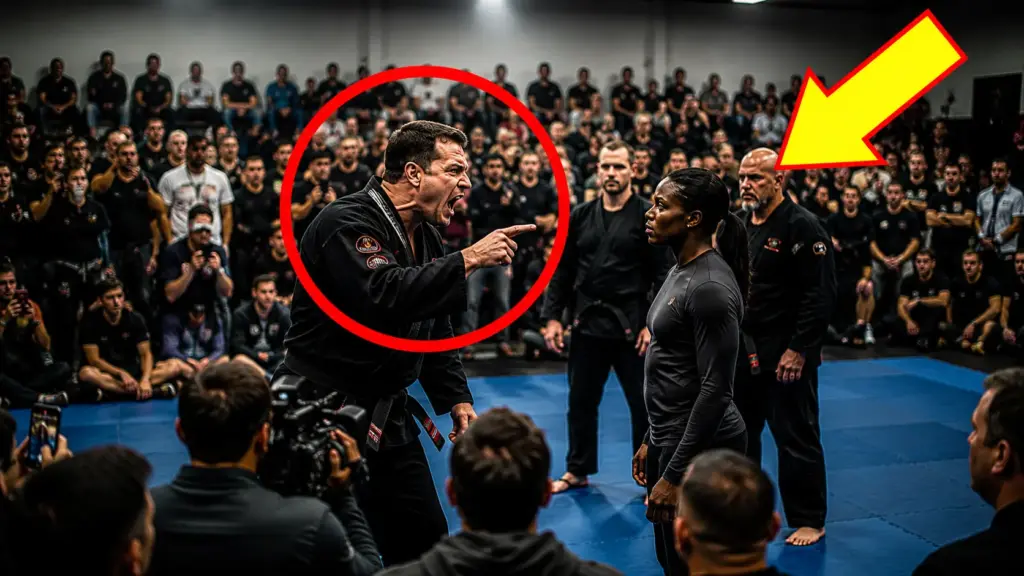
Whitney watched herself walk into the dojo. She watched Tyler point at her. She watched the two students drag her up the aisle. She watched him pour water on her head.
She watched herself say, “Please let me go.” She watched her own knee touch the mat. Then she watched the 1.4 seconds.
Diana paused the video. She looked at Whitney across the kitchen table. Three things, Whitney. First, we have all three news station feeds.
All of them unedited, timestamped. Second, we have 12 witnesses who stood up and saluted you Saturday, including a retired Marine Corps colonel. Third, I already spoke with Colonel Whitaker on the phone tonight.
He is willing to testify as an expert witness on MCMAP doctrine and minimum force application free of charge. Whitney did not say anything for a long moment. Then she asked one question. How bad will it get before it gets better?
Diana did not lie to her. Diana never lied to her clients. It will get worse. They will dig up everything.
They will leak it. They will pay people to say things about you. They will call your old commanding officers. They will say you are mentally unstable.
They will say you are dangerous. They will say you have PTSD and lost control. Whitney nodded once.
And then we will go to court and we will win and Tyler Anderson will spend a very long time wishing he had picked a different woman to drag onto his stage. Diana closed her laptop. She stood up.
She buttoned her jacket. I need three things from you, Whitney. Number one, do not give any interviews. Number two, do not respond to any messages from Tyler’s people.
Number three, wear short sleeves to court. Whitney looked at her for a long moment. Why short sleeves? Diana smiled for the first time that night.
Because juries believe what they can see. She walked to the door. She turned back. She gave Whitney one more piece of advice, the most important one.
And Whitney, when you take the stand, do not say anything you have not already said in this kitchen tonight. Not one word. Six weeks later, Coral Bay Superior Court, Courtroom 3, downtown.
The hearing was scheduled for 9:00 a.m. Thursday. By 8:30, the public gallery was full. Standing room only. The bailiff turned people away at the door.
Tyler Anderson sat at the plaintiff’s table. He wore a charcoal gray suit. His arm was still in the sling six weeks after the dislocation. His two lawyers sat on either side of him.
Expensive haircuts, expensive watches. At the defendant’s table, Diana Moore sat alone next to Whitney. Whitney wore a simple navy blue blouse, short sleeves. The crescent scar on her right arm was visible to every juror, every reporter, every face in the gallery.
The Bronze Star was pinned over her heart. She had not put it on. Diana had put it on her that morning. Behind her, in the second row of the gallery, sat Colonel Frank Whitaker.
He wore his full dress uniform, service ribbons across his chest. Beside him sat Gunnery Sergeant Dwayne Brooks, also in dress blues. Beside Brooks sat Lisa Brennan and beside her 11 other veterans Whitney had never met.
All in uniform, all sitting at attention. The judge entered. Honorable Patricia Mendes, 22 years on the bench. The plaintiff went first.





