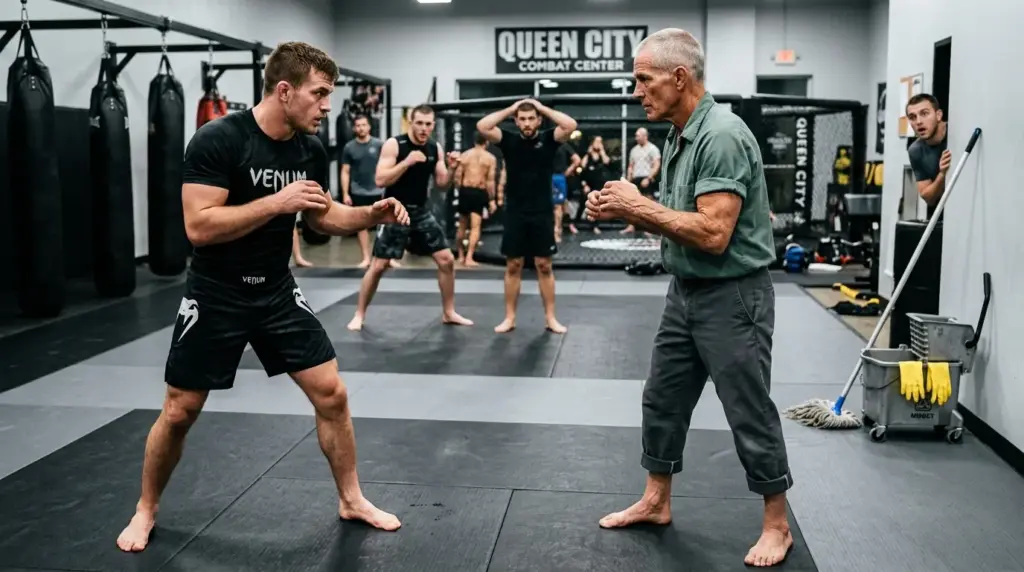
“That was you.”
Walter said nothing.
Trevor almost smiled.
Relief arrived.
Of course.
He had been submitted by Marcus Dawson’s coach.
That made sense.
That made the embarrassment survivable.
Walter saw it instantly.
“There.”
Trevor stopped.
“What?”
“You feel better now.”
Trevor frowned.
“Because now I’m worthy.”
Silence.
Walter stepped toward him.
“When I was only the janitor, losing to me was humiliating.”
Trevor looked away.
“Now you know I coached a champion, so the loss becomes respectable.”
Trevor said nothing.
Walter nodded toward Caleb.
“You do the same thing to him.”
The teenager looked up.
Trevor’s expression tightened.
“He’s younger.”
“So?”
“Less experienced.”
“So?”
Walter waited.
Trevor had no answer.
“You decide people deserve different amounts of respect depending on what they can do to you.”
That landed.
Walter continued.
“If Caleb can’t threaten you, his request to go light doesn’t matter as much.”
“That’s not true.”
“Then why did you ignore it?”
Trevor looked toward the floor.
Walter’s voice softened.
“Skill should make you safer to train with.”
“Not more dangerous.”
The room stayed quiet.
“That black belt around your waist should mean a white belt can trust you more.”
Walter pointed toward it.
“Not fear you more.”
Trevor swallowed.
For the first time that night, the humiliation began turning into something else.
Recognition.
He looked toward Caleb.
The boy had been watching the entire time.
Trevor walked over.
Caleb stiffened slightly.
That alone hurt.
Trevor stopped several feet away.
“Your neck okay?”
Caleb nodded.
“Yeah.”
Trevor waited.
Caleb corrected himself.
“Sore.”
Trevor looked down.
“I went too hard.”
No response.
“You told me to go easy.”
“Yes.”
“And I didn’t.”
Caleb looked at him.
Trevor forced himself not to explain.
Not to say he was competitive.
Not to say Caleb had caught him.
Not to say he did not mean anything.
“I’m sorry.”
Caleb nodded slowly.
“Okay.”
Trevor looked at him.
“Seriously.”
“I know.”
That was all.
No dramatic forgiveness.
No handshake.
Just an apology.
Walter went back to work.
He picked up the mop.
Rolled his sleeves down.
Put the rubber gloves back on.
The entire gym watched him return to cleaning as if nothing unusual had happened.
Trevor stood there.
Then said:
“Walter.”
The older man looked over.
“Can I help?”
Walter raised an eyebrow.
“With what?”
“The mats.”
Frank nearly laughed.
Walter looked toward the floor.
“You know how?”
“No.”
“That makes two things you learned tonight.”
Trevor smiled despite himself.
Walter handed him a second mop.
For twenty minutes, Trevor cleaned beside him.
He was terrible at it.
Too much water.
Wrong direction.
Missed corners.
Walter corrected him without mercy.
“Back to front.”
“Why?”
“Because otherwise you walk through what you just cleaned.”
Trevor changed direction.
A minute later:
“Too much solution.”
“How do you know?”
“I have eyes.”
Trevor laughed.
They worked in silence.
Finally Trevor asked:
“Why are you a janitor?”
Walter stopped.
Not offended.
Just thoughtful.
“Because I applied.”
“You know what I mean.”
“Yes.”
He continued working.
Trevor waited.
Walter eventually said:
“My wife got sick.”
The humor disappeared.
“Cancer.”
Trevor looked down.
“I’m sorry.”
“Thanks.”
Walter pushed the mop toward the wall.
“She fought it seven years.”
“I stopped traveling with fighters.”
“Stopped coaching full-time.”
“Took local work.”
Trevor asked:
“Did she…”
Walter nodded.
“Eight years ago.”
Silence.
“After she died, George asked me to coach again.”
“And?”
“I didn’t want to.”
“Why?”
Walter leaned on the mop.
“For thirty years, I was somebody’s coach.”
He looked around the emptying gym.
“Somebody’s corner.”
“Somebody’s wrestling guy.”
“Somebody’s problem solver.”
He smiled faintly.
“I was tired of needing a title.”
Trevor listened.
“Frank offered me maintenance work.”
“You like it?”
“I like being useful.”
“That’s it?”
Walter shrugged.
“Floors don’t care who I used to coach.”
Trevor looked toward the championship photographs.
“That doesn’t bother you?”
“What?”
“That people here don’t know.”
“No.”
“Why?”
Walter looked at him.
“Because if the only reason somebody listens to me is Marcus Dawson, they aren’t actually listening to me.”
That sentence stayed with Trevor.
A week later, he asked Walter to train him.
Walter said no.
Two weeks later, he asked again.
No.
Third week.
“No.”
Trevor frowned.
“You hate me?”
“No.”
“Then why?”
Walter pointed toward the mat.
“You still want the move.”
“Of course I want the move.”
“That’s why.”
Trevor stared.
Walter continued.
“You think the thirty seconds were about technique.”
“It was technique.”
“Partly.”
“What was the rest?”
Walter looked toward Mason’s phone sitting on the bench.
“Attention.”
Trevor followed his gaze.
“You were performing.”
Walter said.
“You looked toward your friend three times before we started.”
“You were already imagining the clip.”
“You were imagining what people would say.”
“You were imagining how easy I would make you look.”
Trevor’s face tightened.
“And while you were imagining all of that, I was paying attention to your feet.”
Silence.
Walter smiled.
“You weren’t grappling me.”
“You were grappling your audience.”
Trevor stopped asking for the move.
Instead, he started changing small things.
He told Mason:
“No filming people without asking first.”
Mason protested.
“That kills half the content.”
“Then kill it.”
He stopped choosing beginners for showcase rounds.
When someone requested light training, he kept it light.
The first few times were harder than he expected.
Not physically.
Emotionally.
A twenty-year-old blue belt swept him one evening.
Everyone saw it.
Trevor felt the immediate urge to increase the pace.
Then he heard Walter’s voice in his head.
Who are you grappling?
Trevor reset.
“Nice.”
The blue belt looked confused.
“You okay?”
Trevor laughed.
“That bad?”
“Kind of.”
He smiled.
“Fair.”
His online views dropped.
Mason complained constantly.
Then something strange happened.
Trevor started posting breakdowns of his own mistakes.
One video showed him getting caught in a guillotine during a tournament.
Another showed an opponent taking him down.
Another showed a training partner sweeping him.
The series was called:
WHAT I MISSED.
People responded.
Not as explosively.
But differently.
Coaches shared it.
Young athletes asked technical questions.





