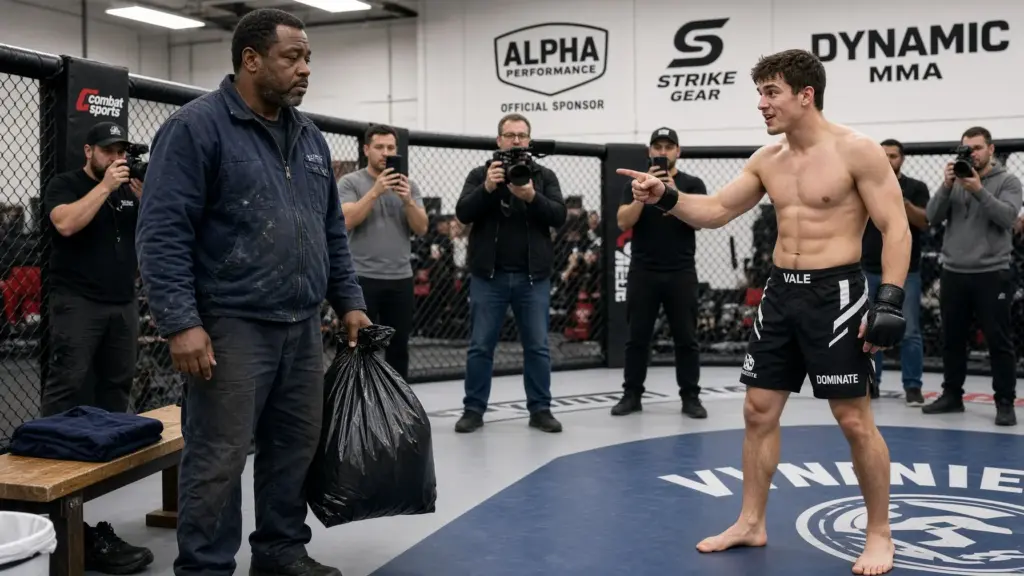
At 5:42 every morning, before the first class at Iron Harbor Fight Academy, Samuel Cole unlocked the rear service door and listened to the building breathe.
The old warehouse always made noise before the people arrived.
Pipes clicked inside the walls. Heating ducts groaned. The refrigeration unit in the smoothie bar hummed too loudly. Somewhere above the boxing ring, a loose vent cover rattled whenever the wind pushed off the river.
Samuel knew every sound.
He knew which locker stuck in the men’s changing room, which shower drain backed up if hair collected under the grate, which heavy bag chain needed oil every third week, and which section of mat near the west wall lifted slightly when humidity rose.
He had been the janitor at Iron Harbor for fourteen months.
Most members knew him only as Sam.
The quiet guy.
The older guy.
The one who cleaned blood without flinching and never watched sparring long enough to be mistaken for a fan.
He was forty-nine, broad through the shoulders but lean, with close-cropped salt-and-pepper hair and a deep scar running from the base of his right thumb toward his wrist. His work jacket was navy blue, thick canvas, faded at the elbows. Beneath it, he wore plain gray shirts and black utility pants.
Nothing about him asked to be noticed.
That suited him.
Iron Harbor was the opposite.
The academy had built its reputation on visibility.
Championship banners hung over the mats. Photos of fighters covered the hallway. Three local television segments played on a loop near reception. Posters advertised weekend seminars, title bouts, and one fighter above all others.
DEREK VALE.
Twenty-six.
Welterweight.
Ten professional wins.
One loss.
Seven knockouts.
Derek’s face was everywhere.
On the academy windows.
On the website.
On posters downtown for an upcoming regional title fight.
He was Iron Harbor’s biggest success story and, increasingly, its biggest problem.
Samuel heard Derek before he saw him most mornings.
Loud music from the parking lot.
Laughter.
Then the rear door slamming even though the sign said PLEASE CLOSE GENTLY.
At 7:10 that Tuesday, Derek entered with his friend Nolan Pierce carrying a phone on a stabilizer.
Nolan filmed nearly everything.
Training clips.
Locker-room jokes.
Trash talk.
Protein shakes.
Derek’s sponsors liked content.
Derek liked attention.
Nolan liked numbers.
Samuel was mopping near the cage when Derek walked across the wet floor.
“Careful,” Samuel said.
Derek stopped.
Looked down.
Then at Samuel.
“You talking to me?”
“The floor’s wet.”
Derek smiled.
“I noticed.”
He stepped anyway.
The sole of his shoe slid half an inch.
Nolan laughed.
Derek recovered.
Samuel moved the mop.
“Yellow sign’s right there.”
Derek looked at it.
Then at Nolan’s phone.
“You get that?”
Nolan nodded.
“Almost ate it.”
Derek pointed at Samuel.
“Man tried to take me out before camp.”
Samuel said, “Insurance would be complicated.”
Nolan laughed harder.
Derek stared at Samuel for a second.
He was not sure whether the janitor had made a joke.
Samuel resumed mopping.
Derek walked away.
That should have been the end.
It wasn’t.
Derek was three weeks from the biggest fight of his career.
Regional title.
Main event.
Sold-out civic arena.
A win would likely get him signed to a national promotion.
Pressure had sharpened everything about him.
His training.
His temper.
His need to be seen as dominant in every room.
Coach Laura Mendes noticed first.
Laura was thirty-eight, former kickboxer, head striking coach at Iron Harbor, and one of the few people Derek still listened to sometimes.
During pad work, he hit too hard.
“Control,” she said.
He hit harder.
“Derek.”
“I’m fine.”
“That wasn’t the instruction.”
He reset.
Two rounds later, he dropped a young sparring partner named Milo with a body shot.
Not intentionally.
Not entirely accidentally either.
Milo folded.
Laura threw the pads down.
“Done.”
Derek backed away.
“He said hard rounds.”
Milo was still on one knee.
Laura looked at Derek.
“He said hard. Not stupid.”
Derek’s jaw tightened.
“He has a fight too.”
“Not anymore today.”
Derek walked away.
Nolan kept filming until Laura pointed at him.
“Phone down.”
He lowered it.
Samuel was emptying a trash bin nearby.
He had seen the whole thing.
Derek noticed.
“What?”
Samuel tied the bag.
“Nothing.”
“You keep looking.”
“I’m cleaning.”
Derek walked closer.
“You got an opinion?”
Samuel lifted the bag.
“On trash?”
A few fighters nearby laughed.
Derek’s face hardened.
Laura said, “Enough.”
Derek looked at Samuel.
“You used to train or something?”
Samuel did not answer immediately.
Then: “Long time ago.”
“What, boxercise?”
Nolan snorted.
Samuel carried the bag away.
Derek called after him.
“Yeah, that’s what I thought.”
Laura stared at Derek.
“Why do you care?”
“I don’t.”
“You do.”
“He looks at me like he knows something.”
Laura picked up the pads.
“Maybe he knows you’re acting like an idiot.”
Derek looked at her.
“Everybody’s got jokes today.”
“No. Just observations.”
Samuel heard none of that.
Or pretended not to.
The truth was, he had trained.
Not “a little.”
Not casually.
For twenty-six years.
Boxing first.
Then judo.
Then wrestling.
Then Brazilian jiu-jitsu when hardly anyone in the city knew what it was.
He had competed.
Coached.
Cornered fighters.
Won enough medals to stop caring where most of them had gone.
He had once owned a small gym called Dockline Combat.
People who trained in the region fifteen years earlier might still recognize the name.
A few might recognize his.
Samuel Cole had not been famous.
He had been respected.
Then, eight years earlier, one of his students died.
Not in a fight.
After one.
The student’s name was Theo Grant.
Twenty-three.
Talented.
Reckless.
Beloved.
Theo had taken a brutal amateur bout on short notice.
Samuel argued against it.
Then allowed it.
Theo won.
Collapsed in the locker room forty minutes later from an undiagnosed vascular condition made worse by trauma and dehydration.
Doctors told Samuel he could not have known.
Theo’s family told him the same.
Samuel did not believe them.
He closed Dockline within six months.





