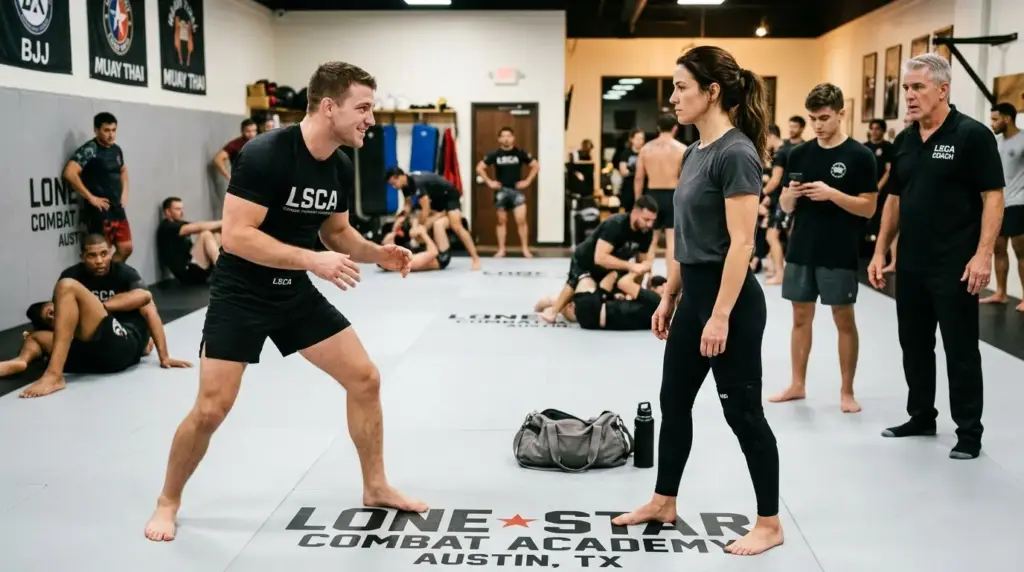
“What does that mean?”
Dylan smiled.
“It means embarrassment made me stupid.”
The answer circulated online.
Sarah texted Robert:
He finally learned English.
Robert forwarded it to Dylan.
He laughed for ten minutes.
Years passed.
Dylan never became a world champion.
He became something else.
A respected professional.
Then a coach.
When his fighting career ended at thirty-six after repeated hand injuries, he began teaching full-time.
His beginner classes became unusually popular.
Not because he was soft.
They trained hard.
But people trusted him.
If someone said their shoulder hurt, he adjusted.
If a student declined a partner, Dylan never asked them to justify it.
If an advanced athlete began punishing beginners for success, Dylan stopped the round immediately.
One evening, a talented twenty-two-year-old named Ryan Holt got swept by a small new student.
Everyone saw Ryan’s expression change.
The pace increased.
Dylan stopped them.
“Time.”
Ryan frowned.
“We’ve got two minutes.”
“You’re done.”
“Why?”
Dylan walked over.
“Because thirty seconds ago you were training.”
“And now?”
“You’re repairing your ego.”
The room went quiet.
Ryan looked embarrassed.
Dylan smiled faintly.
“I know the difference.”
Later that night, one of the younger students asked:
“How?”
Dylan pointed toward an old photograph near the office.
Sarah Mitchell had visited the gym again years earlier, and Robert had finally convinced her to let him add one modest photograph to the wall.
Not a championship podium.
Not an MMA poster.
A simple picture of Sarah teaching a group of beginners.
Underneath was a small caption:
CONTROL BEFORE VICTORY.
Dylan looked at it.
“Someone showed me.”
The student asked:
“Was she your coach?”
Dylan smiled.
“No.”
“Did she beat you?”
“Yes.”
“How fast?”
“Forty-seven seconds.”
The teenager laughed.
“You remember exactly?”
“Unfortunately.”
“What did she catch you with?”
“Triangle.”
“Were you mad?”
Dylan thought.
“At first.”
“What changed?”
Dylan looked toward the empty mat.
“The tap wasn’t the embarrassing part.”
The teenager waited.
Dylan continued.
“The embarrassing part was how much I needed an explanation for why someone I’d underestimated was allowed to beat me.”
The student frowned.
Dylan smiled.
“You’ll understand someday.”
Sarah remained a physical therapist.
She never returned to professional fighting.
She trained when her body allowed.
Some years more than others.
Her knee eventually required another surgery.
Her shoulder stayed troublesome.
None of that erased what she knew.
And none of it made her lesser because she could no longer compete at the level she once had.
That was another thing Dylan eventually understood.
He had first respected her because he discovered she was a black belt.
Then more because she had been a professional fighter.
Then even more because she had won major tournaments.
All of those facts had changed his opinion.
None of them should have been necessary for basic respect.
Sarah had said no to being filmed.
That should have been enough.
She had declined the round.
That should have been enough.
She had asked for a technical pace.
That should have been enough.
Her résumé did not create the right to be listened to.
It only exposed how little Dylan had listened before seeing it.
Years later, someone reposted an old story about the night a cocky professional fighter challenged a new woman “just for fun” and ended up tapping.
The internet embellished everything.
Some claimed Sarah had been a world champion.
She had not.
Some said she submitted Dylan in five seconds.
It took forty-seven.
Others said she mocked him afterward.
She never did.
That was precisely why the real story stayed with him.
She did not need to humiliate him.
He had already done that part himself.
He chose the smallest unfamiliar person in the room because he assumed she would be easy.
He ignored a clear no because he wanted entertainment.
He increased the intensity because people were watching.
Then, once caught, he delayed tapping because he was still trying to win an argument nobody else was having.
Sarah simply gave him enough space to see it.
One triangle.
One tap.
Forty-seven seconds.
The submission ended immediately.
The lesson did not.
And years afterward, when young fighters at Lone Star asked Dylan what the most important thing Sarah Mitchell ever taught him was, they expected something technical.
Hip angle.
Head control.
How to finish a triangle.
How to counter a body lock.
Dylan always shook his head.
“She taught me something harder.”
“What?”
He would look around the room before answering.
“Never decide somebody is beneath your respect just because you haven’t learned their story yet.”
Then, if the students were old enough to understand, he added the part that had taken him much longer to learn.
“And don’t wait until you hear an impressive story before giving them that respect.”
Because on the night Sarah Mitchell first walked into Lone Star Combat Academy, she was already exactly who she was.
Dylan simply had to tap before he was willing to see her.





