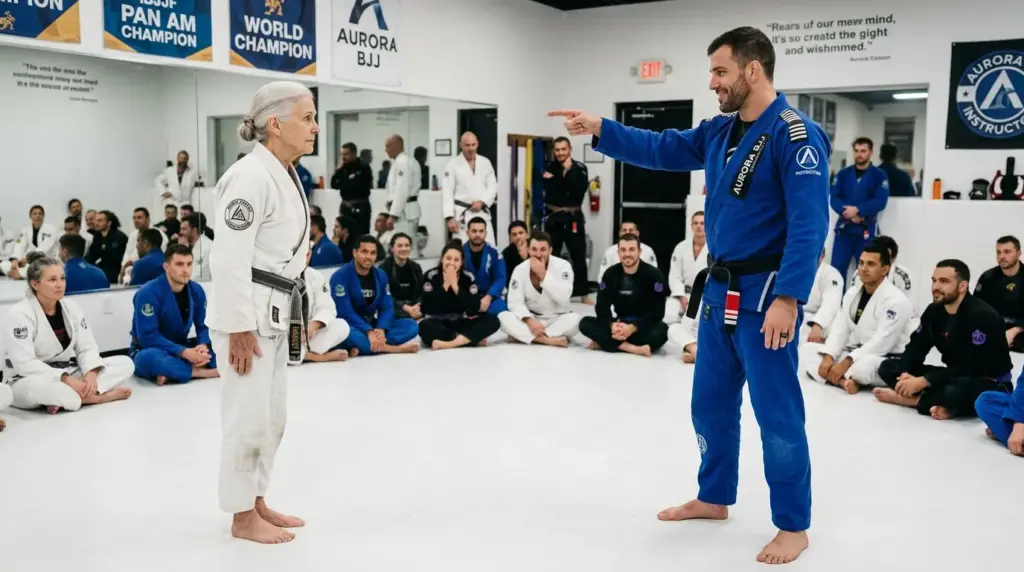
She had not expected the day to end this way. She had come in hoping only to find a mat, to keep moving, to build some small routine in a new town where grief still followed her from room to room. She had not come looking for students. She had not come looking to prove herself.
But perhaps this new chapter had come looking for her.
“I’ll think about it,” she said. “But I have one condition.”
“Name it.”
“This dojo must become a place of respect for everyone who walks through that door. Age, gender, size, appearance, experience. None of it should decide how they are treated before they step on the mat.”
Her eyes held his steadily.
“What happened today should never happen again.”
Jackson nodded. This time, there was no performance in it.
“That is a principle I should have been upholding all along,” he said. “Consider it a promise.”
As Edith gathered her things, several students bowed to her formally. It was the kind of respect usually reserved for the head instructor. The purple belt woman smiled hopefully.
“See you Thursday, Sensei Simmons?”
Edith smiled back.
“Thursday would be fine.”
As she walked toward the exit, she noticed a small group of older adults peering through the glass near the reception area. They had apparently watched part of the class and were speaking excitedly among themselves.
The receptionist approached, her expression sheepish.
“Ma’am,” she said, “there are several people asking if we offer classes for… mature students. They want to know if you’ll be teaching.”
Edith’s smile deepened.
“Tell them to come back Thursday,” she said. “We’ll see what we can do.”
Three months later, Elite Martial Arts Academy was no longer the same place.
What had once been mostly a training ground for young competitors had become a more diverse, more welcoming community. Twice a week, Edith taught what everyone now called the Foundations Class. It was open to all ages and experience levels. Some students were teenagers. Some were competitors. Some were mothers returning to fitness. Some were men and women in their sixties and seventies who had once believed martial arts were no longer for them.
Edith’s class did not focus on athletic dominance. It focused on the timeless parts of jiu-jitsu: posture, balance, breathing, leverage, timing, safety, and respect.
To everyone’s surprise, it became the most popular class on the schedule.
Younger students discovered that slowing down under Edith’s instruction improved their competition performance. Older students discovered that they could learn without being thrown into movements their bodies were not ready for. Women who had felt intimidated by the intensity of the academy found Edith’s presence reassuring. Even Coach Jackson attended regularly, often serving as her demonstration partner.
His students noticed the change in him too.
He listened more. He mocked less. He greeted new members himself. He corrected with patience. The man who had once used authority to embarrass an elderly woman now seemed to understand that authority meant protecting the dignity of the people in the room.
When a local newspaper wrote a feature about Edith, Jackson was quoted saying, “Mrs. Simmons has forgotten more about pressure distribution than most of us will ever learn. She reminded this academy what martial arts are supposed to be.”
One Saturday, Elite hosted a small in-house tournament. Competitors of different ages and belt levels filled the mats. Edith and Jackson co-judged matches, and between divisions, Edith demonstrated techniques with Jackson’s help.
“Notice,” she told the audience as she slowly worked through an armbar setup, “how leverage, not strength, creates the opportunity. When the principle is understood, the technique becomes available to many bodies, not just young or powerful ones.”
In the viewing area sat a group of older students who had begun calling themselves the Silver Belts. They watched Edith with special pride. Many of them had joined after hearing about the seventy-two-year-old woman who walked into a dojo, was laughed at, and changed the place without ever raising her voice.
From the center of the mat, Edith noticed a new visitor enter the academy. He was an elderly man using a cane. He stood near the door, hesitant but determined, the way people stand when they are trying to decide whether they still belong in a world that keeps telling them they do not.
Edith recognized the look immediately.
Coach Jackson followed her gaze. Without being asked, he walked over to the man, greeted him respectfully, and guided him to a seat with a small bow.
Edith watched and smiled.
Some lessons, she thought, went far beyond technique.
That day, the academy was full of motion: young athletes rolling hard, older beginners practicing breakfalls, children laughing near the edge of the mat, parents watching from folding chairs, and Coach Jackson kneeling beside a new student, explaining how to tie a belt properly.
Edith stood quietly in the middle of it all, silver hair in a neat bun, black belt worn soft from decades of practice.
She had not come to Elite to become a legend. She had not come to embarrass anyone. She had come because grief had taken her old life, and she needed a place to keep moving.
But sometimes, when a person refuses to disappear, they give others permission to step forward too.
Edith Simmons had been underestimated when she walked through the door. She had been mocked because of her age, dismissed because of her appearance, and judged by people who mistook youth for mastery.
Then she stepped on the mat and let her actions speak.
And in doing so, she taught an entire academy one of the oldest lessons in martial arts: true strength is not loud. True mastery does not need to boast. And the oldest tree in the forest often has the deepest roots.





