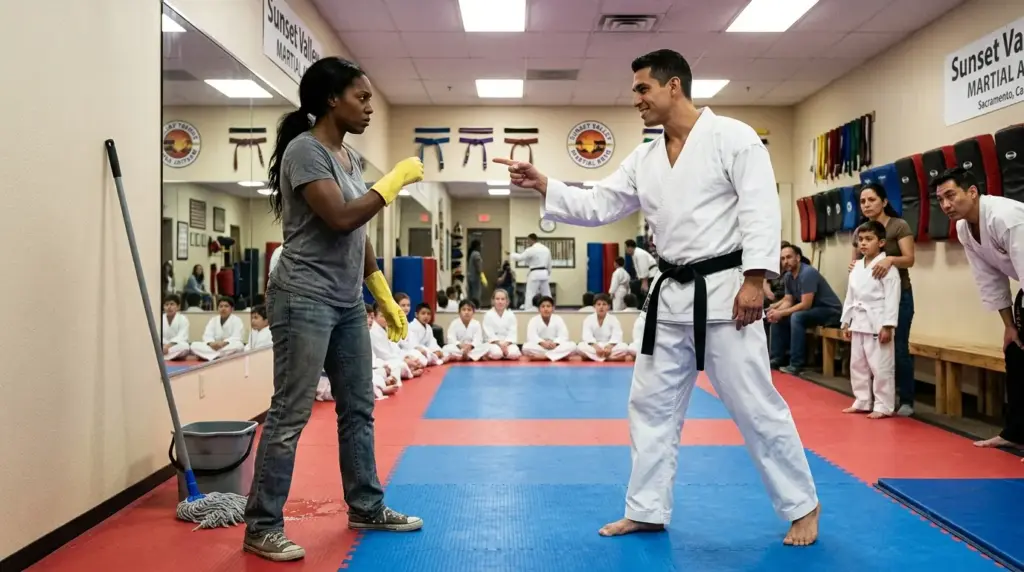
Judo is about more than throwing people. It is about using an opponent’s force against them. It is about staying calm when someone tries to overpower you. Most importantly, it is about protecting what matters. I forgot that for a while, but some lessons you never really lose.
At the bottom of the page, in Emma’s messy teenage handwriting, was another note.
My sister is the strongest person I know. Not because she can throw people around, but because she makes other people feel safe. That’s her real superpower.
Kesha traced the words with one finger.
Tomorrow would come.
New questions.
New attention.
New responsibilities.
But for the first time in years, the thought did not terrify her.
Because the cleaning woman was still there.
The one who had learned to be invisible.
The one who had found safety in being underestimated.
But now, beside her, something else had returned.
The champion.
The sister.
The teacher.
The woman who had forgotten for a while that silence could be its own kind of strength.
In the weeks that followed, Sunset Valley Martial Arts changed.
Not all at once.
Real change never comes in one dramatic moment.
But it began.
The first thing David Park did was rewrite the school’s welcome policy.
Every new student, every parent, every staff member was asked what kind of support helped them learn best.
Not after they struggled.
Not after someone embarrassed them.
On day one.
Aiden stayed in class.
Not as a special exception.
As a student.
Kesha stood beside him during his first full session after the match, not hovering, not rescuing, simply present. When Ryan gave verbal instruction, Kesha worked with David to create visual signals for the whole class. Not just for Aiden.
For everyone.
Hand signals for stop.
Reset.
Watch.
Partner change.
Danger.
The hearing students learned them too.
At first, some did it awkwardly.
Then naturally.
Then proudly.
Within a month, the entire children’s class could follow a silent drill from start to finish.
Aiden was not isolated by the adaptation.
The adaptation made the whole class better.
That was the lesson Ryan had missed.
Accessibility did not weaken standards.
It sharpened them.
Ryan changed too.
At first, painfully.
He apologized to Maria again in private, then to the class in public. Not a vague apology. Not the kind adults give children when they want forgiveness without accountability.
He named what he had done.
He admitted he had treated disability like inconvenience.
He admitted he had confused authority with leadership.
Then he stepped back from teaching beginner classes for a month and attended Kesha’s sessions as a student.
The first night, he bowed to her in front of everyone.
His face was red.
His pride was bruised.
But he did it.
Kesha taught him the same way she taught the children.
Clearly.
Patiently.
Without cruelty.
That was the part that broke him most.
She had every right to humiliate him.
She never did.
One evening, after class, Ryan stayed behind while Kesha wiped down the mats.
He took the mop from her hands.
“I can do that.”
Kesha looked at him.
For a second, old habits made him flinch under her gaze.
Then she let go.
They mopped in silence for ten minutes.
Finally, Ryan spoke.
“I thought being respected meant never letting anyone question me.”
Kesha wrung out a cloth and looked at him.
“Respect that cannot survive a question is fear.”
Ryan nodded slowly.
“I was afraid.”
She waited.
He swallowed.
“Afraid they’d see I wasn’t as strong as they thought.”
Kesha’s hands moved first, then she spoke softly.
“Then become strong enough to be seen.”
That stayed with him.
Months passed.
The adaptive martial arts program began with six students.
Aiden.
Two children with hearing loss.
A teenage girl with cerebral palsy.
A boy on the autism spectrum who had been asked to leave two other schools.
A veteran with partial vision loss who had stopped training after his injury.
By the end of the year, there was a waiting list.
Kesha did not become loud.
She did not become a motivational speaker.
She did not hang her medal on the wall at first.
She kept it in the gym bag, wrapped in tissue.
But one day, Aiden asked if she was ashamed of it.
The question came through his hands, direct in the way children can be.
Are you hiding it because it makes you sad?
Kesha thought about lying.
Then decided he deserved better.
She brought the medal the next week.
Not to brag.
Not to prove.
To teach.
She placed it on the mat and let the students sit around it.
“This is not proof that I am better than anyone,” she told them. “It is proof that training changes what you believe is possible.”
Aiden touched the ribbon carefully.
His eyes were wide.
“Can deaf people win?” he signed.
Kesha smiled.
“Deaf people can win. Deaf people can teach. Deaf people can protect. Deaf people can belong.”
Aiden looked at the medal again.
Then at his own hands.
Something opened in his face.
A future he had not known he was allowed to imagine.
Maria cried quietly in the back row.
David Park eventually framed a photograph near the front desk.
Not the medal podium.
Not the famous shot from Rio.
A simple picture taken during class.
Kesha kneeling beside Aiden, both of them signing, both of them smiling.
Underneath, David placed a small plaque:
Strength creates room.
That became the school’s new motto.
Parents noticed the difference.
Students noticed too.
The dojo became quieter in some ways, louder in others.
There was less shouting.
More attention.
Less performance.
More listening.
Children who had once been overlooked began to thrive. Students learned that leadership meant watching for the person falling behind, not standing on top of them to feel taller.
Ryan still taught.
But differently.
When he corrected a student now, he got down to their eye level. He demonstrated more. He asked questions. He learned basic sign language from Aiden and Maria, then insisted the other instructors learn too.





