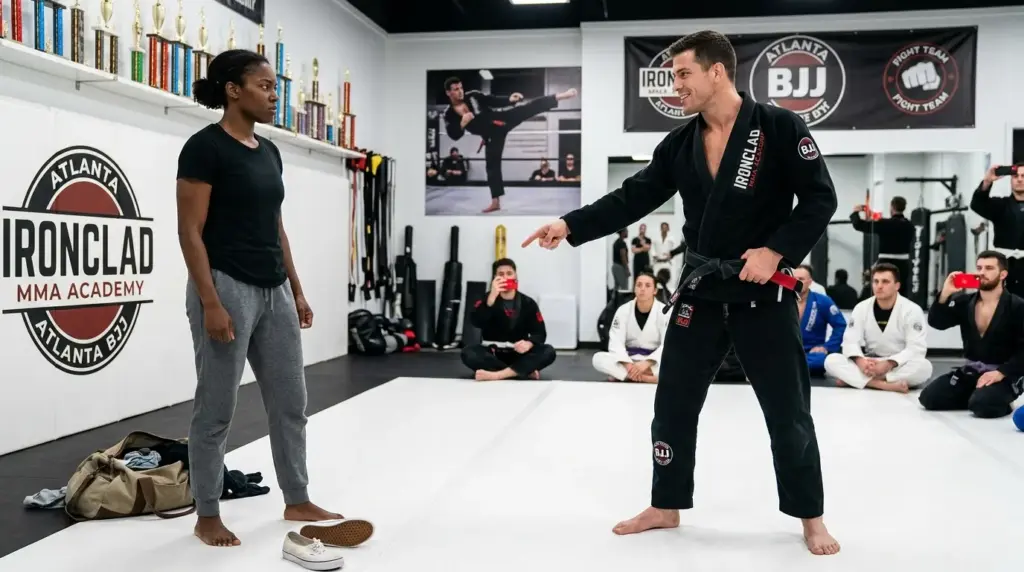
Trent did not care either way.
Views were views.
Then he posted a follow-up clip.
Fifteen seconds.
Just him standing in the dojo, pointing at the camera.
“To the lady from last week,” he said. “You said you’d be back. I’m waiting. Open invitation anytime. Let’s run it again.”
He tagged it:
#IroncladChallenge.
Pinned it to his page.
Two days later, Willa replied with one sentence.
Saturday. 7:00 p.m.
The post exploded.
Shares.
Reposts.
Quote tweets.
By Friday night, every martial arts page in Atlanta had picked it up.
Trent promoted it like a title fight.
He printed flyers.
He streamed a countdown on his channel.
He told his students to bring friends.
Saturday came.
The dojo was packed.
Double the usual crowd.
More than sixty people pressed along the walls — students, friends, strangers, content creators with ring lights and tripods.
The energy was loud and electric.
Someone had brought a portable speaker playing walkout music.
Trent was already on the mat in a full competition gi and a fresh black belt. He shadowboxed, rolled his shoulders, bounced on his toes, and played the part of a main event fighter.
Then Willa walked in.
The room got quieter.
Not silent.
Not yet.
But the volume dropped like someone had turned a dial.
She carried an old faded green canvas gym bag.
She set it on the bench.
Unzipped it.
Pulled out a gi.
Not new.
Not bright white.
Yellowed at the collar and soft from a thousand washes.
Her grandfather’s gi.
She put it on slowly.
Carefully.
Like armor.
Then she reached into the bag and pulled out the belt.
Faded black.
Frayed at the edges.
She tied it around her waist with a knot so practiced that her hands did not shake once.
The room went quiet.
Trent saw the belt.
His grin dropped for half a second.
Only half.
Then it came back wider than before.
But something behind his eyes had shifted.
“Nice costume,” he said. “Let’s see if it’s real.”
Willa stepped onto the mat.
No borrowed gear this time.
No oversized chest protector.
No cracked headguard.
Just the gi.
The belt.
Bare feet on canvas.
They faced each other.
Trent did not bow this time.
He dropped straight into a fighting stance.
Left foot forward.
Hands high.
Weight on the back leg.
Taekwondo base.
He was done performing generosity.
This was about dominance.
He opened fast.
A spinning back kick aimed at her midsection.
The kind of technique that looks devastating on camera and drops beginners cold.
It was fast.
It was clean.
It would have ended most people.
Willa shifted two inches to the left.
The kick sailed past her ribs close enough to move the fabric of her gi.
She did not flinch.
Trent reset.
He threw a roundhouse to the head.
Fast.
Committed.
Willa ducked under it.
Not panicked.
Measured.
As if she had seen it before.
He threw a combination.
Front kick.
Spinning heel.
Backfist.
Flashy.
Athletic.
Everything missed by inches.
Willa moved just enough.
Never more than she needed.
The crowd started murmuring.
Trent’s breathing grew heavier.
His technique widened.
He was throwing harder now, reaching farther, committing more weight, trying to land something — anything — before the story changed.
“Stand still,” he snapped. “Stop running.”
But Willa was not running.
She was reading.
Every Saturday morning for ten years, her grandfather had taught her one thing above all else.
Before you move, you watch.
Before you strike, you understand.
You do not react to what they are doing.
You react to what they are about to do.
Trent loaded up one more kick.
A high roundhouse.
Full power.
Aimed at her temple.
His whole body rotated into it.
Both feet nearly left the ground.
Everything he had was inside that kick.
Willa caught it.
Her left hand wrapped around his ankle.
Her right hand gripped his gi at the collar.
In one seamless motion — weight shift, hip turn, leg sweep — she executed a textbook osoto gari.
A classic judo throw her grandfather had drilled into her five thousand times on the grass in his backyard.
Trent’s back hit the mat so hard the sound cracked through the room like a gunshot.
Before he could breathe, Willa transitioned.
Ground control.
Knee across his chest.
She isolated his right arm.
Locked her legs around it.
Arched her hips.
And sank an armbar so clean it belonged in a textbook.
Trent’s face twisted.
His free hand slapped the mat three times.
Fast.
Desperate.
Tap.
Tap.
Tap.
Eight seconds.
From catch to submission, eight seconds.
Willa released the armbar.
She stood.
Stepped back.
The dojo was silent.
Not quiet.
Silent.
The kind of silence that has weight.
The kind you feel pressing against your eardrums.
Sixty people stood there with phones in the air and mouths open.
Nobody moved.
Nobody spoke.
Then, from somewhere in the back, one person started clapping.
Then another.
Then the whole room erupted.
Cheering.
Shouting.
Feet stamping the floor.
Willa did not celebrate.
Did not raise her arms.
Did not look at the crowd.
She walked to the bench, folded her grandfather’s gi, placed the belt on top, and put them back into the bag.
Then she walked out the same door she had entered.
Trent stayed on the mat, sitting, holding his arm, staring at the floor.
The camera on the shelf was still recording.
The red light still blinking.
Within an hour, four different angles of the fight were online.
By midnight, the clips passed half a million views.
By Monday morning, they had passed two million.
#DojoSilence trended nationally.
Sports blogs picked up the story.
MMA forums broke it down frame by frame.
News outlets ran the clip on morning shows.
Everyone wanted to know the same thing.
Who is she?
Willa did not do interviews.
She did not post online.
She did not respond to a single message.
But someone else did.





