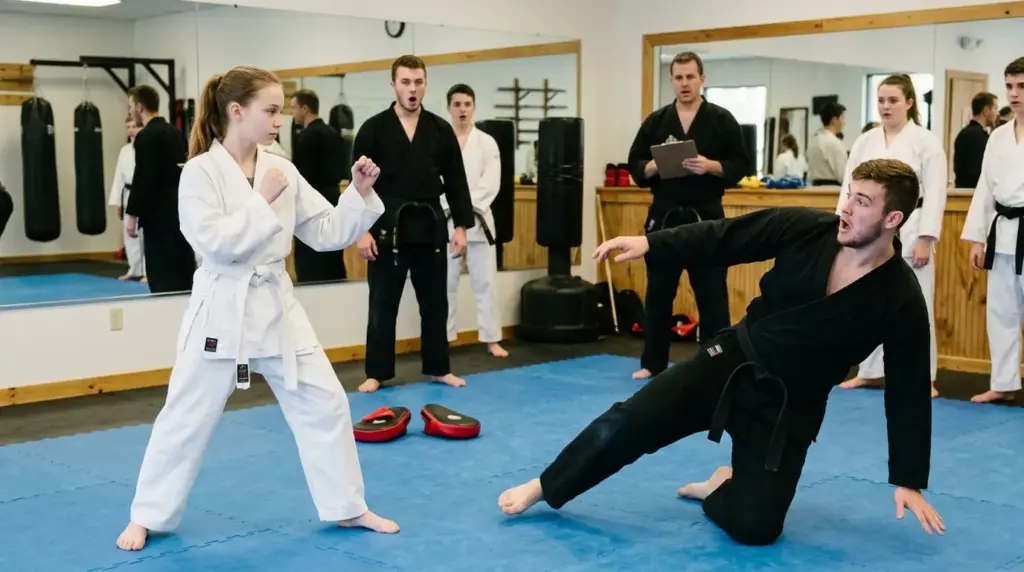
Her mother sat behind the wheel, sunglasses on despite the fading light, cigarette smoke curling out through the cracked window.
“Well?” her mother asked without turning. “Did you hit something? Do you feel better?”
Holland leaned her head against the cool glass.
Her ear pulsed.
Her hands hurt.
The knot inside her chest had not disappeared, but it had changed shape.
“Yeah,” she said quietly. “A little.”
Her mother drove away without asking more.
For once, Holland was grateful.
Back inside Coastal Athletics, Trent finally managed to breathe.
It came in ragged pulls.
Shallow, ugly, humiliating.
Graham helped him sit up, but Trent shoved his hand away.
His face was pale now, eyes wet from involuntary pain, mouth pressed into a hard line.
No one laughed.
That may have hurt him more than the strike.
The room that had once fed his arrogance was now watching him like he had been exposed.
Miller was the first to speak.
“Sensei,” he said carefully, “that wasn’t beginner movement.”
Graham shot him a look.
“I know what I saw.”
But he did not.
That was the problem.
He had seen a white belt.
A girl.
A small body.
A liability.
He had not seen a fighter.
He had not seen the way she grounded force while holding pads.
He had not seen the way she read Trent’s telegraphs before they became motion.
He had not seen the discipline it took for her to endure the mocking, the bad drill, the first cheap shot.
He had only looked after violence forced him to.
That night, Graham reviewed the security footage.
At first, he watched it to protect the business.
Liability.
Parents.
Insurance.
Police.
A gym owner thinks in those terms when something goes wrong on the mats.
But the footage did not show what he wanted it to show.
It showed Trent throwing too hard.
It showed Holland absorbing strikes cleanly.
It showed Trent’s kick bouncing off a girl he thought he could move.
It showed his embarrassment.
His anger.
His glove cutting through the gap and striking the side of her head.
It showed Graham looking at his phone.
Then it showed Holland standing still for one full second after the hit.
Not rushing.
Not attacking blindly.
One second of choice.
Then the pads dropped.
Graham rewound that part three times.
The posture change.
That was what chilled him.
She went from trying to disappear to becoming centered in the room.
Nothing dramatic.
Nothing theatrical.
Just a complete change in architecture.
Then the sparring exchange.
Trent’s hook.
The angle.
The low kick.
The charge.
The slip.
The body shot.
The elbow.
It took less than ten seconds.
Graham sat back in his office chair and felt something sour settle in his stomach.
This was not a beginner losing control.
This was a trained champion using just enough force to stop someone who had crossed a line.
And Graham had let that line be crossed.
The next morning, he called the front desk girl and asked for the waiver Holland had signed.
The name was almost illegible.
Holland Wright.
He searched it.
Within minutes, the truth appeared.
Tournament footage.
National rankings.
Photos from Kyokushin events.
A younger Holland standing on podiums, black belt tied properly around her waist, bruised shins visible below her uniform, gold medals hanging against a face that looked just as serious then as it had in his gym.
Three consecutive national championships.
Full-contact division.
Junior black belt category.
Graham closed the laptop.
For the first time in years, he felt like a white belt again.
Not in skill.
In humility.
Trent did not return for a week.
When he did, the room was different.
No one said it out loud, but everyone knew.
The story had spread through the academy.
Not to the public.
Not online.
No viral video.
No grand humiliation outside the walls.
But inside the dojo, where reputation mattered most, Trent’s crown had cracked.
He walked in wearing the same black gi, the same embroidered belt, the same polished arrogance.
But he moved differently.
His left leg still carried the memory of Holland’s shin.
His ribs tightened every time he inhaled too deeply.
And his eyes no longer looked at smaller students the same way.
Not with respect.
Not yet.
But with caution.
That was a beginning.
Graham called the class together that night.
He stood in front of the room without his clipboard.
No coffee.
No phone.
That alone made the students pay attention.
“What happened last Thursday was unacceptable,” he said.
Trent looked down.
Graham continued, “And I am not talking about the girl who defended herself.”
The room shifted.
“I am talking about a culture I allowed. Mocking beginners. Training without control. Holding rank like permission to intimidate people. That ends tonight.”
Nobody spoke.
Graham looked directly at Trent.
“Any strike during pad work that misses the pad because of carelessness or anger ends the round immediately. Any student who ignores control will sit out. Any advanced belt who targets a smaller or newer student to feed his ego will be removed from class.”
Trent’s jaw flexed.
Graham’s voice hardened.
“And if you think that makes us soft, you are welcome to train somewhere else.”
Two students left that month.
That was fine.
Some people mistake boundaries for weakness because they only feel strong when no one checks them.
Coastal Athletics became quieter after that.
Not weaker.
Quieter.
Better.
Meanwhile, Holland did not return.
For nine days, she avoided every gym in Wilmington.
She went to school.
She unpacked boxes.
She listened to her mother argue with lawyers over the phone.
She sat on the floor of her new bedroom and stared at the cardboard box labeled KARATE until the black marker blurred.
On the tenth day, her mother came home early and found her sitting beside it.
“You going to open that?” she asked.
Holland shrugged.
Her mother looked older than she had six months earlier.
Divorce had thinned something in her face.





