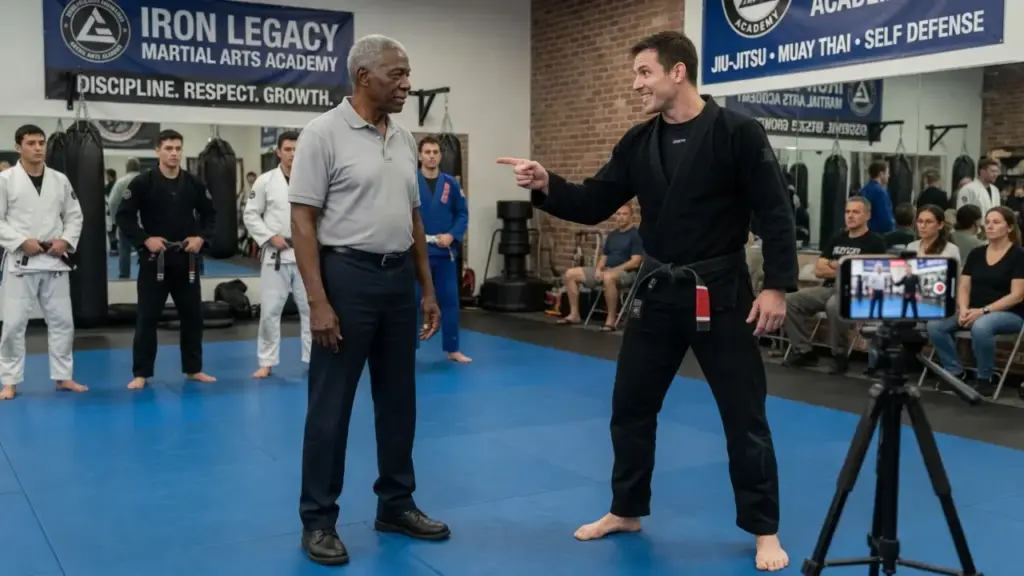
“That’s what I thought,” Trevor said, turning toward his audience. “Just another old—”
He never finished the sentence.
Trevor lunged forward to grab Elijah by both shoulders.
But Elijah was no longer where Trevor expected him to be.
The movement was so fast most people missed it. One moment Trevor was charging forward. The next, his right arm was controlled, his balance was gone, and his body was sailing toward the mat.
He hit face first with a heavy thud.
Before Trevor could understand what had happened, Elijah had one knee placed gently but firmly between his shoulder blades. Trevor’s arm was held behind him at an angle that made movement impossible without pain.
Elijah did not twist harder than necessary. He did not strike him. He did not humiliate him.
He simply held him there for three seconds.
Then he released him and stood.
The academy remained frozen.
Elijah looked around the room, meeting the shocked faces one by one.
Then he said, “Respect comes before combat.”
And he walked out.
In the parking lot, Jordan ran after him.
“Sir, wait.”
Elijah turned. The boy was breathing hard, his face flushed with fear and excitement.
“I just wanted to say thank you,” Jordan said. “Nobody’s ever stood up to Trevor like that.”
Elijah studied him. Jordan reminded him painfully of Marcus at that age, all nerves and heart, carrying more than he should.
“You don’t need to thank me,” Elijah said. “Go home. Stay out of trouble.”
“But you showed everyone he’s not—”
“Jordan,” Elijah said gently, but firmly. “Whatever happens next, keep your head down. Don’t make yourself a target.”
Inside the academy, Trevor’s voice exploded through the walls.
“He attacked me! That old man came in looking for a fight!”
Elijah shook his head and kept walking.
By the time he got home to his small apartment at Magnolia Arms, the video was already spreading online. A student had recorded everything clearly. The clip showed Trevor’s insults, the shove, the lunge, and Elijah’s controlled response.
At first, people praised Elijah.
Old Marine schools arrogant instructor.
Respect your elders.
That is real discipline.
But Dana Whitfield understood damage control. By Saturday morning, Ironway posted an official statement. Dana sat behind a polished desk, her voice calm and professional.
“An elderly man attended our academy and, without warning, attacked one of our certified instructors.”
Then she released edited security footage.
The clip began after Trevor had already shoved Elijah. It showed only the takedown. Without context, Elijah looked like the aggressor.
Trevor posted his own video from what looked like a hospital room. His wrist was bandaged. His eyes were red. His voice trembled.
“I was just doing my job,” he said. “He snapped. Not all veterans come home stable. I hope he gets the help he needs.”
Elijah watched the video with his daughter-in-law, Maya Brooks, sitting beside him on his couch.
Maya was a nurse. She had been married to Marcus. Since Marcus died, she had been the closest thing Elijah had to family. She wore wrinkled scrubs from a night shift and had worry written all over her face.
“He’s lying,” Elijah said.
“I know,” Maya said. “But people online don’t.”
The comments had already turned. Some called Elijah unstable. Dangerous. A violent veteran. A bitter old man looking for attention.
Maya took his hand.
“Dad, promise me you won’t respond. No interviews. No online arguments. Don’t get pulled deeper into this.”
Elijah stared at Marcus’s photograph on the dining table.
“What if staying quiet lets them win?”
“Then you stay safe,” Maya said. “And that matters more to me.”
That evening, Jordan knocked on Elijah’s door.
He stood in the hallway clutching a backpack like it contained something dangerous.
“I need to tell you what really happens at Ironway,” he whispered.
Inside the apartment, Jordan unzipped the backpack and pulled out folders, printed screenshots, injury photos, and notes he had been collecting for months.
“Trevor’s been hurting students,” Jordan said. “Not training them. Hurting them. Dana lets it happen because his livestreams bring attention.”
Maya leaned forward. “What kind of hurting?”
Jordan told them about Caleb Price, a fifteen-year-old who had been forced into a sparring demonstration he was not ready for. Trevor mocked him, shoved him into the drill, and threw him so hard his head struck the mat. Caleb vomited and passed out.
“Concussion,” Jordan said, his voice breaking. “The doctor said it could’ve killed him.”
Elijah’s face hardened.
“Why didn’t anyone report it?”
“They tried,” Jordan said. “Dana brought lawyers. Made the family sign papers. Paid medical bills in exchange for silence.”
There were others. Kyle Morrison. Sarah Woo. Kevin Murphy. Ruth Henderson, a woman in her seventies whom Trevor had mocked until she quit. Injured students. Humiliated seniors. Parents threatened with lawsuits if they complained.
Elijah listened without interrupting.
A part of him wanted to close the folder, close the door, and return to the quiet grief he knew how to survive. He was tired. His body ached. His hands had begun to tremble on bad mornings. He had spent three years avoiding purpose because purpose always seemed to lead back to loss.
But these were children.
Children who had trusted adults to protect them.
And adults had failed them.
“I’m not a crusader anymore,” Elijah said finally. “I’m too old and too tired to save the world.”
Jordan’s face fell.
“But I can gather facts,” Elijah continued. “I can ask questions. I can make sure the truth gets heard.”
Maya looked worried. “These people have already shown they’ll twist anything to protect themselves.”
“Then we make sure there’s nothing left to twist.”
Elijah opened an old Marine notebook and wrote down three names.
Trevor Vance.
Dana Whitfield.
Caleb Price.
On Sunday morning, Elijah and Jordan found Mrs. Price outside First Milbrook Baptist Church. She stood by her car in a neat but inexpensive dress, looking like a woman who had not slept well in months.





