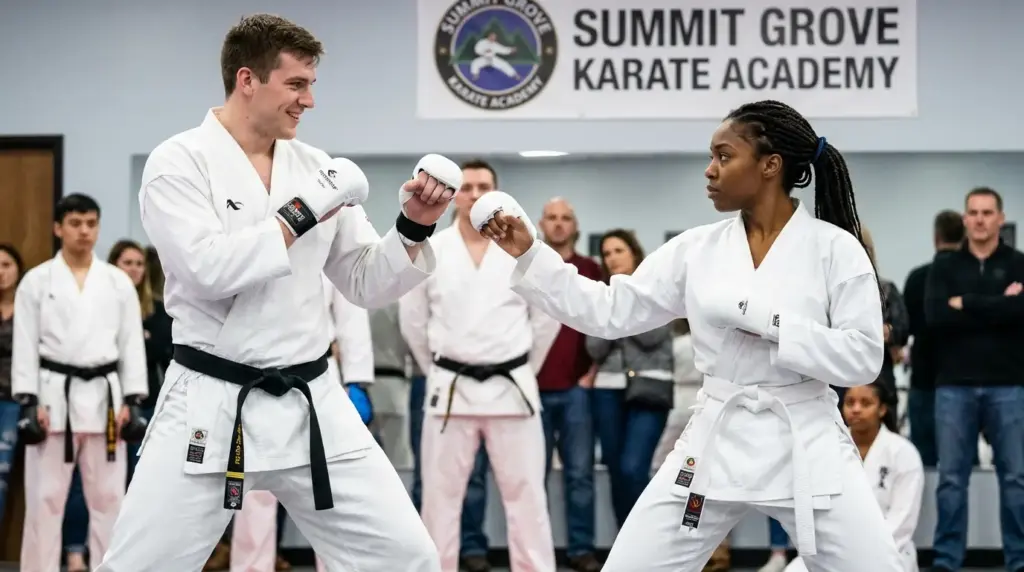
“I never said I was.”
Victor looked at the white belt.
Then at the registration tablet near the wall.
“Who gave you that?”
“The front desk.”
Victor called:
“Sarah?”
The receptionist looked guilty.
“She said she was new.”
Nadia shook her head.
“I said I was new here.”
Sarah closed her eyes.
“Oh.”
The room laughed.
Victor looked back at Nadia.
“Rank?”
She hesitated.
“Third dan.”
Silence.
Mason stared.
“Third-degree black belt?”
“Yes.”
Eric whispered:
“You told a third dan you’d go easy.”
Mason pointed.
“Quiet.”
More laughter.
Victor’s expression changed.
“Under who?”
Nadia answered:
“Sensei Monica Hayes.”
Victor stopped smiling.
“Chicago?”
“Yes.”
“Northline Karate?”
“Yes.”
Now Victor stared longer.
“Nadia Ellis?”
She sighed.
“That is still my name.”
Victor laughed.
Not mockingly.
In disbelief.
Mason looked between them.
“What?”
Victor turned toward him.
“You seriously don’t know?”
“No.”
Victor looked at Nadia.
“Can I say it?”
Nadia glanced around the dojo.
Then nodded.
“Apparently we’re doing this now.”
Victor looked toward Mason.
“Three-time Midwest kumite champion.”
Mason’s smile disappeared.
Victor continued:
“National senior bronze medalist.”
Nadia corrected immediately.
“Once.”
“Two national top-eight finishes.”
“Yes.”
“Pan-American team trials?”
“Alternate.”
Mason stared.
“You competed internationally?”
“Not really.”
Victor laughed.
“You made the national pool.”
“Briefly.”
Mason looked down at the white belt.
Then back at her.
“How long ago?”
“Last serious tournament was seven years ago.”
“Why’d you stop?”
Nadia’s expression changed.
The question reached somewhere the room had no right to follow.
Mason saw it.
“Sorry.”
She nodded.
“No problem.”
Victor looked at the white belt again.
“Take that off.”
Nadia smiled.
“No.”
Everyone stared.
Victor laughed.
“Nadia.”
“I’m keeping it tonight.”
“Why?”
She looked toward the beginners.
“Because this is the class I joined.”
Victor understood.
Mason did too.
Partly.
Nadia continued:
“I haven’t trained consistently in years.”
“My rank didn’t disappear.”
“My conditioning did.”
Someone laughed.
She smiled.
“My timing is rusty.”
“My knee is older.”
“My lungs have betrayed me.”
More laughter.
“And I wanted to see how your beginner class worked before anybody treated me like a black belt.”
Victor’s expression became serious.
“Fair.”
Mason looked at her.
“So that move…”
“What about it?”
“You knew what I was going to do.”
“No.”
“Come on.”
“I knew what you were likely to do.”
“That’s different.”
Mason smiled.
“Not much.”
Nadia shook her head.
“Very much.”
She pointed toward him.
“You’re faster than I am.”
“Bigger.”
“Current.”
“You compete.”
“If I assume I know exactly what you’re going to do, I eventually get hit.”
Mason looked at the floor.
Good answer.
Victor clapped once.
“Class is over.”
People bowed out.
Nobody wanted to leave.
Of course.
The dojo’s best active black belt had told a quiet white belt he would go easy.
Then one movement made him step backward.
The interesting part was not that Nadia had once been elite.
The interesting part was what Mason did next.
He did not ask for revenge.
He did not raise the pace.
He did not demand a full-contact round.
He simply looked at Nadia and said:
“One normal kumite round sometime?”
Nadia thought.
“Maybe.”
“What does maybe mean?”
“It means not tonight.”
Mason nodded.
“Okay.”
That mattered more than the step.
No pressure.
No:
Scared?
No:
Come on.
No:
Just for fun.
A question.
An answer.
Complete.
Nadia Ellis had been nine years old when she first entered a karate dojo.
Not because she dreamed of competition.
Because her older brother Marcus had gotten suspended from school for fighting.
Their mother, Denise, decided he needed discipline.
She found a small Shotokan school in Cleveland.
Marcus lasted four months.
Nadia never left.
Her first instructor, Sensei Robert Allen, was seventy by the time Nadia became a teenager.
Old-school without being cruel.
Strict without confusing suffering with learning.
He taught her that karate began and ended with courtesy.
He meant it.
Not as decoration.
As mechanics.
“If you cannot control how you enter a room,” he would say, “you will not control what happens when pressure arrives.”
Nadia did not understand at nine.
She understood at thirty-six.
Competition came later.
At fourteen, she entered a small regional tournament.
Lost her first kumite match.
Three points to zero.
She cried in the car.
Denise drove.
For twenty minutes, neither spoke.
Then Nadia said:
“I’m terrible.”
Denise kept her eyes on the road.
“You competed terribly.”
Nadia frowned.
“Same thing.”
“No.”
“How?”
“One describes Saturday.”
“The other tries to describe Nadia.”
Silence.
Denise continued:
“Fix Saturday.”
“Leave Nadia alone.”
That sentence stayed.
Nadia competed again.
Lost again.
Then won.
Then lost.
Then started winning more often.
By seventeen, she was one of Ohio’s strongest junior kumite competitors.
Her advantage was not power.
She was rarely the strongest athlete in her division.
Timing.
Distance.
Reading shoulders.
Recognizing the instant someone committed weight forward.
At nineteen, she moved to Chicago for college.
Northline Karate became her new home.
Sensei Monica Hayes became her coach.
Monica was five-foot-four, Japanese American, terrifyingly calm, and allergic to excuses.
She looked at Nadia’s junior medals once.
Then pushed them back across the desk.
“Those belong to yesterday.”
Nadia stared.
“You don’t care?”
“I care that you earned them.”
“Then?”
“They cannot fight today.”
Good.
Nadia loved her immediately.
College years became competition years.
Regional championships.
National events.
Long drives.
Cheap hotels.
Ice packs.
Early mornings.
Bad airport food.
The glamorous life no one puts in highlight videos.
She won her first Midwest senior title at twenty-two.
Again at twenty-four.
Again at twenty-five.
At twenty-six, she took bronze at a national championship.
The medal mattered.
What mattered more was the semifinal she lost.
Her opponent, Rachel Kim, was faster that day.
Nadia spent six months thinking about one missed timing exchange.
Monica finally told her:
“You are trying to turn a point into a personality.”
Nadia knew the language.
Her mother had taught the same lesson years earlier.
“Fix Saturday.”
“Leave Nadia alone.”
She smiled.
Then trained.
At twenty-seven, she entered the Pan-American selection process.
Made alternate.
Never went.





