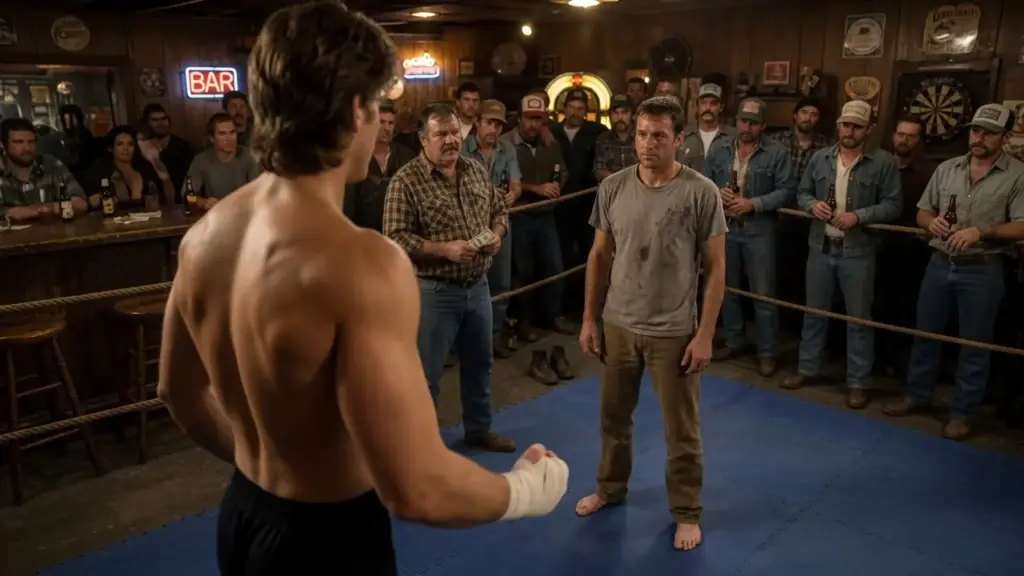
He wiped it away with the back of his taped hand, leaving a faint red streak across his knuckles. He didn’t look at the crowd anymore. The performance aspect of the fight had evaporated, replaced by a hot, ugly panic that he desperately tried to mask with rage. He had never been handled like that. He was used to guys who swung wild, guys who telegraphed their haymakers from the next zip code, guys who gassed out in 60 seconds.
Clayton wasn’t swinging. Clayton wasn’t even breathing hard. He just stood there, his shoulders hunched, his bare feet gripping the peeling duct tape, watching Trent’s hips with dull, tired eyes. “Lucky push,” Trent snarled, his voice tight. He stepped forward, abandoning the bouncy point karate stance.
He adopted a tight Muay Thai guard hands high, elbows tucked, intending to walk the farmer down and chop his legs out from under him. Trent advanced more carefully and attacked Clayton’s legs before following with a close-range strike. Clayton absorbed the first impact and barely avoided the second, the wrapped hand grazing his cheek. Trent kept pressing, too angry to notice that every exchange was costing him more control. The proximity brought the violent stench of Trent’s aerosol deodorant and fear sweat directly into Clayton’s nostrils.
It smelled sharp, metallic, and acidic. It smelled like every terrified young man Clayton had ever dragged out of a compound in Fallujah. The memory flashed hot and bright, the crunch of glass under combat boots, the static crackle of a radio earpiece, the heavy suffocating weight of ceramic plates against his chest. Clayton blinked forcing the desert out of his eyes, dragging himself back to the humid beer-soaked air of the Iron Horse Tavern. Trent seized the brief hesitation and dragged Clayton into a tight clinch.
A heavy knee struck Clayton’s ribs, sending a hot bolt of pain through his side and stealing his breath. The crowd roared, convinced the older man was finally breaking. Instead, the pain stripped away his fatigue and awakened the calm survival instincts he had spent years trying to bury. Clayton broke the clinch with a short, forceful movement, turned Trent off balance, and drove the contest to the mat before the younger man could attack again. Trent scrambled for the defensive positions he taught at his own gym, but Clayton did not engage in a technical exhibition.
He settled his weight, denied every escape, and controlled the younger man with exhausting pressure. Trent pushed, twisted, and bucked, reaching for the familiar movements he taught to paying students beneath bright lights. None of them created the space he needed. Clayton stayed low and patient, giving the younger man no opening and no dramatic target to strike. There was no performance in his expression, only the detached concentration of someone completing unpleasant work.
Trent’s breathing grew ragged. The anger that had carried him into the contest drained away, replaced by the frightening realization that strength and reputation were not helping him. Clayton worked into a firm restraint around the upper body and neck, applying it gradually rather than violently. The room fell silent as Trent’s movements slowed and panic replaced rage. Rusty stood frozen at the edge of the mat, a wet rag dangling from his hand, while the crowd that had demanded blood moments earlier refused to make a sound.
At last, Trent slapped the mat three times in surrender. Clayton released him immediately and shifted away, making it clear the contest was over. He didn’t jump up and pound his chest. He didn’t glare at the crowd. He slowly pushed himself off the younger man, rolling to the side and getting to his knees.
His breath was coming slightly faster now, catching sharply on the injured rib. He pressed a hand against his left side, his face tightening into a grimace of pure exhaustion. Trent rolled onto his side coughing violently. He drew several ragged breaths and curled onto his side, clutching his neck while tears of shock gathered at the corners of his eyes. He looked up at Clayton expecting a taunt, a sneer, a kick.
Clayton wasn’t even looking at him. He was looking at his work boots sitting neatly at the edge of the mat. Clayton stood up. A severe limp slowed his left leg as he walked over and picked up his socks. He sat on a nearby wooden stool methodically pulling the thick wool over his pale feet, then sliding his boots on.
He left the laces loose. Bending over hurt too much. The silence in the room was absolute. It was thick, heavy, and intensely uncomfortable. The men who had been shouting for violence a minute ago were now staring at the bottom of their beer bottles, suddenly very interested in peeling the labels.
They had come to watch a flashy show. They had just watched a man get dismantled with terrifying emotionless efficiency. It felt too real and too intimate. Rusty walked over his heavy boots thudding against the plywood floor. He extended a thick calloused hand holding five crumpled hundred-dollar bills.
Clayton took the money. The paper felt damp with Rusty’s sweat. He folded it neatly once and shoved it deep into the front pocket of his oil-stained Carhartts. “Good Lord, James,” Rusty muttered, his voice barely a whisper. “Where did you learn to move like that?” Clayton looked at the bartender.
The dull headache at the base of his skull was roaring back to life fueled by the receding adrenaline crash. His hands were beginning to tremble slightly, a physiological reaction he hated more than anything else. He gripped the edge of the stool to hide the shaking. “I just wanted to get back to my truck, Rusty,” Clayton said quietly. He stood up favoring his injured ribs and began the long walk to the door.





