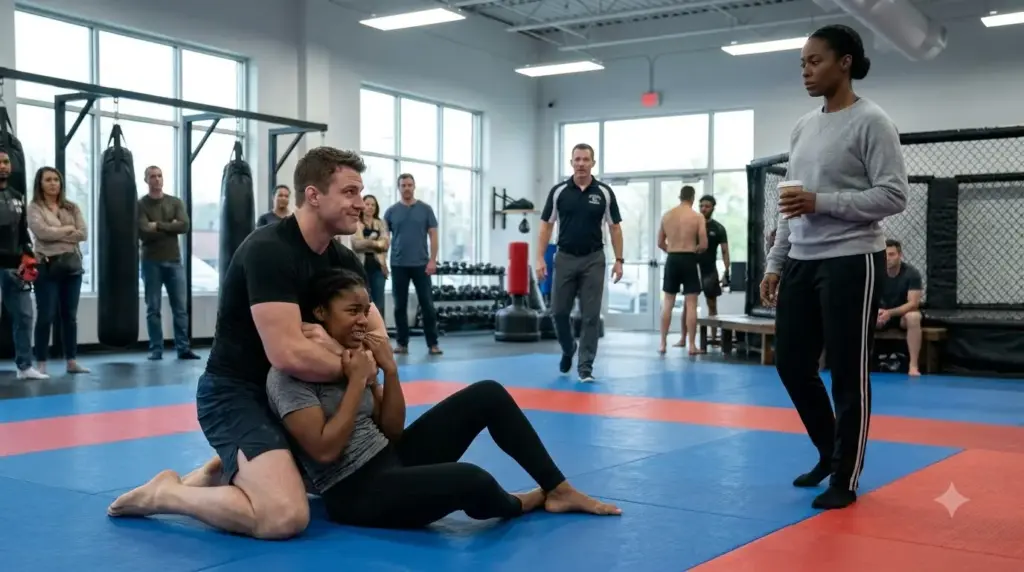
Nia sat on the bench with an ice pack wrapped in a towel.
Maren walked over.
“Throat?”
“Sore.”
“Swallow okay?”
“Yeah.”
“Vision?”
“Fine.”
“Headache?”
“No.”
Malik:
“Her parents are on the way.”
Daniel:
“I’m sending her to urgent care.”
Nia looked frustrated.
“I’m fine.”
Maren sat beside her.
“You can be fine and still get checked.”
Nia looked at her.
“You really think I was right to tap?”
The question made Daniel close his eyes.
Maren answered immediately.
“Yes.”
“I tapped fast.”
“Yes.”
“I could’ve fought hands more.”
“Maybe.”
Nia:
“So maybe I quit early.”
Maren’s voice sharpened, not loud.
“Stop.”
Nia blinked.
“You do not owe anyone extra seconds inside a choke to prove what kind of person you are.”
The room stayed quiet.
Maren continued:
“You felt something you didn’t want. You tapped. That was the agreement.”
Nia looked down.
“He said I panicked.”
“Maybe you did.”
Nia looked hurt.
Maren:
“Panic doesn’t cancel your right to stop.”
That changed something.
Nia nodded.
Daniel sat on the other side.
“I’m sorry.”
“For what?”
“I should’ve stopped it after first tap.”
Nia:
“It happened fast.”
“No.”
Daniel shook his head.
“That’s what coaches say when they don’t want responsibility. I saw it.”
Maren looked at him.
He understood.
No excuse.
Good.
Nia’s mother arrived twelve minutes later.
Her name was Rochelle Brooks.
Forty-one.
Black.
Emergency-room nurse.
She came through the door still wearing navy scrubs under a winter coat.
When she saw Nia holding ice to her throat, her face changed.
“What happened?”
He Ignored Her Tap and Kept the Choke Locked — Then a Quiet Woman Said, “Let Her Go.”
Daniel stood.
“My fault.”
Maren respected that answer.
Rochelle:
“Meaning?”
Daniel explained.
No minimizing.
No “briefly.”
No “miscommunication.”
Cole ignored multiple taps.
Daniel ended seminar.
They were recommending urgent care.
Rochelle looked at Nia.
“You breathe okay?”
“Yes.”
“Swallow?”
“Sore.”
“Any dizziness?”
“Earlier.”
Rochelle:
“We’re going.”
Nia:
“Mom.”
“No.”
Maren almost smiled.
Rochelle noticed her.
“Were you there?”
“Yes.”
“Nia said a woman told him let go.”
Maren:
“That was me.”
Rochelle held her gaze.
“Thank you.”
“You’re welcome.”
Nothing else.
No hero speech.
Rochelle took Nia.
At the door Nia turned.
“Maren?”
“Yes?”
“Are you coming back?”
Maren understood why she asked.
Not because she wanted instruction.
Because she wanted someone in the room who had said stop and meant it.
“Yes.”
“Okay.”
They left.
Daniel waited until the parking lot cleared.
Then he locked the front door.
Only staff remained:
Daniel.
Malik.
Maren.
Maren reached for her bag.
Daniel:
“Can we talk?”
She looked.
“I’m tired.”
“I know.”
“Then tomorrow.”
“Okay.”
No pressure.
She appreciated that.
Outside, snow had started.
Not enough to stick.
Maren sat in her car with the engine off.
Her hands still shook.
She stared at them.
She had spent twelve years making sure she never again became the person a room turned toward when someone needed to be physically stopped.
That life had been loud.
Cameras.
Crowds.
Corners.
Promoters.
She had chosen quiet.
Tonight, quiet had spoken anyway.
And the worst part was not that Cole Mercer had challenged her.
The worst part was that for one second, when he stepped toward her, some old piece of her had wanted him to keep coming.
Maren hated that piece.
She started the car.
Her phone buzzed.
Unknown number.
She almost ignored.
Text:
This is Rochelle, Nia’s mom. Daniel gave me your number with permission. Doctor says mild throat strain, no airway injury. Thank you again.
Maren typed:
Glad she’s okay.
Then another message.
Nia wants me to ask if you are a coach.
Maren stared.
She typed:
Sometimes.
Three dots appeared.
Then:
She says that means yes.
Maren smiled despite herself.
At home, she left her training bag by the door.
Her apartment was small, clean, and intentionally boring.
No medals on walls.
No framed posters.
No gloves displayed.
The only photograph from her old career sat inside a kitchen drawer beneath spare batteries.
She kept it there because throwing it away had felt dishonest.
Displaying it had felt worse.
Maren poured water.
Her older sister, Valerie, called.
“You sound weird.”
“I said hello.”
“You have different hellos.”
Maren sat.
Valerie was forty-eight, lived two hours away, and had been the only family member who followed Maren through every stage of her combat career without ever pretending to understand why she loved it.
“What happened?”
“Gym issue.”
“Your gym?”
“The one I train at.”
“You have a gym now?”
“Sometimes.”
“Okay, secret agent.”
Maren sighed.
“A guest ignored a kid’s tap.”
Silence.
“How old?”
“Sixteen.”
“You did what?”
“Told him release.”
“And?”
“He did.”
Valerie:
“That’s all?”
“No.”
“I knew.”
Maren told enough.
Not Cole’s name.
Not details that would make Valerie search.
Valerie:
“You fought him?”
“No.”
“Good.”
Maren:
“Why good?”
“Because your voice changed when you said he stepped toward you.”
Maren leaned back.
“I didn’t do anything.”
“I know.”
“That’s good.”
“Yes.”
Maren rubbed her face.
“I hate that part of me still wakes up.”
Valerie:
“Part of you trained twenty years to wake up.”
“Twelve.”
“Whatever. You know what I mean.”
Maren:
“I don’t want that life.”
“You didn’t go back.”
“I wanted to.”
“For a second.”
“Enough.”
Valerie:
“Wanting isn’t doing.”
Maren looked toward the kitchen drawer.
“People might find out.”
“About you?”
“Yes.”
“Eventually.”
“I don’t want.”
Valerie:
“Then don’t tell.”
“It’s internet.”
“Then let internet be annoying.”
Simple.
Maren:
“You make everything sound easy.”
“No. I make phone call short because I have soup.”
Maren laughed.
“Good night.”
“Call tomorrow.”
They hung up.
Maren opened the drawer.
The photograph showed her at thirty.
Shorter hair.
Red gloves.
A championship belt over one shoulder.
Her left eyebrow cut.
Beside her stood Coach Everett Shaw, already gray then, smiling wider than she was.
On the back, in Valerie’s handwriting:
ATLANTIC CROWN TITLE — 2012.
Maren put it back.
She had not retired because she stopped loving fighting.
That would have been easier.





