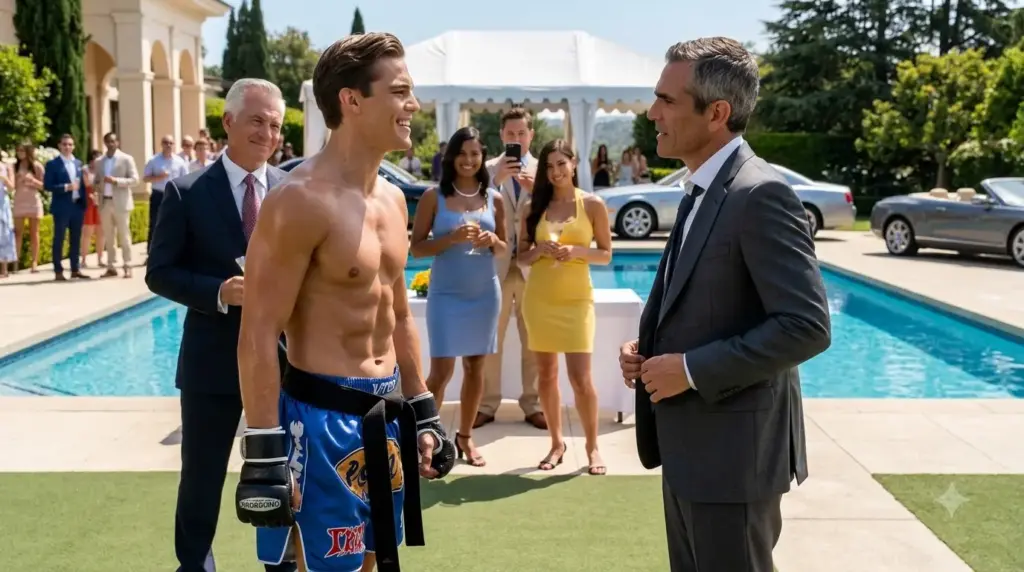
He was twenty-two, drove a matte black Porsche bought with his father’s money, and genuinely believed the black belt around his waist made him dangerous.
He cornered me near the catering tent with a grin on his face and a crowd behind him.
He wanted to break the quiet, graying driver in front of his friends.
He did not know I had spent twelve years in the teams.
He did not know violence was not a sport to me.
It was a language I had spent half my life trying to forget.
My name was Jack Hayes, though to the Cole family, I was usually just “the driver.”
Officially, my job title was executive protection and logistics. In reality, I drove Richard Cole’s armored Mercedes Maybach, opened doors, carried bags, watched exits, and stayed quiet while billionaires treated the world like a board game.
Richard Cole had made his fortune buying distressed industrial properties, stripping them down, and selling the pieces for more than the whole. He was cold, brilliant, and efficient. Everyone around him was either a tool, an obstacle, or an audience.
I was a tool.
A quiet one.
A useful one.
And that suited me perfectly.
The leather seat of Richard’s Maybach always smelled like expensive cologne and sterile recycled air. I sat behind the wheel most days with the engine idling, eyes on mirrors, hands calm, voice flat.
“Jack,” Richard’s voice came through the intercom one rainy night.
“Yes, Mr. Cole.”
“We’re going to be late for the merger dinner. Find a way around this.”
“Traffic is deadlocked on the FDR, sir. Accident ahead. I’ll cut through the surface streets.”
I slipped the massive vehicle through a closing gap between a delivery truck and a cab with barely an inch to spare. No sudden acceleration. No sharp braking. No drama.
Smooth meant invisible.
Invisible was what I wanted.
Five years earlier, I had not been invisible.
I had been leading a six-man element through dark, dusty corridors in Helmand Province. Night vision turned the world into a grainy green nightmare. I carried a suppressed rifle, wore armor, and moved through danger with men who trusted me to read a room before anyone in it knew we were there.
I spent twelve years as a Navy SEAL.
I had the ruined knee and the ringing in my left ear to prove it.
But mostly, I had the quiet.
The deep, heavy quiet that settles inside a man after he spends his adult life balancing on the edge of survival, then gets thrown back into a civilian world where people scream over parking spaces and lukewarm coffee.
I took the job with Richard Cole because it paid well. Better than well.
I needed the money.
My daughter, Sarah, lived with her mother in Connecticut. She was nine years old and had been born with a congenital heart defect. Most of the major surgeries were behind her, but the therapy, medication, specialist visits, and out-of-pocket care never stopped.
Richard Cole’s money helped my little girl breathe easier.
So I wore the cheap black suit.
I endured the condescension.
I stayed invisible.
We reached the Cole estate in Greenwich just after ten that night. The house was a monstrosity of glass, imported stone, and cold lighting, the kind of place that looked expensive before it looked like a home.
I opened Richard’s rear door.
Before he stepped out, the front doors swung open and Tyler Cole came outside.
Tyler was twenty-two, thickly built, and rich in the way that makes a person mistake attention for respect. He had his father’s jawline but none of the older man’s intelligence. Tyler was all entitlement, protein powder, designer aggression, and the kind of confidence that comes from never being corrected by anyone who could afford to offend you.
He wore a customized rash guard and fight shorts, sweat shining on his neck. He bounced lightly on his toes and threw shadow punches into the damp night air.
“Dad,” Tyler said, barely glancing at me. “You missed it. Tapped out my striking coach three times today. Guy couldn’t handle my ground game.”
Richard patted his son’s shoulder with rare warmth.
“Good work, Ty. Keep it up. It builds discipline.”
Tyler stopped shadow boxing and looked at me.
I am not a small man. Six-two, two hundred ten pounds. But I do not look like a bodybuilder. Real muscle, the kind built by carrying weight up mountains and dragging men through dust, does not always announce itself through a suit.
It just sits there.
Dense.
Quiet.
“Hey, driver,” Tyler said. He never called me Jack unless he wanted to make something personal. “You look stiff. You should get on the mats with me sometime. Loosen up those old joints.”
“I’m fine, thanks.”
“Suit yourself,” he said with a smirk. “Wouldn’t want you pulling a hamstring carrying groceries.”
His father chuckled.
I closed the car door and stood in the driveway as the rain slowed to mist.
My thumb pressed against the steering wheel later, feeling the old callus on my knuckle.
Just breathe.
Sarah’s medical bills.
The mortgage.
The quiet life.
Breathe.
Over the next three months, Tyler’s obsession with martial arts became his entire identity.
He had passed a black belt test at a high-end MMA gym in Manhattan, the kind of place where wealthy men choked each other on lunch breaks and went back to pretending they understood violence.
Tyler thought it made him lethal.
His behavior shifted around the estate. He blocked hallways when maids tried to pass. He squeezed the landscaper’s hand too hard during greetings. He bumped shoulders with staff like every room was a dominance drill.
Then he focused on me.
At first, it was small.
An intentional shoulder check in the kitchen. A shove disguised as an accident near the garage. A comment here, a smirk there.
The first time he bumped me hard, my body reacted before my thoughts did. My center of gravity dropped. My right foot shifted half an inch. My hands stayed low, but my forearms hardened.





