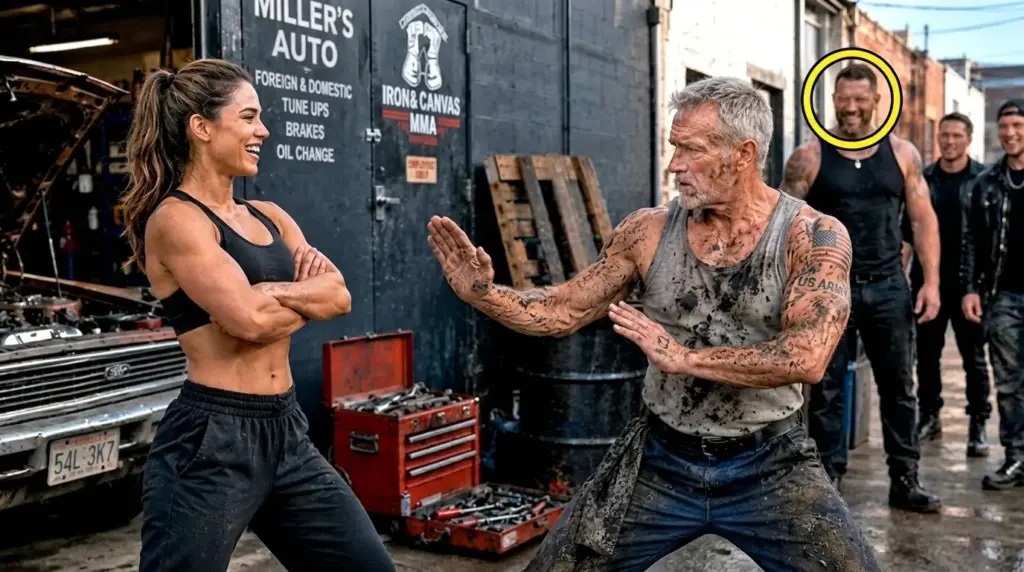
She found herself spending her evenings sitting on the stack of old tires in Arthur’s garage. It wasn’t a sudden cinematic friendship. Arthur remained gruff, quiet, and largely uncommunicative. He didn’t offer advice. He explicitly refused her repeated requests to show her the stance he used in the alley. “I’m a mechanic,” he would say, handing her a wrench to hold while he slid under a chassis on his creeper board. “I fix brakes. I don’t teach people how to break necks.”
But he stopped chasing her away. He let her buy the terrible bodega coffee. He let her sit in the damp freezing garage and watch him work. And slowly, in fragments and half-sentences dropped between the clatter of tools, the picture of the man began to form.
It was a Tuesday night. The sleet was hammering against the tin roof of the garage, a deafening metallic drumbeat. Arthur had finally fired up a small kerosene space heater, and the two of them were huddled near it, nursing their cups. “1989,” Arthur said suddenly. Chloe looked up. They hadn’t spoken in twenty minutes. “Panama,” he continued, staring into the bright orange coils of the heater. “Operation Just Cause. That was the first time.”
Chloe stayed perfectly still, terrified that if she moved, he would stop talking. She didn’t press. She just listened. “People watch movies,” Arthur said, his voice dropping to a low rumble to undercut the sound of the sleet. “They think it’s all slow motion, heroic music, guys screaming and charging machine-gun nests. It’s not. It’s just chaos. It’s deafeningly loud and then it’s terrifyingly quiet and it smells like copper and voided bowels.”
He took a slow sip of his coffee. His hands, usually so steady with a wrench, had a microscopic tremor to them. “We were clearing an airfield. We pushed into a hangar. Dark. Sweeping the corners. A kid. Couldn’t have been more than nineteen, maybe twenty, stepped out from behind a stack of crates. He had an AK-47. He didn’t even have it raised. He was just holding it across his chest. Frozen. Shaking.”
Arthur closed his eyes. The deep creases around his mouth tightened. “My training took over. It’s a physiological response. Muscle memory bypassing the brain. My rifle came up. Two rounds to the chest, one to the head. Less than a second. He dropped like a sack of wet cement.” Chloe felt a chill that had nothing to do with the drafty garage.
“We secured the hangar,” Arthur said, opening his eyes. They were devoid of any light. “I walked over to the kid. He was wearing canvas sneakers. They had holes in the toes. He had a picture of a girl tucked into the webbing of his vest. She had dark hair. Smiling.” Arthur rubbed his right shoulder, right over the spot where Chloe knew the faded SEAL trident was inked into his skin.
“I killed him,” Arthur said flatly. “I did exactly what I was trained to do. I executed a flawless tactical maneuver. I saved my own life and maybe the lives of the guys behind me. And it broke me.” He looked at Chloe and for the first time, she saw the sheer weight of the ghost he dragged around with his bad leg.
“I came home and they gave me medals. They patted me on the back and called me a warrior. But every time I closed my eyes, I saw those canvas sneakers with the holes in the toes. I realized that the kid and I, we were just two terrified animals in a dark room. And I was just a slightly faster animal. There was no glory in it. It was just sad. Just a miserable, tragic waste of human life.”
Chloe swallowed hard. Her throat felt tight. “Is that why you limped away? Why you hide here?” “I don’t hide,” Arthur corrected her softly. “I retired. I spent fifteen years breaking things. Breaking doors. Breaking governments. Breaking people. The military builds you into a hammer, Chloe. And when you’re a hammer, you start looking for nails.”
He looked around the dirty, cluttered garage. He looked at the rusted cars waiting for salvation. “I wanted to fix things. For the rest of my life, I just wanted to put broken pieces back together. A car is honest. If a car doesn’t start, there’s a mechanical reason. You trace the wire. You replace the spark plug. You turn the key and the engine catches. It makes sense. It’s predictable. It’s safe.”
Chloe looked down at her hands. The calluses on her knuckles built from years of punching heavy bags suddenly felt incredibly childish. “In the alley,” Chloe said, her voice barely a whisper. “You didn’t look broken. You looked perfect.” “That’s the curse,” Arthur said bitterly. He tossed the rest of his coffee into a nearby drain grate. “You never unlearn it. The nervous system never forgets how to kill. Those three idiots pushed and pushed. They threatened you. And for two seconds, I let the hammer out of the box.”
He leaned forward, locking eyes with her. “And I hated every millisecond of it. I felt the cartilage in that boy’s nose shatter against my palm, and it made me sick to my stomach. I’m going to pay for that for months. In nightmares. In the shakes.” He reached out and tapped the sleeve of her heavy winter coat. “You love the mat, Chloe, because it’s a game. It’s a test of wills. Keep it a game. Be proud of your belts. Win your plastic trophies. But never ever mistake what you do in that cage for what happens in the dark.”
If you ever find yourself in a situation where the rules are gone, where the referee isn’t there, he paused, the silence stretching out against the drumbeat of the sleet. “Run,” he said. “Run as fast as you can. Because even if you win, you lose.”





