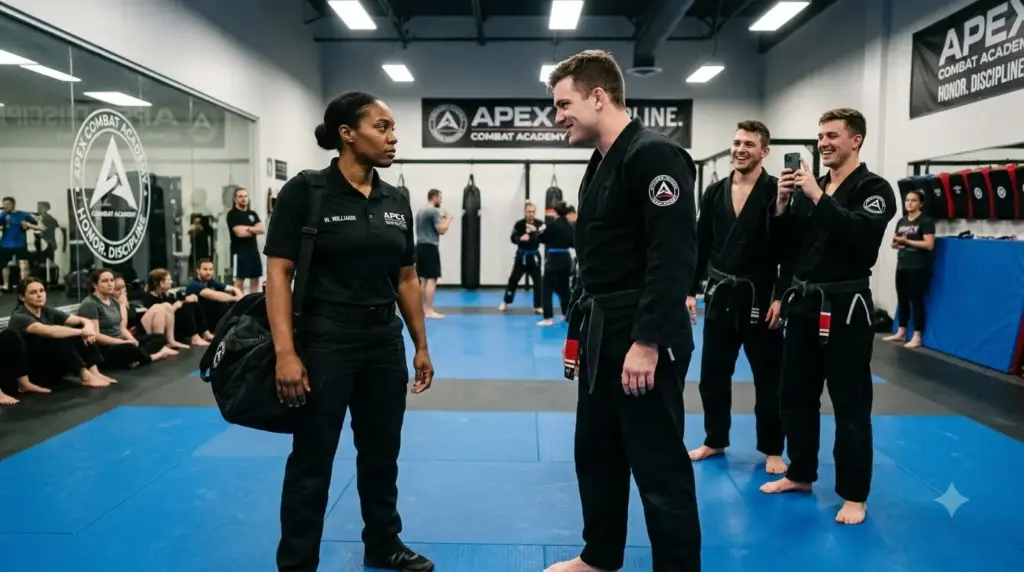
“You’re not easy.”
Leah smiled.
“Useful discovery.”
Mason laughed.
Blake turned.
“You go.”
Mason’s face changed.
“No.”
The room laughed.
Daniel looked at him.
“You called her easy too.”
“I said nothing.”
Trevor pointed.
“You absolutely did.”
Mason looked at Leah.
She shrugged.
“You can say no.”
That line landed.
He heard the mirror.
Mason smiled reluctantly.
“One round.”
Leah said,
“No.”
Everyone laughed harder.
Mason stared.
“What?”
“I did one.”
“But—”
Leah picked up her cup.
“I’m tired.”
Mason looked at Daniel.
Daniel folded his arms.
“She said no.”
Simple.
No debate.
Mason nodded.
“Fair.”
That moment ended the joke.
Or should have.
But curiosity spread.
Students asked Daniel who Leah was.
He refused.
“Ask her.”
Most did not.
Because the way she carried herself after the round made the answer less important.
Blake did ask.
Later.
Near the lockers.
“Seriously, where’d you train?”
Leah was putting on her shoes.
“Benton Boxing first.”
His eyes widened.
“The old place on Fifth?”
“Yes.”
“Coach Reggie Benton?”
“Yes.”
Blake knew the name.
Everyone serious in the region did.
Reggie Benton trained boxers for four decades.
Then Leah continued.
“Karate with Ellen Park.”
Blake stared.
“Ellen Park?”
“Yes.”
“National team Ellen Park?”
“The same.”
“And judo?”
Leah looked at him.
“Why judo?”
“The wrist thing.”
She smiled.
“My husband.”
Blake paused.
“Your husband trains?”
“Trained.”
Past tense.
Something in her voice stopped the next question.
He waited.
Leah appreciated that.
Then she said,
“David was a judo coach.”
Blake nodded.
“Still?”
“No.”
She tied the other shoe.
“He died seven years ago.”
Blake’s face changed.
“I’m sorry.”
“Thank you.”
Silence.
Leah stood.
Blake looked awkward.
Then said,
“I really did think you were new.”
“I know.”
“Because you didn’t have a belt.”
“I know.”
“And you were helping beginners.”
“I know.”
He laughed.
“You’re making this worse.”
Leah smiled.
“I’m not doing anything.”
He looked down.
Then said,
“I guess I decided beginners do that.”
“Do what?”
“Stand at the edge.”
“Help.”
“Stay quiet.”
Leah nodded.
“That is how assumptions work.”
He exhaled.
“Coach told us not to underestimate you.”
“Yes.”
“I thought he was messing with us.”
“He enjoys that.”
“Who were you?”
Leah stared.
“What do you mean?”
“Competition.”
She understood.
“Midwest kickboxing circuit.”
“How good?”
Leah smiled.
“There it is.”
“What?”
“Need the résumé.”
Blake laughed.
“Curiosity.”
“Fine.”
She thought.
“Three state titles.”
His eyes widened.
“One national silver.”
He stared.
“Seriously?”
“Yes.”
“When?”
“Long time ago.”
“Why stop?”
Leah looked toward the mat.
“Life.”
He waited.
She continued.
“Injury first.”
“Then David got sick.”
Blake said nothing.
“Then Caleb was nine.”
“Then work.”
“Then I woke up one day and realized six years had passed.”
Blake nodded.
“That why you don’t train publicly?”
“Partly.”
“What else?”
Leah smiled faintly.
“I got tired of rooms where everybody needs proof.”
That stayed with him.
Daniel found Leah after open training.
“You okay?”
“My ankle hates you.”
“I did nothing.”
“You invited me.”
“True.”
She looked toward Blake.
“He apologized.”
Daniel smiled.
“Good.”
“You warned them.”
“Yes.”
“Why not tell them?”
“Tell them what?”
“Who I was.”
Daniel looked at her.
“Because that would make your résumé the reason to respect you.”
Leah stared.
Then nodded.
“Good answer.”
“I have those occasionally.”
She smiled.
Then became serious.
“Your team has a problem.”
Daniel sighed.
“I know.”
“Blake isn’t the whole problem.”
“I know.”
“They perform for each other.”
“Yes.”
“They treat uncertainty like weakness.”
“Yes.”
Leah looked at him.
“How long have you known?”
“Too long.”
That answer disappointed her.
Daniel continued.
“I kept thinking competition would mature them.”
Leah laughed softly.
“Competition magnifies what’s already there.”
“I know.”
“So?”
He looked across the gym.
“Help me.”
“No.”
Daniel laughed.
“I knew that was coming.”
“You coach them.”
“I do.”
“Then coach.”
He nodded.
Fair.
Before Leah left that afternoon, Daniel asked one more question.
“Why did you really stop training in public?”
She looked at him.
“I told Blake.”
“You told Blake the short version.”
She sighed.
“Because you’re nosy.”
“Yes.”
They sat on the edge of the mat.
The gym was nearly empty now.
Only the hum of the ventilation system.
A vacuum in the lobby.
Someone laughing downstairs.
Leah looked at the old scar near her ankle.
“My injury wasn’t the reason.”
Daniel waited.
“I tore two ligaments.”
“I remember.”
“You visited.”
“You were horrible company.”
“I was on pain medication.”
“You were still horrible.”
She smiled.
Then became serious.
“The real reason was after.”
Daniel listened.
Leah had returned to competition too fast.
Not medically reckless.
Emotionally reckless.
She had spent ten months in rehabilitation.
Lost speed.
Lost confidence.
Gained fear she did not know how to admit.
Her first tournament back, she won two rounds.
Lost the third.
Nothing dramatic.
But afterward, one of her coaches said,
“You’re not the same fighter.”
He meant technique.
Maybe.
Leah heard identity.
She trained harder.
Too hard.
Every session became proof.
Every round a test.
Every younger woman with speed became a threat to the version of herself she was trying to preserve.
David noticed first.
Her husband had been a judo coach.
Calm.
Patient.
The kind of man who could watch someone fail a throw twenty times without changing tone.
One night, Leah came home after sparring with bruised ribs and a swollen ankle.
David looked at her.
“Did you win?”
She stared.
“What?”
“Whatever you were trying to win.”
She became angry.
“I was training.”
“No.”
He shook his head.
“You were negotiating with the past.”
She hated him for saying it.
For about three days.
Then understood.
Leah looked at Daniel now.
“I thought if I stopped competing, everybody would know the injury changed me.”
Daniel said nothing.
“So I kept going.”
She laughed softly.
“Which meant the injury changed everything.”
“What made you stop?”
“David.”
“What did he do?”
“Nothing.”
Daniel frowned.
Leah continued.
“He stopped coming to watch.”
That surprised him.
“He said he couldn’t sit there and watch me punish myself because I thought toughness meant refusing to become different.”
Daniel looked down.
Leah continued.
“I was furious.”
“Then I retired.”
“Just like that?”
“No.”
She smiled.
“I spent six months pretending it was temporary.”
Daniel laughed.
“Then?”
“Then I realized I slept better.”
“My ankle hurt less.”
“I ate like a normal person.”
“I had weekends.”
She looked toward the empty mat.
“I started liking martial arts again.”
Daniel nodded.
“That why you still train alone?”
“Partly.”
“What’s the other part?”
Leah hesitated.
“David died.”
Daniel’s expression softened.
“I know.”
“After that, public gyms felt…”
She searched.
“Too loud.”
He understood.
David died from an aneurysm.
Sudden.
No warning.
He left for work.
Never came home.
For months, Leah could not tolerate the sound of mats slapping.
People shouting.
Timers.
Gloves hitting pads.
Everything felt offensively alive.
So she trained at home.
Quiet.
No timer.
No crowd.
Sometimes no music.
Just movement.
Daniel said,
“You know this place can be quiet.”
Leah smiled.
“No gym full of black belts is quiet.”
“Fair.”
She stood.
Daniel asked,
“Will you come back?”
“No.”
He nodded.
“See you Thursday.”
She laughed.
“Manipulative.”
“Effective.”
That conversation explained something Daniel had misunderstood for years.
Leah was not hiding from martial arts.
She had simply changed her relationship to it.
There was a difference.
The lesson mattered later when one of his own black belts nearly quit.
Trevor Lane injured his shoulder during tournament camp.
Not severe.
Rotator cuff strain.
Six weeks reduced training.
He hated every day.
When he returned, his timing felt wrong.
His right hand slowed.
He lost confidence defending kicks on that side.
After one bad session, he threw his gloves into his bag.
“I’m done.”
Daniel looked at him.
“With today?”
“With competition.”
“Okay.”
Trevor stared.
“That’s it?”
“What do you want?”
“I don’t know.”
“An argument?”
“Maybe.”
Daniel shrugged.
“Your life.”
Trevor looked angry.
“You don’t care?”
“I care.”
“Then?”
Daniel thought about Leah.
Then said,
“I don’t know whether quitting competition is fear or wisdom.”
Trevor became quiet.
“Only you know.”
That irritated him more.
Good.
Two days later, Trevor called Leah.
Daniel had given him her number with permission.
Trevor said,
“Coach says you know about coming back after injury.”
Leah laughed.
“Coach is lazy.”
“Probably.”
“What happened?”
He explained.
Leah listened.
Then asked,
“If you never competed again, would you still train?”
Trevor paused.
“Yes.”
“Good.”





