Not because these were dramatic injuries.
Because they were ordinary.
Small humiliations.
Small abuses of rank.
Small moments where people had been taught that discomfort was the price of belonging.
Claire had seen this before.
Too many times.
A martial arts school rarely becomes unsafe all at once.
It becomes unsafe by inches.
A joke excused.
A tap ignored.
A beginner embarrassed.
A coach choosing private correction because public correction feels uncomfortable.
A senior student allowed to confuse fear with respect.
And then one day, a child quits.
A woman stops coming.
A white belt disappears.
A parent says, “Maybe this just isn’t for us.”
But it was for them.
The room simply failed to deserve them.
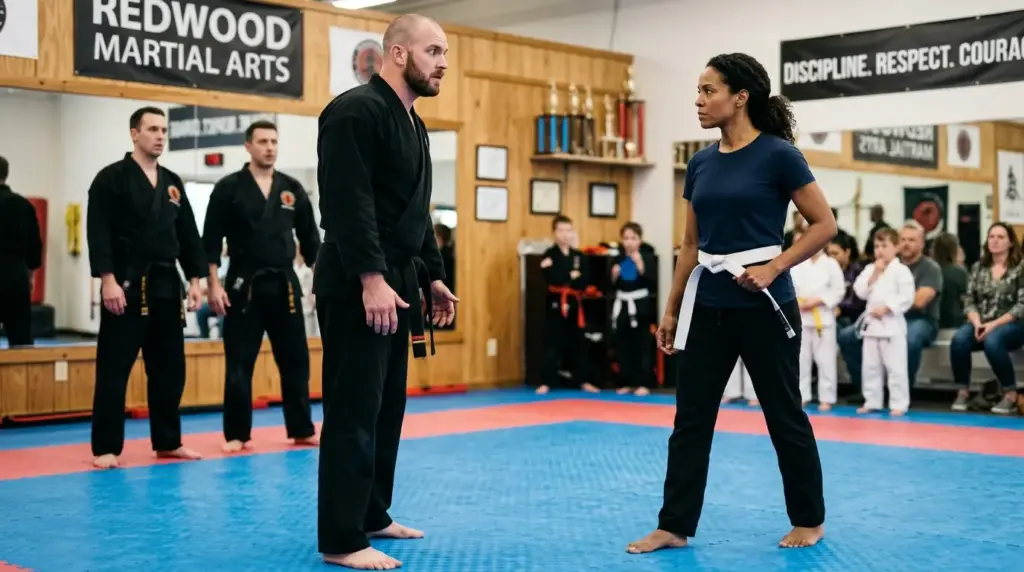
Coach Park stood in the center of the mat, face pale.
He looked at the wall motto.
DISCIPLINE. RESPECT. COURAGE.
Then he turned back to the students.
“I owe this room an apology.”
Ryan started to speak.
Coach Park lifted a hand.
“No.”
Ryan stopped.
Coach Park’s voice shook once, then steadied.
“I built this school to teach discipline, respect, and courage. But I allowed skill to become status, and status to become permission. I corrected privately what harmed people publicly. That was wrong.”
Dana’s eyes filled.
Coach Park faced Ryan, Mason, and Tyler.
“Effective immediately, all three of you are suspended from sparring, teaching, and demonstrations pending review.”
Ryan stared.
“All three?”
“Yes.”
Mason scoffed.
“Because she embarrassed us?”
Coach Park turned to him.
“Because students are telling me they do not feel safe around you.”
Mason said nothing.
Coach Park continued.
“You will each meet with me individually. You will listen to the complaints. You will apologize where appropriate. You will not approach anyone who does not want to speak to you. You will not retaliate through jokes, cold shoulders, or social pressure.”
Tyler swallowed.
“And if we don’t?”
Coach Park’s voice became very quiet.
“Then you will not train here.”
That sentence changed the school more than the demonstration had.
Because this was the first time the room heard the owner choose safety over rank.
Claire watched the students’ faces.
Some relieved.
Some shocked.
Some uncertain.
Change always frightens people, even when it is necessary.
Ryan pulled at his belt.
“So that’s it? Years here and I’m suddenly the villain?”
Claire answered before Coach Park did.
“No.”
Ryan looked at her.
“That would make this too easy,” she said. “A villain is something people can point at and feel innocent. You are not the only problem. You are the loudest symptom.”
The room went still.
Claire looked around.
“The laughter was part of it. The silence was part of it. The coaching delay was part of it. The parents who felt uneasy and said nothing because they did not know if they were allowed. The students who watched someone get embarrassed and looked away because they were relieved it was not them.”
Her gaze returned to Ryan.
“You did harm. But the room protected the harm. That means the room has to change.”
No one spoke.
Then Eli raised his hand again.
“What happens now?”
Coach Park looked at Claire.
She shook her head slightly.
This was his school.
His responsibility.
He turned back to Eli.
“Now we rebuild the rules.”
That night, open mat ended early.
No one complained.
Students stayed in clusters, talking quietly. Parents approached Coach Park. Some were angry. Some grateful. Some both.
Claire sat near the front desk tying her shoes when a girl approached.
She was eleven, thin, with curly dark hair and a lavender hoodie.
Claire recognized her immediately from her sister’s photos.
“Sophie,” Claire said softly.
The girl looked surprised.
“Mom said you might come.”
“I did.”
Sophie glanced toward the mat.
“Did you fight them because of me?”
Claire considered the question carefully.
Children deserve answers that do not make them responsible for adult choices.
“No,” she said. “I faced them because adults should not let rooms become unsafe. What happened to you helped me see the room clearly.”
Sophie looked down.
“Ryan said I was too dramatic when I cried.”
Claire’s face softened.
“What happened?”
“He made me spar Mason. Mason kept pushing me down. I said I wanted to stop. Ryan told me I had to learn pressure if I wanted a real belt.”
Claire looked across the room at Coach Park, who was listening to a parent with his shoulders heavy.
Then she turned back to Sophie.
“You were allowed to stop.”
Sophie’s eyes filled.
“I didn’t feel allowed.”
“I know.”
“Am I weak?”
“No.”
“Then why did I cry?”
Claire leaned forward.
“Because your body told the truth before the room did.”
Sophie stood very still.
That sentence entered her quietly.
Claire continued.
“You can cry and still be brave. You can stop and still belong. You can leave a room and still love martial arts.”
Sophie wiped her eyes with her sleeve.
“Will it be different now?”
Claire looked at Coach Park.
Then at Dana.
Then at the students still talking along the mat.
“It has a chance to be.”
The next week was ugly.
Real change often is.
Ryan did not return.
Mason returned angry and left angrier.
Tyler sent a long email explaining that everyone had misunderstood his humor.
Coach Park did not accept the explanation.
Three families withdrew because they believed the school had become too sensitive.
Five former students emailed Coach Park to say they wished the changes had happened earlier.
Two came back.
That mattered more than the three who left.
Coach Park removed Ryan, Mason, and Tyler’s photos from the instructor board while the review was ongoing. He did not remove their tournament photos from the history wall. The past had happened. Hiding it would make the lesson too tidy.
But beneath the wall motto, he added a new sign.
NO ONE IS A PROP. NO ONE IS PRESSURED. NO ONE IS ABOVE THE RULES.
At the beginning of every class, he read a new safety statement.
Partners could be refused.





