Blake had decided to drag me back into view.
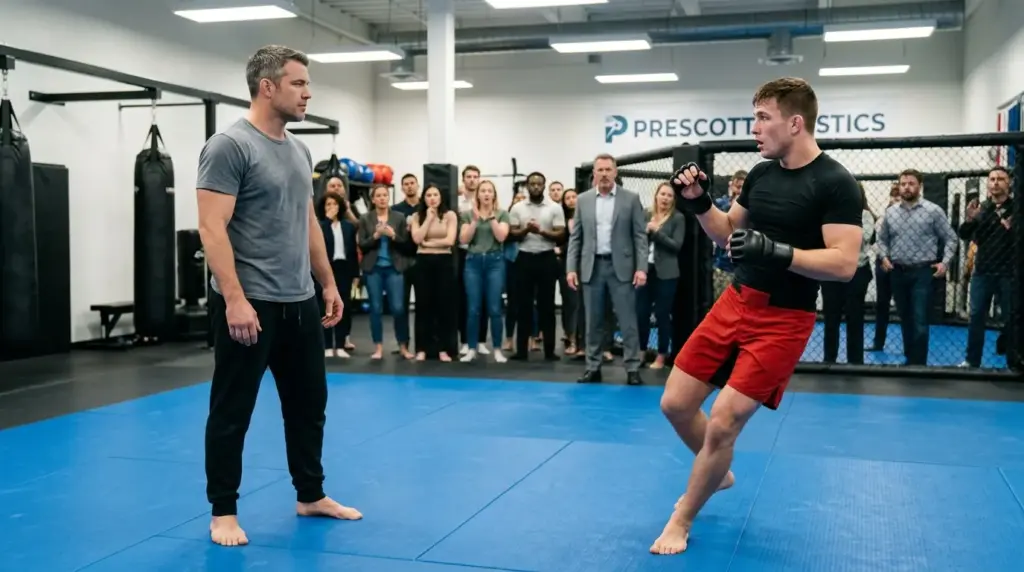
At 3:55, nearly forty employees crowded the basement. Richard Whitmore stood near a steel pillar wearing a gray suit and watching like a man who had been promised entertainment.
In the locker room, I changed.
The mirror showed a body covered in memories I normally kept hidden: the old wound near my shoulder, the jagged scar across my ribs, marks left by years I had no interest in explaining. I pulled on a plain gray T-shirt and black sweatpants. No gloves. No hand wraps.
I had no intention of fighting Blake.
I planned to let him exhaust himself and go home.
When I stepped onto the mat, the room fell quiet.
Blake looked like a sponsored athlete—red grappling shorts, fitted rash guard, MMA gloves. He bounced on his toes and played to the crowd.
“Today we’re talking about pressure,” he announced. “Pressure crushes weak people and creates strong ones. Ethan is going to help demonstrate.”
I removed my shoes slowly and stepped onto the soft mat.
Blake smiled.
“Light contact. Strikes, takedowns, submissions. We stop when somebody taps. You know how to tap, Mercer?”
“I know.”
“Then put your hands up.”
I let them hang loosely.
He thought I was defenseless.
That was what he wanted to think.
He rushed forward with a jab and a hard right hand. I moved my head just enough for the jab to miss, turned my body, and let the right cross travel past my chin. Blake had committed so much weight that he stumbled forward. I touched his hip and guided him past me.
Murmurs moved through the room.
Blake turned red.
“Lucky.”
He attacked again, this time with the same low kick he had used on Daniel. I saw the change in his hips before his foot left the mat. I stepped inside the arc, taking away the force before it developed, then lowered myself beneath the hook that followed.
A moment later, I was standing behind him.
He spun around.
I was already several feet away.
“Stand still and fight!”
His breathing had become louder.
“I thought this was about handling pressure.”
Someone near the back laughed.
I think it was Daniel.
That sound broke something in Blake.
He charged.
Left. Right. Hook. Uppercut.
For nearly a minute, he threw everything he had.
I moved.
Nothing more.
A few inches left. Half a step right. Turn the shoulder. Change the angle.
I had spent years learning that the safest place during violence was often not farther away, but simply somewhere the other person had not expected you to be.
Blake hit nothing.
By the time he stopped, his chest was heaving.
I had not thrown one strike.
Then he looked toward his father.
Richard was no longer smiling.
Blake saw disappointment on his face, and desperation replaced frustration.
He stepped backward as if resetting.
Then he spun and threw an elbow far harder than anything allowed under his own “light contact” rules.
I moved, but not completely.
The point of the elbow clipped my cheek.
Skin opened.
The room gasped.
I touched the cut and looked at the blood on my fingertips.
For a moment, the basement disappeared.
I remembered dust.
Metal.
Men shouting.
That terrible copper smell.
I had spent three years convincing myself that the part of me capable of functioning inside violence was something monstrous. Something that needed to stay locked away.
Then I looked at Blake.
He was smiling.
He thought drawing blood meant he had won.
I exhaled.
“Okay.”
When he came forward again, I stopped retreating.
I entered the space before his combination developed, disrupted his balance, controlled his upper body, and turned him. All the polished techniques he had practiced depended on distance, rhythm, and cooperation. I gave him none of those things.
Suddenly he was on the mat.
Before he could recover, I controlled him and stopped his movement.
Blake struggled.
Then struggled harder.
Then panic appeared in his eyes.
For the first time that afternoon, he understood he was no longer deciding what happened next.
His hand slapped the mat.
Once.
Twice.
Again.
I released him.
I leaned close enough that only he needed to hear me.
“This is pressure, Blake. Not humiliating an accountant who can’t fight. Pressure is when the situation stops caring who your father is.”
Then I stood.
Blake stayed on his side, gasping and staring at the floor.
Forty people were silent.
I walked to the bench, pressed a towel against my cheek, and began putting my shoes back on.
Richard Whitmore finally moved.
“What the hell was that?”
I tied my boot.
“Mandatory resilience training.”
“You assaulted an executive.”
“I participated under the rules your son established. He changed those rules when he used the elbow.”
Richard pointed at me.
“You’re fired. I’ll make sure no logistics company in this city hires you.”
I stood.
“You talk a lot about killer instinct, Richard.”
His face changed when I used his first name.
“You tell these people they need it. You encourage your son to beat it into employees who are afraid to tell him no.”
I looked toward Blake.
“That isn’t killer instinct. It’s bullying.”
Richard stared at me.
“Who do you think you are?”
“My name is Ethan Mercer. Before I worked for you, I spent seven years in Naval Special Warfare. I survived three deployments, two gunshot wounds, and a helicopter crash. I spent my twenties pulling people out of places where nobody cared about corporate titles.”
The room seemed to shrink.
“I came here because I wanted a quiet life. I wanted spreadsheets. Bad coffee. Boring meetings. I worked very hard to become ordinary.”
I removed my employee badge.
“But your son couldn’t leave ordinary people alone.”
I tossed the badge onto the mat.
“You don’t need to fire me. I quit.”
I walked out.
Nobody tried to stop me.
Outside, Seattle rain fell in a cold mist. My cheek throbbed. My bank account was not large enough for unemployment. Rent was due soon.





