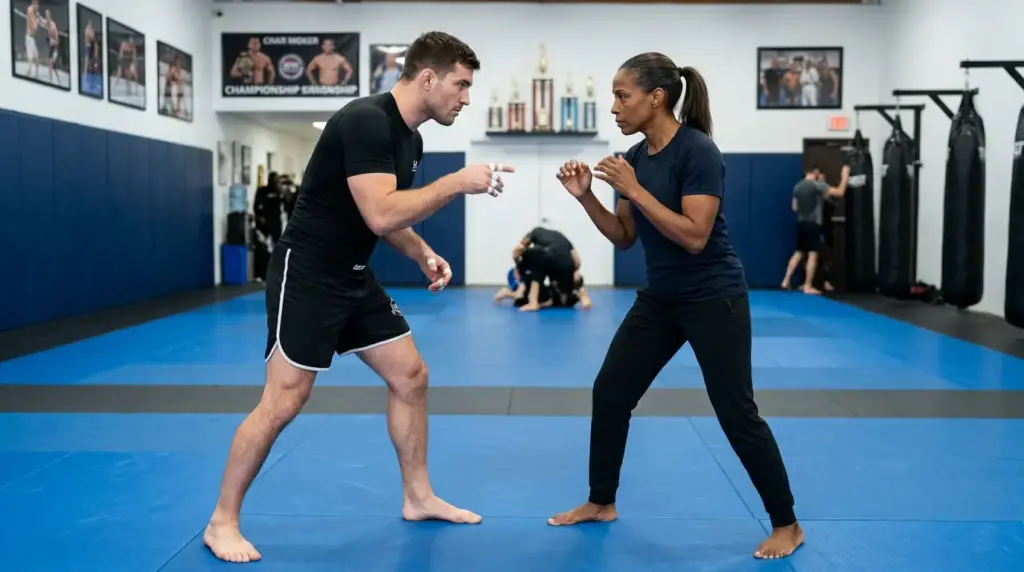
Laura released him immediately.
Silence.
Robert looked toward the wall clock.
Seven seconds.
Brian slowly started laughing.
Not cruelly.
In disbelief.
Jason sat up.
He stared at Laura.
She stood and offered him a hand.
He looked at it.
Then took it.
Laura helped him to his feet.
“You had three seconds left.”
Brian laughed louder.
Several students finally joined him.
Even Robert smiled.
Jason rubbed his arm.
“You surprised me.”
Laura nodded.
“That was the idea.”
Jason shook his head.
“I wasn’t resisting.”
Laura looked at him.
“No?”
“I mean, not fully.”
Robert’s smile disappeared.
“Jason.”
Jason knew he should stop.
Pride kept him talking.
“Let’s go again.”
Laura picked up her towel.
“No.”
Jason frowned.
“No?”
“You asked me for ten seconds.”
“So?”
“I used seven.”
Someone near the wall laughed.
Jason’s face reddened.
“I want a real round.”
Laura looked at him calmly.
“You want a different result.”
The words landed harder than he expected.
Jason said nothing.
Laura continued.
“That’s not the same thing.”
The room went quiet.
Robert folded his arms.
“Laura, I think now is a good time to tell us who you are.”
Laura sighed.
“I’m Laura Mitchell.”
“You know what I mean.”
She looked around the gym.
For the first time all evening, she seemed uncomfortable with the attention.
Robert continued.
“Where did you train?”
“Originally? Chicago.”
“Who with?”
Laura hesitated.
“Frank Russo.”
Robert’s expression changed.
“Frank Russo?”
Laura nodded.
Robert stared at her.
“Wait.”
He looked closer.
“Laura Mitchell. Were you Laura Benson before you got married?”
Laura’s smile faded slightly.
“Yes.”
Robert stepped backward.
“You’re Laura Benson?”
Brian looked between them.
“Who is Laura Benson?”
Robert laughed once in disbelief.
“She was one of the best American judo competitors in the country in the late nineties.”
The room became silent.
Laura lowered her head.
Robert continued.
“Two national titles.”
Laura corrected him.
“Three.”
Robert stared.
“Three?”
She nodded.
“And you competed internationally.”
“Yes.”
Jason looked at her.
“You were on the national team?”
“For a few years.”
“You almost made the Olympic team.”
Laura looked at Robert.
“Almost doesn’t count.”
Robert shook his head.
“It counts enough.”
Everyone stared at her.
Jason looked back toward the spot where he had just tapped.
Suddenly the seven seconds made much more sense.
But Robert noticed something else.
“Why did you stop?”
Laura’s expression changed.
The question touched something deeper than competition.
She sat against the wall.
For a moment, nobody spoke.
Then Laura answered.
“My son got sick.”
The room softened instantly.
Laura had been thirty-two years old when her life changed.
At the time, she was still competing.
She and her husband, David Mitchell, lived outside Chicago with their two children.
Their daughter, Sarah, was seven.
Their son, Daniel, was four.
Daniel had always been energetic.
He climbed everything.
Ran everywhere.
Asked questions from the moment he woke up until the moment he fell asleep.
Then one winter, he began getting tired.
At first, Laura thought he had caught a virus.
Then came the bruising.
Then fevers.
Then blood tests.
Leukemia.
Laura remembered sitting beside David in a hospital office while a doctor explained treatment.
She remembered the sound of the heater.
A clock on the wall.
A nurse quietly closing the door.
She remembered almost nothing else.
The national championships were three months away.
Laura had been expected to compete.
She withdrew the next morning.
At first, she believed she would return after Daniel’s treatment.
A few months.
Maybe a year.
But illness does not care about schedules.
Daniel spent nearly two years moving between hospitals and home.
Chemotherapy.
Infections.
Scans.
Medication.
Periods of improvement followed by setbacks.
Laura stopped training.
David worked extra hours.
Sarah spent evenings doing homework in hospital waiting rooms.
Laura slept in chairs.
She learned how to read blood counts.
She learned which nurses would explain things honestly.
She learned how to smile when Daniel was scared.
And how to cry only where he could not see her.
Daniel eventually went into remission.
For almost a year, the family believed life was returning.
Then the cancer came back.
More aggressively.
Daniel died two months before his seventh birthday.
Laura stopped talking.
The gym was silent.
Jason had lowered his eyes.
Laura continued.
“After that, I couldn’t go back.”
Robert nodded slowly.
“To competition?”
“To any of it.”
The mats reminded her of the life she had before Daniel got sick.
Tournament photographs hurt.
Old teammates called.
Laura stopped answering.
Her medals went into boxes.
Her uniforms went into storage.
She and David focused on Sarah.
Life continued because it had to.
Laura became a physical therapist.
David remained with her through the grief, but losing a child had changed both of them.
For years they learned how to be married again after becoming two people shaped by the same absence.
Sarah grew up.
Went to college.
Became a teacher.
Laura built a quiet life.
The competitive fighter disappeared.
Or at least Laura believed she had.
Then David died unexpectedly from a stroke when Laura was forty-six.
The second loss left her alone in a house that suddenly felt too large.
Sarah visited often.
Friends tried to keep her busy.
But Laura had spent nearly two decades building her identity around taking care of everyone else.
Without David, she no longer knew what belonged only to her.
One afternoon, Sarah came over to help clean the garage.
They opened an old storage box.
Inside were Laura’s medals.
Photographs.
A folded judo uniform.
And a picture of Daniel sitting on the edge of a training mat.
He was maybe five years old.
He was smiling at the camera.
On the back, in David’s handwriting, were four words.
Daniel watching Mom train.
Laura sat on the garage floor holding the photograph.
Sarah sat beside her.
“You should go back.”
Laura shook her head.
“I’m too old.”
Sarah smiled.
“For the Olympics?”
Laura laughed despite herself.
“No.”
“Then what are you too old for?”
Laura had no answer.





