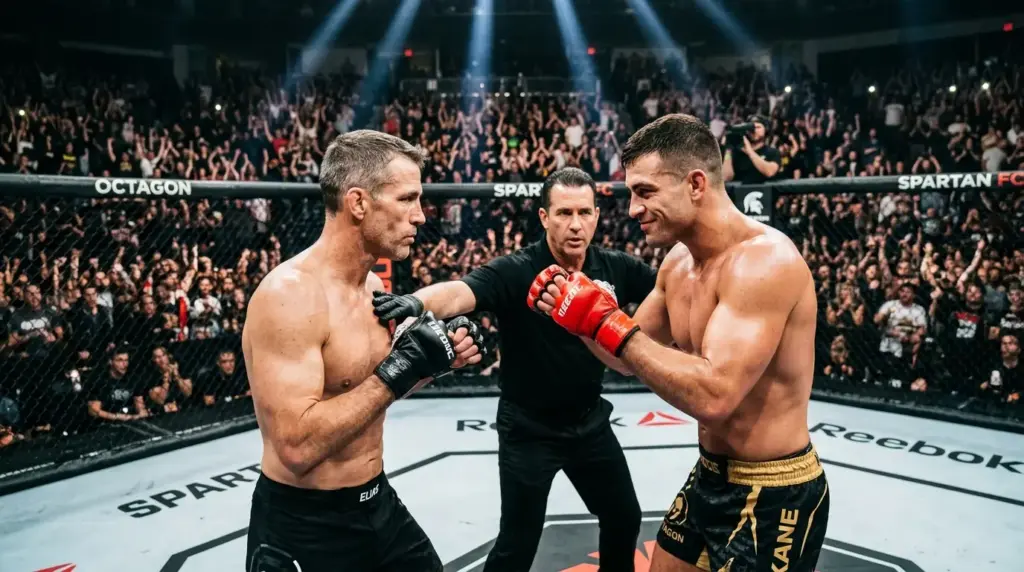
Every active contender had a reason to say no.
Not enough time.
Wrong weight.
Injury.
Visa issue.
Contract dispute.
Then promoter Henry Sloan made a joke.
“What about Elias Ward?”
His matchmaker looked at him.
“Ward retired.”
“I know.”
“He’s forty-one.”
“I know.”
“He hasn’t fought in six years.”
Henry smiled.
“Exactly.”
The matchmaker did not.
“You want to put a retired mechanic against Victor Kane?”
“I want to sell a fight.”
The idea spread.
At first as comedy.
Then nostalgia.
Then possibility.
A veteran returns.
Champion versus old-school technician.
One last night.
Victor heard and loved it.
“Bring him.”
His coach, Marcus Deen, did not.
Marcus had trained Victor since he was twenty-three.
He knew Elias.
Not personally.
Professionally.
He had watched hours of old footage.
He remembered the way Elias could make aggressive fighters feel like they were chasing a shadow.
Marcus told Victor,
“No.”
Victor laughed.
“No?”
“He’s wrong for six days.”
Victor stared.
“He’s retired.”
“That’s why he’s wrong.”
Victor smiled.
“You’re scared of a mechanic?”
Marcus leaned forward.
“I’m scared of people you don’t respect.”
Victor’s smile disappeared.
“That sounds like a fortune cookie.”
“It sounds like experience.”
Victor stood.
“You want me to fight some random replacement?”
“I want you to fight someone who has been active this decade.”
Victor laughed.
“He’s forty-one.”
Marcus said,
“And you are already fighting the age instead of the man.”
Victor walked away.
The promotion called Elias.
He declined.
They doubled the offer.
He declined.
They added pay-per-view percentage.
He declined.
Then the third call came.
Not from the promoter.
From a woman named Sarah Ward.
Elias’s younger sister.
She was thirty-eight.
School counselor.
Mother of two.
Owner of the most effective guilt in three states.
“You should do it.”
Elias held the phone between his shoulder and ear while tightening a bolt.
“No.”
“You didn’t even think.”
“I have thought for six years.”
“About this exact fight?”
“Yes.”
“That seems statistically impossible.”
Elias smiled despite himself.
“No.”
Sarah continued.
“You miss it.”
“I miss parts.”
“You watch every event.”
“For technical reasons.”
“You yell at judging.”
“Civic responsibility.”
“You shadowbox when nervous.”
“That is slander.”
She laughed.
Then grew serious.
“Why did you really stop coaching?”
Elias’s hand paused.
“Sarah.”
“I know.”
“No, you don’t.”
“I know enough.”
He set down the wrench.
The shop became quiet.
Sarah said,
“You stopped after Jonah.”
Elias closed his eyes.
Jonah Price had been twenty-two.
One of Elias’s best young students.
Fast.
Fearless.
Too fearless.
Jonah had loved training hard.
Too hard.
He ignored injuries.
Ignored headaches.
Ignored recovery.
Elias saw it.
Warned him.
Then praised him for pushing through anyway.
That contradiction haunted him.
Three years after Elias retired from fighting, Jonah entered a regional bout after suffering concussion symptoms in training.
He told no doctor.
No commission.
No family.
He told Elias he was fine.
Elias wanted to believe him.
Because Jonah’s fight mattered.
Because momentum mattered.
Because young athletes are good at telling coaches what coaches want to hear.
Jonah won the fight.
Two days later, he collapsed at home.
A brain bleed.
He survived.
Barely.
Months of rehabilitation followed.
Speech therapy.
Balance work.
Memory problems.
His career ended.
Elias never forgave himself.
Jonah told him repeatedly it was not his fault.
Elias disagreed.
He had built a room where toughness received too much praise.
After Jonah’s injury, Elias stopped coaching.
He still visited.
Still helped privately.
But he refused leadership.
Sarah knew.
She said,
“You think going back means becoming that person again.”
Elias looked at the open shop door.
Rain fell outside.
“I think arenas make people stupid.”
“People make people stupid.”
“That is not comforting.”
“Neither are you.”
He laughed softly.
Sarah continued.
“What if you go back differently?”
Elias said nothing.
“What if this isn’t about proving you still have it?”
“Then what?”
“Maybe proving you don’t need to be who you were.”
Elias hated when she said useful things.
He hung up.
Then called Henry Sloan.
“I have conditions.”
Henry nearly shouted.
The first condition:
No fake retirement storyline.
No “one last ride.”
No sentimental marketing about age.
The second:
No trash talk required.
No scripted press conference insults.
The third:
Medical testing beyond commission minimums.
Full neurological clearance.
The fourth:
A portion of his purse would go to a rehabilitation foundation for athletes with traumatic brain injuries.
Henry agreed to everything.
Mostly because he thought the story would sell itself.
It did.
Within two hours, the promotion announced:
VICTOR KANE VS. ELIAS WARD
CHAMPION VS. THE RETURNING VETERAN
Victor posted:
They found me someone’s uncle.
Elias saw it.
Closed the app.
Returned to work.
His first training session happened that night.
Alone.
He rolled old mats across the back of the motorcycle shop.
He took out a heavy bag stored above a parts shelf.
It smelled like dust.
His knees complained before his ego had a chance.
He laughed.
“Good start.”
The next morning, a truck arrived.
Jonah Price stepped out.
Elias stared.
Jonah walked with a slight limp.
His speech had recovered almost completely, though fatigue sometimes slowed words.
He was twenty-eight now.
He worked with adaptive athletes and helped run the same neurological rehabilitation foundation Elias planned to support.
Elias folded his arms.
“Sarah.”
Jonah smiled.
“Sarah.”
“You drove four hours.”
“Yes.”
“To stop me?”
“No.”
Elias waited.
Jonah carried a duffel bag inside.
“To corner you.”
Elias’s face changed.
“No.”
Jonah dropped the bag.
“That’s not your decision.”
“It absolutely is.”
Jonah smiled.
“You taught me that line.”
Elias looked away.
“You shouldn’t be around fight camp.”
“Why?”
“You know why.”
“No.”
Jonah’s voice sharpened.
“You know why you think.”
Elias became still.
Jonah continued.
“You think seeing training brings everything back.”
“It does.”
“For you.”
Silence.
Jonah stepped closer.
“You keep turning my life into your punishment.”
Elias looked at him.
“That is not what I’m doing.”
“It is.”
Jonah’s eyes were hard.
“I got hurt.”
“Yes.”
“I hid symptoms.”
“You were twenty-two.”
“I lied.”





