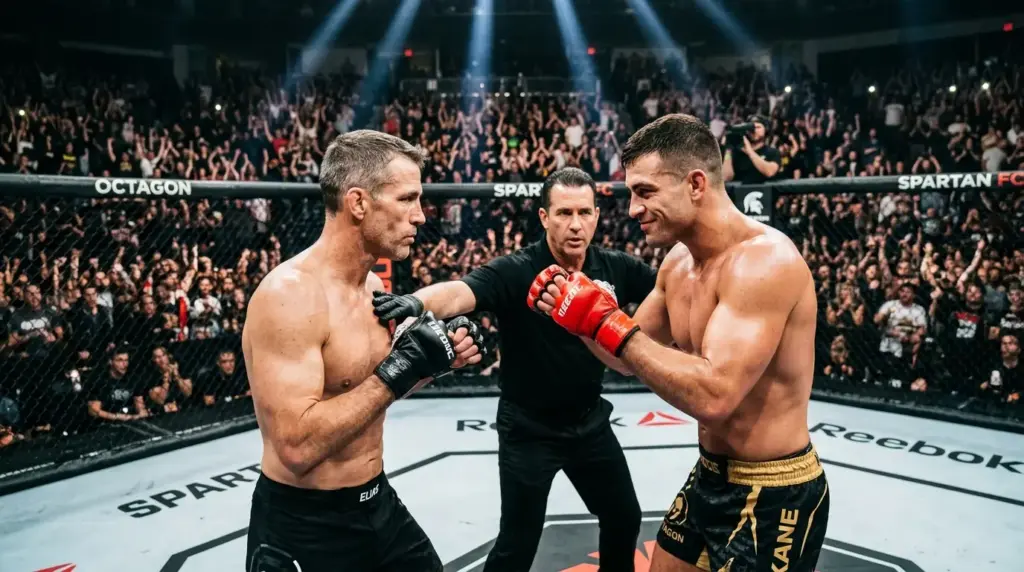
The arena went silent at exactly 9:14 p.m.
Not quiet.
Silent.
There is a difference.
Quiet means people are waiting.
Silent means people have forgotten how to react.
Seven thousand four hundred people had spent the previous three hours shouting, clapping, booing judges, cheering knockdowns, arguing over scorecards, and filming anything that looked dramatic enough to post before the night was over.
Then Victor Kane hit the mat.
No one moved.
The referee took one step forward.
Stopped.
Victor rolled to one knee.
His face was blank.
The man standing six feet away from him had not raised his hands.
Had not celebrated.
Had not even changed expression.
That man’s name was Elias Ward.
And twelve seconds earlier, Victor Kane had laughed in his face and said,
“Try not to get hurt.”
Elias had answered,
“I’ll do my best.”
People laughed.
Victor laughed louder.
Then the bell rang.
The first three seconds looked normal.
Victor moved forward.
Elias moved back.
Victor feinted with his left.
Elias did not react.
Victor threw a fast right hand.
Elias slipped outside.
Nothing dramatic.
Four seconds.
Victor kicked low.
Elias checked.
Five.
Victor smiled.
Six.
Victor stepped in again.
Seven.
Elias touched Victor’s lead hand.
Eight.
Victor threw a hook.
Nine.
Elias ducked under it.
Ten.
He stepped to Victor’s outside angle.
Eleven.
Victor turned too late.
Twelve.
Elias touched him once.
Not hard.
Not with a wild swing.
A short strike to the body.
Victor Kane folded.
The sound disappeared from the arena.
And for the first time in five years, the champion looked confused.
The entire story had begun three months earlier with a phone call almost nobody expected Elias Ward to answer.
He was forty-one years old.
Retired from professional competition.
Retired from coaching.
Retired, in his own words, from “being punched by people with better knees.”
He lived in a small town near the Missouri River and ran a repair shop that specialized in restoring old motorcycles.
The sign outside said:
WARD MOTOR & STEEL
The shop smelled like oil, metal, coffee, and rain whenever the weather turned.
Elias liked it.
Machines were honest.
A damaged chain did not pretend it was fine.
A cracked bearing did not call pain weakness.
A bent frame did not become offended when corrected.
He found that refreshing.
For fourteen years, Elias had fought professionally.
Kickboxing first.
Then mixed martial arts when the sport became more organized.
He had won twenty-two fights.
Lost six.
Never held a major world title.
Never became famous enough to need security.
Never became obscure enough to disappear completely.
People who knew combat sports remembered him.
Especially coaches.
Elias had been known for one thing.
Timing.
Not speed.
Not knockout power.
Timing.
He moved late.
Dangerously late.
The kind of late that looked like a mistake until the other person missed.
He retired at thirty-five after his second knee surgery.
No farewell fight.
No documentary.
No dramatic gloves left in a cage.
He simply finished the final bout of his contract, lost a close decision, thanked his team, and went home.
Six years passed.
He coached for a while.
Then stopped that too.
People assumed age had made him bitter.
That was not true.
Age had made him clear.
He loved martial arts.
He hated what attention did to people who confused applause with proof.
Victor Kane had become the clearest example.
Victor was thirty years old.
Undefeated in eleven professional fights.
National middleweight champion.
Former collegiate wrestler.
Fast hands.
Excellent conditioning.
Strong takedown defense.
Charismatic enough for television.
Cruel enough for short clips.
Promoters loved him.
Fans loved arguing about him.
Opponents hated press conferences with him because he treated every question like a chance to humiliate someone.
He had once told an older fighter,
“You trained ten years to become my warm-up.”
He told another,
“I don’t beat people. I remove their delusions.”
The lines went viral.
So did the finishes.
Victor won brutally.
He stopped nine of eleven opponents.
When people criticized his arrogance, he smiled.
“They can stop me.”
Nobody had.
Then Victor’s scheduled opponent withdrew six days before the Madison Crown Arena event.
A rib injury.
The promotion panicked.
Victor was the main event.
Tickets had sold on his name.
The broadcast deal depended on the title defense.
They needed a replacement.
The Champion Laughed, “Try Not to Get Hurt” — Moments Later, the Arena Went Silent
Every active contender had a reason to say no.
Not enough time.
Wrong weight.
Injury.
Visa issue.
Contract dispute.
Then promoter Henry Sloan made a joke.
“What about Elias Ward?”
His matchmaker looked at him.
“Ward retired.”
“I know.”
“He’s forty-one.”
“I know.”
“He hasn’t fought in six years.”
Henry smiled.
“Exactly.”
The matchmaker did not.
“You want to put a retired mechanic against Victor Kane?”
“I want to sell a fight.”
The idea spread.
At first as comedy.
Then nostalgia.
Then possibility.
A veteran returns.
Champion versus old-school technician.
One last night.
Victor heard and loved it.
“Bring him.”
His coach, Marcus Deen, did not.
Marcus had trained Victor since he was twenty-three.
He knew Elias.
Not personally.
Professionally.
He had watched hours of old footage.
He remembered the way Elias could make aggressive fighters feel like they were chasing a shadow.
Marcus told Victor,
“No.”
Victor laughed.
“No?”
“He’s wrong for six days.”
Victor stared.
“He’s retired.”
“That’s why he’s wrong.”
Victor smiled.
“You’re scared of a mechanic?”
Marcus leaned forward.
“I’m scared of people you don’t respect.”
Victor’s smile disappeared.
“That sounds like a fortune cookie.”
“It sounds like experience.”
Victor stood.
“You want me to fight some random replacement?”
“I want you to fight someone who has been active this decade.”
Victor laughed.
“He’s forty-one.”
Marcus said,
“And you are already fighting the age instead of the man.”
Victor walked away.
The promotion called Elias.
He declined.
They doubled the offer.
He declined.
They added pay-per-view percentage.
He declined.
Then the third call came.
Not from the promoter.
From a woman named Sarah Ward.





