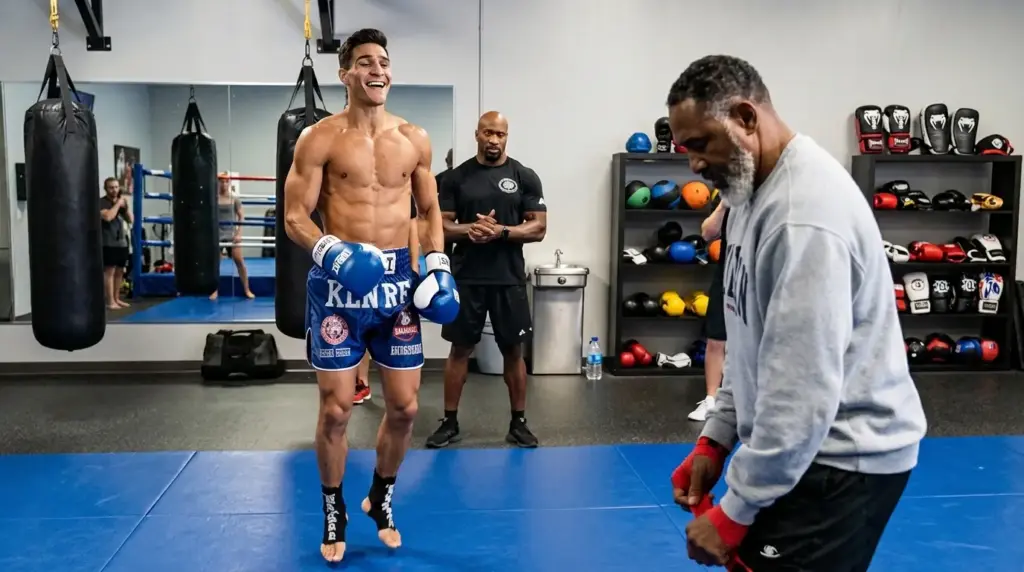
They missed the point.
At first, the internet made it about the move.
The way Caleb stepped off line.
The angle of the wrist control.
The timing of the hip turn.
The shoulder pin.
The restraint.
Every expert had an opinion.
Then the full video emerged.
Not just the throw.
The whole thing.
Marcus mocking Caleb’s age.
The knee brace comment.
The illegal punch after Raymond ended the round.
The camera catching Jonah behind the office glass.
Caleb saying, “You do not teach children that pride is self-defense.”
The conversation changed.
Sponsors called Marcus.
Then dropped him.
His upcoming fight was canceled after the athletic commission opened an inquiry into gym misconduct and unsportsmanlike conduct during public training.
Podcasts invited him to explain himself.
He declined at first.
Then posted a statement that used many words without saying sorry.
People noticed.
Northside Combat Club received hundreds of messages.
Some praised Caleb.
Some threatened Marcus.
Some asked to train with the quiet man in the gray sweatshirt.
Caleb hated all of it.
He had spent years building a small life away from attention.
After leaving military contracting and tactical instruction, he had moved into construction management, coached Jonah’s robotics team, and spent weekends fixing things around the house. He had done everything possible to make sure his son knew him as a father, not a weapon.
Now strangers were freezing his face in thumbnails and calling him “The One-Move Dad.”
Jonah thought the nickname was hilarious.
Caleb did not.
A week after the video went viral, Raymond called.
“I’m not asking you to teach,” he said quickly.
“Good.”
“I’m asking you to help me build something.”
Caleb almost hung up.
Raymond continued.
“A class for kids who don’t want to become fighters. Kids who are bullied. Kids who freeze. Kids who need to learn how to stand, speak, leave, report, and defend only when there is no other choice.”
Caleb said nothing.
“Darnell is helping. I want counselors involved too. Not just martial arts. Actual support. Documentation. Parent meetings. School reporting. Confidence without turning them into Marcus.”
Caleb looked across the kitchen at Jonah, who was pretending not to listen while building a small robot out of spare parts.
“Why me?” Caleb asked.
“Because you know the difference between control and violence.”
Caleb closed his eyes.
For years, he had avoided teaching because teaching had once meant preparing grown men to survive rooms where hesitation could kill them.
But this was different.
This was children.
This was Jonah.
This was making sure the quiet ones had somewhere to go before they broke or became cruel themselves.
“I’ll help design it,” Caleb said. “I’m not being the face of it.”
Raymond exhaled.
“Fair.”
“I mean it.”
“Understood.”
“And no cameras.”
“Absolutely.”
Three days later, the first meeting took place after closing.
Ten students.
A few parents.
Darnell.
Raymond.
Caleb.
Jonah sat near the back, arms crossed, pretending he was only there because his father made him.
Caleb stood in front of the group in the same gray sweatshirt.
No belt.
No title.
No dramatic introduction.
“My name is Caleb,” he said. “I’m not here to teach you how to win fights.”
One boy looked disappointed.
Caleb noticed.
“Fighting is easy to start and hard to finish. Avoiding one without surrendering your dignity is harder. That’s what we’re working on.”
He wrote four words on a whiteboard.
Notice.
Leave.
Speak.
Protect.
“Notice means pay attention before danger becomes contact. Leave means you are allowed to exit without asking pride for permission. Speak means tell someone who can help, and keep telling until someone listens. Protect means if you cannot leave, you defend yourself long enough to get safe.”
A girl near the front raised her hand.
“What if they call you scared?”
Caleb looked at her.
“Then they are trying to control you with a word.”
“What if everyone laughs?”
“Then everyone is wrong.”
A small silence followed.
Not the silence of shock.
The silence of children hearing something they needed.
Jonah looked up.
Caleb continued.
“Self-defense begins before anyone touches you. It begins when you believe you are worth protecting.”
Raymond looked down.
Darnell nodded.
That became the heart of the class.
Not punches.
Not throws.
Worth.
Over the next months, Northside changed.
Slowly.
Messily.
Not everyone liked it.
Some fighters left when Marcus did. They said the gym had gone soft. They mocked the new posters about consent, conduct, and safety. They called Raymond weak.
Raymond let them go.
The heavy bags still swung.
The ring still held hard sparring.
Fighters still trained.
But something under the noise shifted.
Coaches stopped laughing at beginners.
Students were corrected without being humiliated.
Parents were allowed to observe youth classes.
A complaint box was installed, then replaced by a real reporting policy because Caleb said boxes were where truth went to die if no one checked them.
The three boys who had bullied Jonah were given a choice: restorative meetings, apologies, counseling, and probationary return after three months — or permanent removal.
Two chose the process.
One left.
Jonah attended the meetings with Caleb beside him.
The boys apologized awkwardly at first.
Then, after Raymond made them watch the full video of themselves laughing in the background while Marcus mocked Caleb, something changed.
One of them began crying.
“I didn’t think it was that bad,” he said.
Jonah looked at him for a long moment.
“It was.”
The boy nodded.
“I know.”
That did not fix everything.
But it opened a door.
Marcus did not walk through one for a long time.
For months, he disappeared from the local fight scene. His social media went quiet. Rumors spread — that he was training at another gym, that he was suing Northside, that he was moving to Florida, that he had been offered a reality show.
Most were false.
The truth was simpler.
He was ashamed.
Not immediately.
Immediate shame had looked like anger.





