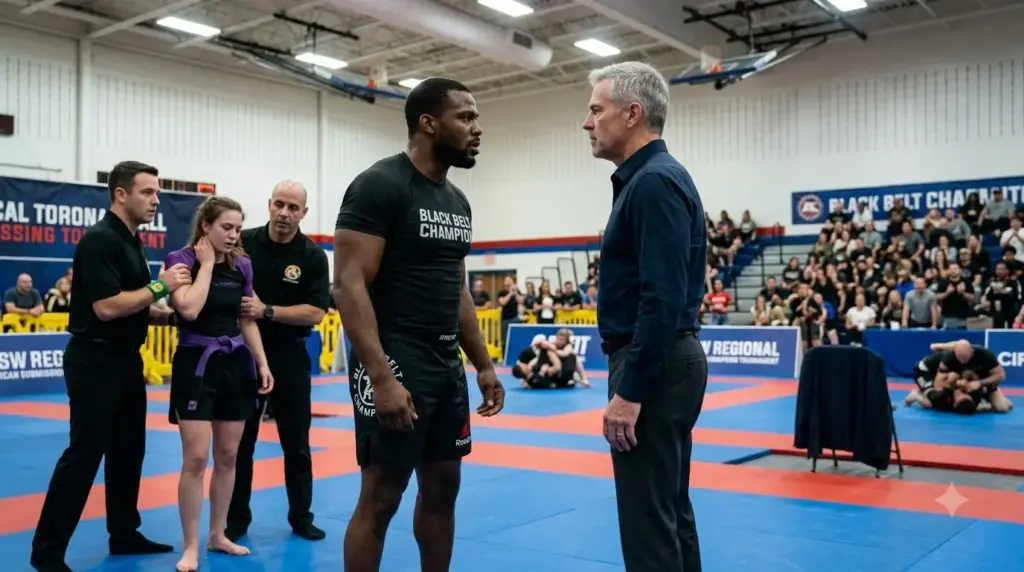
Caught Marcus rising.
Then Marcus taking off his jacket.
Then cut.
That edit changed everything.
Caption:
CHAMPION REFUSES TO RELEASE WOMAN — GRAY-HAIRED STRANGER TAKES OFF JACKET
By Sunday morning:
1.2 million views.
By Monday:
4.8 million.
Then the invented version appeared.
OLD MASTER CHALLENGES CHAMPION AFTER HE CHOKES HIS NIECE
Marcus never challenged him.
Another:
RETIRED SPECIAL FORCES FIGHTER MAKES BLACK BELT PANIC
Marcus had never served in Special Forces.
Another:
CHAMPION BEGS FORGIVENESS AFTER LEARNING WHO OLD MAN REALLY IS
Also false.
Derek apologized after reviewing what he had done.
Marcus’s identity changed the room.
That was true.
It should not have.
Emily hated the comments most.
Many said:
Good thing she had a dangerous uncle.
She posted one response.
Only one.
Good thing there was a referee, medical staff, video, and a rules process. My uncle did not need to fight anyone.
That received far fewer views than the fantasy.
Of course.
People wanted Marcus to fight Derek.
Even people who claimed to care about safety wanted another dangerous situation immediately after criticizing the first one.
Marcus found that strange.
At dinner Sunday, Emily showed him one comment:
If Marcus had choked him unconscious, Derek would learn.
Marcus stared.
Then:
“No.”
Emily smiled.
“I know.”
He continued:
“If I hurt Derek because he failed to release you, what rule would I be teaching?”
She thought.
“That violence is okay when the right person does it?”
“Exactly.”
Marcus cut his steak.
“Bad lesson.”
Emily’s mother, Marcus’s sister Laura, asked:
“Could you beat him?”
Marcus sighed.
Family.
“Laura.”
“What?”
“I’m curious.”
“He’s thirty.”
“You’re sixty-two.”
“Thank you.”
“You’re welcome.”
Marcus smiled.
“Probably not now.”
Emily laughed.
“Internet ruined.”
“Good.”
Then Marcus became serious.
“At twenty-eight?”
Laura leaned forward.
“Yeah?”
Marcus thought.
“Depends on rules.”
That was the only answer serious people usually give.
The deeper review happened at Derek’s home gym, Apex Submission Academy.
Ray Sullivan did something he had avoided for too long.
He asked students anonymously:
“Have you ever seen Derek continue pressure after a tap or coach people to delay tapping?”
The responses were mixed.
No other clear ignored tap.
Good.
But several described phrases like:
“Don’t tap that early.”
“Fight through it.”
“You had more.”
A blue belt wrote:
“Derek is safe with competitors, but he sometimes treats beginners like they need to prove toughness.”
A purple belt wrote:
“He’s one of the best coaches I’ve had.”
Both true.
Ray reviewed class footage.
No hidden pattern of abuse.
No secret scandal.
The issue was narrower.
Derek had developed a coaching philosophy that confused resilience with overriding other people’s threshold.
Not always.
Enough.
Apex changed policy.
A new sign appeared beside the mat.
THE TAP ENDS THE ACTION.
Below:
No judgment.
No delay.
No lesson after the tap until both athletes have reset.
Another rule:
Coaches may challenge decisions before or after a round. Never by holding a finished submission.
Ray also added:
Pressure must have purpose.
Competitors preparing for events could agree to late-stage escape drills.
Beginners did not automatically consent.
A fighter could practice not tapping too early during a specific drill.
That did not turn every ordinary roll into a resilience test.
Derek hated the sign.
Ray knew.
“Good.”
“You enjoy this too much.”
“No.”
“I enjoy you remembering.”
Derek stayed away from beginner coaching for ten weeks.
During that time, he trained.
Competed nowhere.
Helped clean mats.
Reviewed video.
Not as theatrical punishment.
Because his coaching role had been suspended.
One evening, Marcus visited Apex.
Not to test Derek.
Ray invited him to speak with coaches about safety culture.
Derek was there.
He approached before the meeting.
“Can I ask you something?”
Marcus nodded.
“Why did you take off the jacket?”
Marcus looked confused.
“It was warm.”
Derek stared.
Then laughed.
“No.”
“Seriously.”
Marcus smiled.
“I stood up.”
“The jacket caught on the chair.”
“I took it off.”
“That’s it?”
“That’s it.”
Derek laughed harder.
“The internet thinks you were preparing to kill me.”
“The internet needs hobbies.”
Then Derek became quiet.
“When you walked toward me, I thought you were going to fight.”
Marcus nodded.
“Why?”
“Because I had just held your niece after the tap.”
“Okay.”
“And you looked like…”
Derek stopped.
“Like what?”
“Like you knew what you were doing.”
Marcus smiled faintly.
“That should not have mattered.”
Derek looked at him.
Marcus continued:
“If an untrained sixty-two-year-old man told you to release after the referee had already stopped the match, would the instruction be less valid?”
“No.”
“If Emily had no uncle in the building?”
Derek looked down.
“No.”
“Good.”
Same principle.
Different costume.
That night Marcus spoke to the coaches.
Not about being tougher.
About role clarity.
Athlete.
Coach.
Referee.
Medical staff.
Tournament organizer.
Family.
Different authority.
Different responsibility.
He said:
“Every unsafe room eventually develops one person everybody expects to fix things.”
“Usually the toughest coach.”
“Or the owner.”
“That is fragile.”
A coach asked:
“What’s better?”
Marcus answered:
“Many people allowed to interrupt danger.”
Referee.
Partner.
Coach.
Bystander.
Student.
Anybody.
If safety depends on one respected person being present, the room is not safe.
That line changed Ray’s policy more than anything else.
Apex added a rule:
ANYONE MAY CALL STOP FOR AN IMMEDIATE SAFETY CONCERN.
Stopping a round did not automatically mean the concern was correct.
But nobody would be punished for raising it sincerely.
That mattered later.
Derek returned to beginner coaching slowly.
First as assistant.
Then lead.
The first time a white belt tapped unusually early to an armbar, Derek released immediately.
No reaction.
Reset.
After the round, the student asked:
“Did I tap too soon?”
Derek said:
“Maybe.”
Then:
“Want to look at the position?”
“Yes.”
They recreated it without pressure.
Derek showed the escape.
The student tried.
Good.
Lesson happened after the tap.
Better.
Emily returned to competition two months later.
Lost her first match on points.
No dramatic comeback.
She trained.
Improved.
Won a local division six months later.
Lost again at another event.
Normal competitive life.





