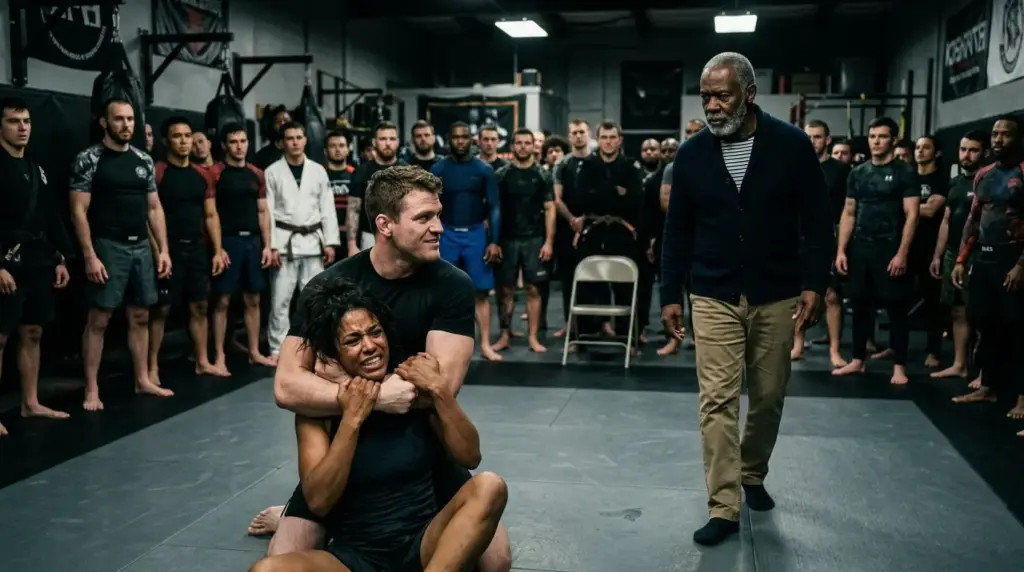
From the outside, control can look like normal training until the person underneath says otherwise.
Tasha called.
“Do not read Instagram.”
Naomi laughed.
“That means I have to.”
“Naomi.”
Too late.
A clip already existed.
Not the bad part.
The first forty seconds of the demonstration.
Grant passing.
Naomi escaping once.
People cheering.
Caption:
CHAMP VS BLUE BELT — PRESSURE LESSON.
No incident footage yet.
Good.
Naomi closed the app.
At 7:30 that evening, Danielle emailed every participant.
There had been a safety-related interruption.
The guest instructor was removed from the remainder of the event.
A formal review was underway.
Anyone with direct video or witness information should submit it privately.
Do not harass participants or staff.
Good.
Within two hours, Danielle had six videos.
Only two showed the relevant angle.
One captured audio clearly.
Naomi:
“Reset.”
Grant:
“Don’t run.”
Naomi:
“Reset.”
Then:
“Get off.”
Grant:
“You’re fine.”
Then Raymond:
“Release her.”
Time from first clear reset to release:
Fourteen seconds.
Time from “get off” to release:
Seven.
Not a movie.
Still too long.
Danielle collected statements separately.
Naomi.
Tasha.
Mason.
Three participants.
Raymond.
The camera operator.
Grant was invited to submit his own statement.
He did.
His version:
The demonstration was intended to illustrate pressure tolerance.
Naomi had agreed to realistic resistance.
He interpreted her first reset request as technical frustration rather than withdrawal.
After the second request, he believed she remained physically safe and wanted to complete the teaching point.
He released when staff intervened.
That statement was more honest than his public reaction.
It also proved the central issue.
He heard.
He interpreted.
The Champion Smirked While Holding Her Down — Then the Quiet Stranger Across the Room Got to His Feet
He overrode.
The event agreement did not give him that authority.
Danielle sent the file to the university recreation department because the venue had been rented under its event rules.
The university did not investigate martial technique.
It reviewed compliance with facility terms.
The terms required immediate adherence to stop instructions and medical staff authority.
Finding:
Grant violated the event’s participant-stop policy and initially disregarded direction from medical staff.
The university barred him from instructing at its facilities for twelve months.
Not from entering campus.
Not from competing.
Specific.
Roll Forward’s organizing company suspended him from teaching its events for six months.
His seminar contract was settled according to written terms.
He received the portion earned for instruction completed.
Travel reimbursement.
No bonus tied to full event completion.
Again.
No emotional punishment disguised as accounting.
Grant’s management team was furious.
Then they watched the video.
Less furious.
His agent called him.
Conversation lasted forty minutes.
No one knew exact words.
Mason later said Grant arrived at practice the next day quieter than usual.
The public story still leaked.
Of course.
Someone posted the clip.
Not Naomi.
The video spread locally.
Comments polarized.
Some said:
“She was never in danger.”
Others:
“She said stop.”
Some:
“Combat sports are supposed to be uncomfortable.”
Others:
“Then choose discomfort. Don’t impose it after no.”
Grant posted once.
“I never intended to hurt anyone.”
True, probably.
But intention was not the whole question.
Then:
“The drill became more intense than planned.”
Also true.
Then:
“I should have reset when asked.”
There.
That mattered.
No dramatic confession.
A start.
Naomi did not reply.
She went to work.
Twelve-hour shift.
A patient with severe COPD needed repeated respiratory treatments.
Another needed transport.
A family wanted updates she could not provide because the physician had not spoken yet.
Life does not stop because the internet is arguing about you.
That night, Naomi’s ribs were sore.
Not injured.
Just pressure soreness.
Her anger lasted longer.
Wednesday, she returned to her home gym.
Not the event gym.
Her coach, Simone Webb, was forty-two.
Black.
Brown belt.
Former college basketball player.
She had known Naomi three years.
She asked one question.
“Do you want people to pretend nothing happened?”
Naomi thought.
“No.”
“Do you want people to make everything about it?”
“No.”
Simone smiled.
“Complicated.”
“Yes.”
Good.
They agreed:
No hard rounds that night.
Naomi drilled.
During one escape sequence, her partner, Leah, settled into side control.
Naomi’s body stiffened.
Leah came up instantly.
“You good?”
“Yes.”
“Pressure?”
“Less.”
Leah reduced pressure.
They continued.
Tiny moment.
Huge effect.
The next class, Naomi rolled lightly.
The next, harder.
Two weeks later she asked Simone for a normal round.
Simone smashed her for five minutes.
With consent.
Naomi laughed afterward.
“That was horrible.”
“You asked.”
“I regret everything.”
Good.
Choice changes how pressure feels.
That became one of Naomi’s clearest lessons.
The Champion Smirked While Holding Her Down — Then the Quiet Stranger Across the Room Got to His Feet
Hard is not the problem.
Unchosen hard is.
A month later, Raymond visited Naomi’s gym.
Simone had invited him to give a short talk on event medical safety.
He refused to make it about Grant.
Good.
He covered concussions.
Neck symptoms.
Rib injuries.
When to stop training.
Then someone asked:
“What if somebody says stop but medically they’re fine?”
Raymond answered:
“Then you stop for the nonmedical reason.”
Silence.
Then laughter.
Simple.
Afterward Naomi thanked him.
“You didn’t need to stand up that day.”
Raymond looked confused.
“Yes, I did.”
“I mean somebody else was moving.”
“Danielle was coming.”
“Tasha was there.”
He nodded.
“And?”
Naomi shrugged.
Raymond said:
“Safety works better when people don’t wait to see whether somebody more qualified acts first.”
Good.
Then:
“I did not need to be the hero.”
“I needed to be one person who moved.”
That distinction stayed.
Raymond had no martial-arts secret.
He could not outgrapple Grant.
If Grant had physically refused everyone, staff would have called security and police.
Numbers.
Procedure.
No fantasy duel.
Three months after the event, Grant returned to competition.
He won two matches.
Lost the final.
People online predicted scandal would destroy him.
It did not.
His career continued.
One sponsor paused a campaign for a month.
Another did nothing.
Two seminars were canceled.





