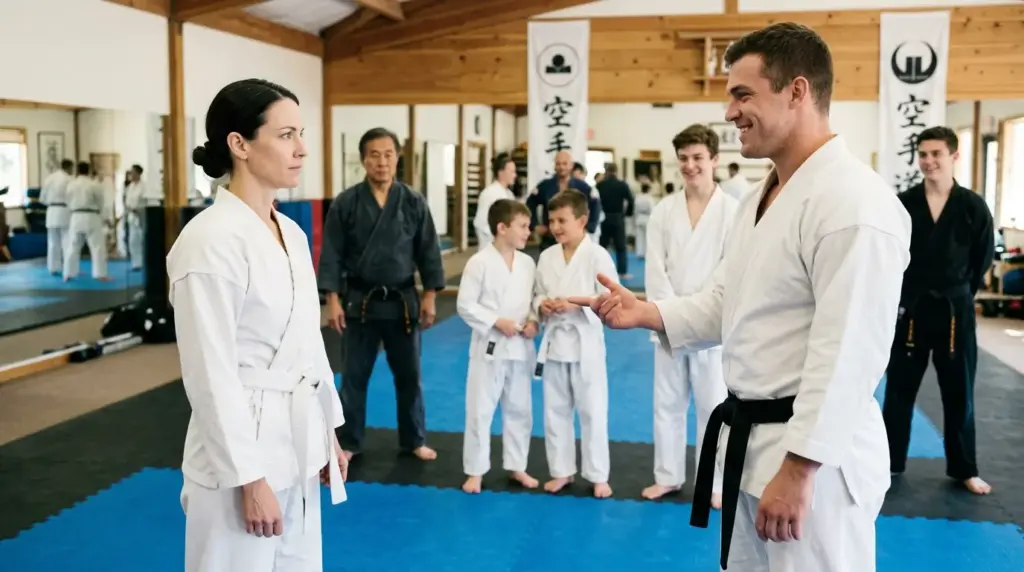
The Dojo’s Best Fighter Picked a Quiet Woman for an Easy Spar — One Move Silenced the Entire Room
The loudest man in the dojo chose the quietest woman in the room because he thought she would be easy.
That was his first mistake.
His second mistake was smiling before he bowed.
The smile told everyone what he believed.
It said he was not choosing a partner.
He was choosing an audience.
The woman standing near the edge of the mat saw the smile, the loose shoulders, the tilted chin, the way the younger students leaned forward because they expected entertainment. She saw all of it and said nothing.
Her name was Claire Bennett.
She was thirty-nine years old, maybe forty, with dark hair tied in a low knot, calm gray eyes, and a plain white gi that looked too new to carry history. The sleeves were slightly long. The belt around her waist was white, stiff, and tied without any pride in it.
To everyone at Redwood Martial Arts Academy, she looked like a beginner.
A mother taking an evening class.
A woman trying something new after a divorce, a health scare, or a New Year’s resolution.
No patches.
No medals.
No team jacket.
No rank.
No swagger.
Just quiet.
In that dojo, quiet was treated like weakness.
At least by the people who had forgotten what quiet could hide.
Redwood Martial Arts Academy sat behind a pharmacy and a dental office in a clean strip mall outside Sacramento, California. The front windows displayed black-and-white photos of tournaments, trophies, and students holding championship belts. Inside, the mats were spotless, the mirrors stretched wall to wall, and a red banner above the entrance read:
Discipline. Respect. Control.
The words looked beautiful.
They had become less true over the years.
The dojo’s best fighter was Ryan Maddox.
Twenty-seven years old.
Six feet tall.
Lean, fast, and powerful.
A regional kickboxing champion with a black belt in karate, a blue belt in Brazilian Jiu-Jitsu, and enough local trophies to believe humility was something weaker people invented to survive losing.
Ryan was not untalented.
That was the problem.
If he had been average, someone would have corrected him sooner.
But Ryan was good.
Fast hands.
Heavy kicks.
Excellent timing.
Strong competitive instincts.
He could stop a young fighter with a body kick before the kid knew the round had started. He could counter a jab with a right hand so clean the room would gasp. He could sweep teenagers off their feet during light sparring and call it a lesson in balance.
Parents admired him at first.
Kids feared him.
Beginners avoided him.
And Master Daniel Park, the dojo owner, had allowed too much of it because Ryan won.
Winning brings trophies.
Trophies bring students.
Students pay rent.
And little by little, the man who built the dojo to teach discipline began tolerating a fighter who made discipline look optional.
Claire noticed that within ten minutes of entering.
She noticed the beginners lined up along the wall, watching the advanced students like villagers watching weather they could not control.
She noticed one teenage boy rubbing his ribs after Ryan’s “light” body kick.
She noticed a young woman laughing nervously when Ryan told her not to be scared, then hit her pads hard enough to make her stumble.
She noticed Master Park watching from the office doorway with his arms crossed, not approving exactly, but not stopping it either.
And she noticed Ryan looking at her.
Again and again.
Not with curiosity.
With appetite.
Claire had come to Redwood for one reason.
Master Park had asked her to.
He had known her years ago under another name, in another life, before she disappeared from the competition circuit. Back then, she had been Claire Donovan, one of the most feared point-fighting and full-contact karate competitors in the country, a woman whose footwork had been studied by fighters who never knew her name because old tournament footage was passed around without context.
She had won national titles before social media made every victory public.
She had trained in Okinawan karate, judo, and catch wrestling before hybrid fighting became fashionable.
She had been small enough to be underestimated and disciplined enough to make that mistake expensive.
Then she left.
Not because she lost.
Because she got tired of what winning was doing to her.
After a final tournament in Las Vegas, where she broke an opponent’s jaw with a counter she still remembered in her sleep, Claire walked away from competition and spent the next decade teaching small private classes: women rebuilding confidence, veterans trying to reconnect with their bodies, abused teenagers learning boundaries, older adults learning balance, frightened people learning that fear did not have to own them.
She did not advertise.
She did not post clips.
She did not call herself a legend.
But serious coaches remembered.
Daniel Park remembered.
Two weeks earlier, he had called her.
His voice sounded older than she expected.
“I need help,” he said.
That was all.
Claire almost said no.
Then he told her about Redwood.
About Ryan.
About the complaints that never became official because students quit instead of confronting him.
About the parents who said their children loved martial arts but hated sparring.
About the night a thirteen-year-old beginner cried in the changing room after Ryan swept him during what was supposed to be controlled movement training.
“I built a good dojo,” Daniel said.
Claire listened.
Then said, “Did you?”
The question hurt him.
It was meant to.
After a long silence, he said, “Maybe I built one once.”
So Claire came.
No announcement.
No seminar poster.
No dramatic introduction.
Just a plain white gi, a white belt, and an agreement with Daniel that she would observe before deciding whether the room was worth correcting.
Now she stood near the mat edge as class moved into sparring rounds, and Ryan Maddox finally saw his chance.
Master Park clapped once.
“Controlled sparring. Thirty percent. Work timing, distance, and clean exits. No ego.”





