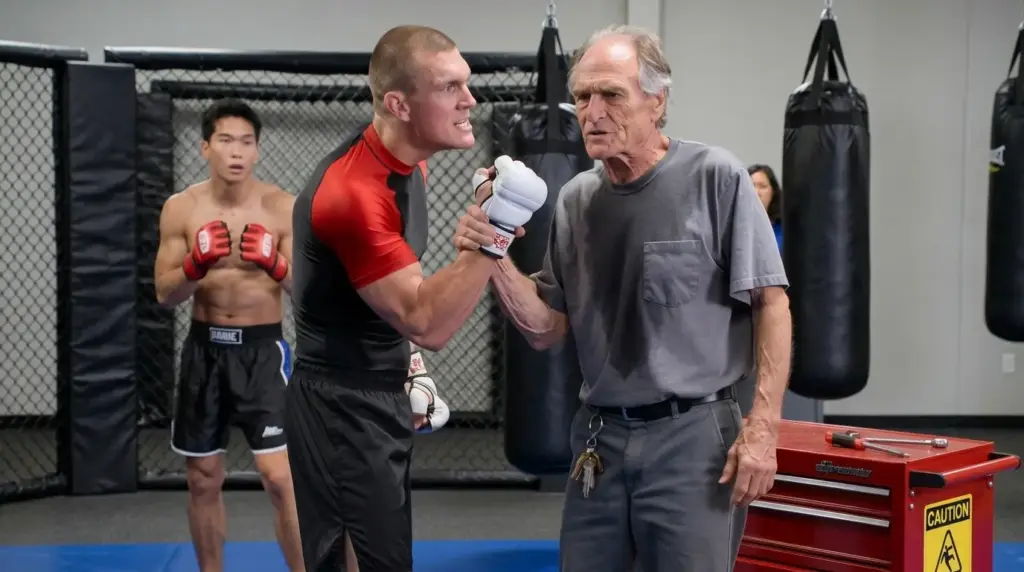
For ten seconds, no one moved.
The stereo was still off.
The room held only the wet, jagged sound of Brad crying on the blue mats.
He was not unconscious.
He was not bleeding badly.
He was not dramatic in the way fighters expect damage to be dramatic.
He had been crippled by a single digit.
Coach Greg pushed through the crowd.
Greg was a pragmatist, a forty-year-old former journeyman fighter who ran the gym mostly to pay for his divorce. He did not care about drama. He cared about liability.
“What happened?” Greg demanded.
He knelt beside Brad and reached for the injured hand.
Brad flinched away with a squeal.
“Don’t touch it! The old man snapped it.”
Greg frowned and looked up at the circle of silent fighters.
“Hank did this?”
Nobody wanted to be first to speak.
Admitting they had watched an arthritic janitor fold their star fighter felt like admitting magic was real.
Sam stepped forward.
“Brad stepped on Hank’s cleaning rag and refused to move. Hank reached for it. Brad grabbed him. Hank put a lock on his thumb. Leveraged it down. The whole thing took maybe three seconds.”
Greg stared at Sam.
Then looked at Brad’s weeping face.
There was no sympathy in the coach’s eyes.
Only calculation.
A fighter with a busted thumb could not spar.
Could not fight the upcoming regional card.
Could not generate hype.
“Get up,” Greg said. “Go to urgent care. Have them X-ray the joint. If it’s a dislocation, they’ll pop it back. If it’s a fracture, you’re in a cast for six weeks. Either way, stop crying in my gym.”
Brad scrambled to his feet.
He did not glare.
Did not threaten.
Did not give a speech.
His head was down.
His shoulders were hunched.
The invincible aura was gone, punctured and deflated, leaving a scared young man in a sweaty rash guard.
He hurried toward the locker room, avoiding eye contact with the very door Hank had just walked through.
The crowd dispersed slowly.
The energy was ruined.
The heavy bags hung untouched.
Sam did not go back to the weights.
He could not.
His accountant’s brain, trained to find discrepancies in spreadsheets and tax codes, was stuck on the mechanics of what he had witnessed.
It defied the gym’s social logic.
Brad was strong, fast, trained, and dangerous.
Hank was old, slow, and broken.
Yet the physics made perfect sense.
The human body was a series of levers and pulleys. Power did not always belong to the larger machine. It belonged to whoever understood where the structure was weakest.
Hank had not needed massive force.
He had isolated the farthest joint, created leverage, applied pressure at the perfect angle, and let Brad’s own anatomy do the rest.
It was not magic.
It was engineering.
Sam waited.
Two hours later, the gym was empty.
Greg had locked the front office and gone. Only dim security lights remained, casting long bruised shadows across the mats.
Sam sat in his car in the parking lot, engine off, windows cracked to let in the cool night air.
He watched the side exit.
At 11:45, the heavy steel door creaked open.
Hank walked out carrying a clear plastic trash bag full of empty energy drink cans and dirty paper towels. He limped heavily to the dumpster, hoisted the bag with a small grunt, tossed it in, and slammed the lid shut.
Then he leaned against the cold metal and rubbed his lower back with one scarred hand.
He looked old.
Deeply old.
The effortless machine that had dismantled Brad was gone.
In its place stood a tired man who had just spent four hours cleaning other people’s filth.
Sam opened his car door and stepped out.
Gravel crunched under his sneakers.
Hank turned slowly.
He did not look surprised.
Only annoyed.
“Gym’s closed, kid,” Hank rasped. “Come back tomorrow.”
“I saw what you did,” Sam said.
He stopped ten feet away, instinctively respecting the space Brad had not.
Hank pulled a crushed pack of generic cigarettes from his pocket, placed one between his lips, and lit it with a cheap plastic lighter. The flame briefly lit his crooked nose and the deep lines around his mouth.
He exhaled a thin stream of blue smoke.
“You saw a kid trip over his own ego,” Hank said. “Nothing more.”
“That wasn’t a trip,” Sam said. “That was a standing thumb lock from a wrist-grab defense. You isolated the joint, locked your elbow to your core so he couldn’t spin out, then dropped your center of gravity. That wasn’t luck. That was muscle memory.”
Hank took another drag.
His eyes stayed flat.
“You watch too many movies. Go home.”
“I’m an accountant,” Sam said. “Those guys in there train for sport. They train for a cage with a referee and padded mats. But you trained for something else.”
Hank chuckled.
A dry, hollow sound.
“I don’t train, accountant,” he said. “I survive. There’s a difference.”
He turned and started walking toward a rusty faded blue Ford Ranger parked under a flickering streetlight.
Sam followed.
“Where did you learn it? Catch wrestling? Judo? Military?”
Hank stopped at the driver’s side door.
His hand rested on the handle.
When he looked back, the annoyance had faded, replaced by something heavier.
Exhaustion.
“You want a story?” Hank asked. “You want a master to teach you some secret touch so you can feel tough at your desk job?”
His voice changed.
The janitor disappeared from it.
Something cold and hard remained.
“There are no secrets. There is anatomy, and there is consequence.”
Hank held up his left hand.
Under the yellow streetlamp, Sam finally saw the details.
The pinky finger was missing from the second knuckle up. The healed skin was tight and shiny over the stump. The other knuckles were flattened and swollen with calcium deposits, like jagged stones pushed under the skin. A thick white scar cut from the base of his thumb across his palm and disappeared into his wrist crease.





