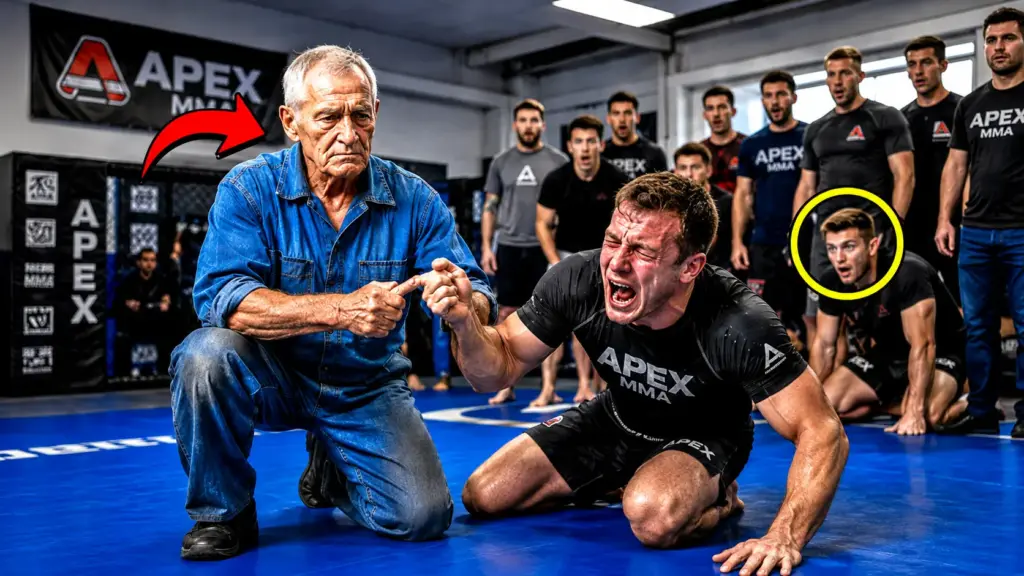
Hank held up his left hand—the one Brad had tried to grab. Under the yellow streetlamp, Sam could finally see the details. The pinky finger missing entirely from the second knuckle up. The skin healed tight and shiny over the bone stump. The knuckles flattened, swollen with calcium deposits, looking like jagged rocks pushed under the skin. The scars. A thick, ragged white line tracked from the base of his thumb across his palm and disappeared into his wrist crease. A knife wound. Deep and old.
“I spent twenty-five years working corrections at a maximum-security penitentiary in Nevada,” Hank said quietly. “Before that, I was a bouncer at a biker bar outside Reno. I never fought for a plastic belt. I never had a referee step in when I was tired. I fought men who had nothing to lose. Men who would bite your nose off, gouge your eyes with their thumbs, or slip a sharpened toothbrush into your kidney just because they didn’t like the way you breathed.”
Hank lowered his hand.
“You learn how to stop a man from killing you, and you learn it quick. You learn what joints snap first. You learn that pain is a better restraint than handcuffs. But mostly, you learn that violence is a filthy, ugly thing. It leaves a stain on you that bleach can’t wash out.”
Hank opened his truck door. The hinges screamed in protest.
“That kid in there,” Hank gestured vaguely toward the gym. “He thinks hurting people makes him a man. He doesn’t know the first thing about pain. He thinks it’s a game. Today I just reminded him it’s not.”
“Will you teach me?” Sam blurted out. He hadn’t planned to say it. It just fell out of his mouth.
Hank paused halfway into the cab. He looked at Sam with genuine pity.
“No,” Hank said. “Because if you’re lucky, you’ll never need to know the things I know. Go balance your spreadsheets, kid. Be glad your biggest worry is a paper cut.”
He slammed the door, started the engine, and drove away, leaving Sam standing alone in the empty parking lot.
Brad didn’t come back the next week. According to the gym gossip, he had suffered a training accident and had a grade-two sprain of the ulnar collateral ligament in his thumb. His Instagram feed was quiet, devoid of the usual shirtless flexing photos. The sycophants who usually orbited him quickly attached themselves to a new up-and-coming heavy hitter. In the ecosystem of the gym, weakness was a terminal illness. Brad was already a ghost.
The atmosphere at Apex shifted. It was subtle at first. The sparring rounds were a little less vicious. The loud booming insults yelled across the mats vanished. There was a quiet realization that crept into the minds of the fighters. The toughest guy in the room wasn’t the one screaming for attention. The toughest guy in the room was the one emptying the spit buckets.
Sam changed too. He stopped trying to hit the heavy bag as hard as he could. Instead, he slowed down. He paid attention to his footwork. He focused on leverage, balance, and center of gravity. He realized that tension was the enemy of power. When you force something, you create resistance. When you flow with it, you take control.
He didn’t bring up the incident to anyone. He didn’t tell them about his conversation with Hank in the parking lot. The truth was heavier than the myth, and Sam knew these guys couldn’t carry it.
Two weeks after the incident, a heavy thunderstorm rolled through the city. The rain hammered against the cinder-block walls of the gym, masking the sound of the traffic outside. Sam stayed late. He was working on a complicated tax audit and needed a mental break, so he hit the bags alone in the back corner.
At eleven p.m., the lights in the main gym shut off, leaving only the dim perimeter bulbs. Hank emerged from the supply closet. He looked worse than usual. The damp, cold weather was wreaking havoc on his joints. His limp was more pronounced—a heavy, dragging step that forced his right shoulder to dip with every movement. He was carrying a large industrial mop and a yellow bucket of soapy water.
Sam watched him from the shadows. Hank pushed the mop across the blue mats. His movements were slow. Strained. He winced audibly as he leaned into the handle, his lower back spasming. He stopped, leaned heavily against the wooden mop handle, and closed his eyes, his breathing shallow and tight.
The invincible old man from the parking lot was gone.
This was the reality of a body that had spent a lifetime absorbing impact. The violence Hank had inflicted on Brad had cost him. The sudden drop in his center of gravity. The twisting torque of his own core. It had flared up decades of chronic nerve damage. He had paid for those three seconds of mastery with two weeks of agonizing sciatica.
There was no glory in it. No cinematic triumph. Just a tired, broken man in his sixties earning minimum wage to mop up the sweat of younger men.
Sam unlaced his gloves. He dropped them next to his gym bag. He walked out onto the mats, his bare feet silent on the rubber. Hank heard him approaching and opened his eyes. He tightened his grip on the mop, his jaw set in a stubborn, defensive line. He hated being seen when he was hurting.
“Gym’s closed, accountant,” Hank muttered, turning back to the floor.
“I know,” Sam said. He stopped a few feet away.
Hank pushed the mop again. The friction of the wet cotton on the rubber mat required a hard driving push from the legs. Hank’s left leg buckled slightly, and he let out a sharp hiss of pain, catching himself on the handle before he went down.





