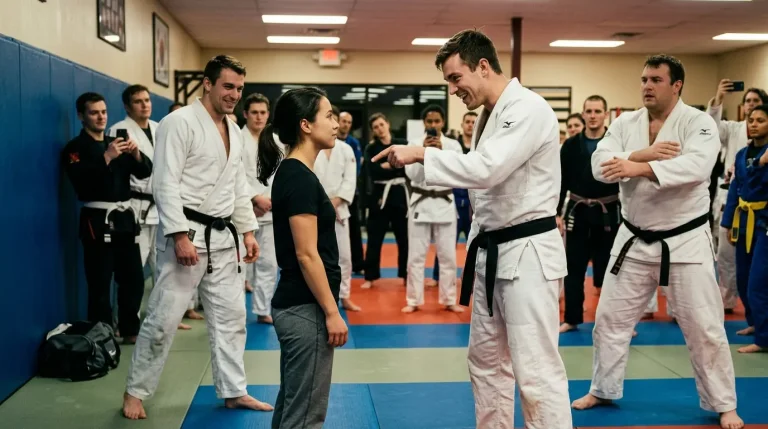
Samuel did not answer. He lowered his head. For the first time since Lena arrived in the academy, the silence was not a pause before applause. It was the beginning of a debt being counted.
Rosa helped Lena into the small assessment room. Behind the door the world became ordinary again: an electric kettle, a plastic skeleton, disinfectant wipes, a box of tissues. Lena placed the torn pieces of her mother’s jacket on the table. One sleeve still bore a yellow mark where Marian had spilled tea during a stormy night years earlier. Seeing it nearly undid her.
“Are you hurt?” Rosa asked.
“My shoulder’s sore.”
“I can document that.”
“I wasn’t thinking about my shoulder.”
Rosa waited.
“My mother kept this longer than she kept any wedding present,” Lena said. “And I brought it here thinking maybe I could understand her.”
Rosa picked up the loose sleeve carefully, without unfolding it. “May I call someone for you?”
Lena took out her phone and stared at her father’s number. She knew what his first question would be, and she had no wish to answer it. But lying by omission was how their family had lived with Marian’s past for almost twenty years.
“I’ll call him,” she said.
When Isaiah arrived, he carried an old brown work coat. He found Lena in the assessment room with Rosa and the torn jacket between them. He didn’t ask for the story until he had examined her hands and arms. He looked into her face, saw that she was holding herself together by effort, and wrapped the coat around her.
“I shouldn’t have told you to ask him,” he said.
“You didn’t tell anybody to tear Mom’s jacket.”
“I knew people in that building could be cruel.”
“So did she. And she went anyway.”
Isaiah sat beside her. He was fifty-nine now, with silver along his temples and dark hands marked by decades of winter work. He had the weary patience of a man who had outlived one terrible year after another. “She went because there were kids who needed somebody to stand between them and a bully. That never changed.”
“Then tell me what happened.”
He nodded once. “I will. But there are other people who owe you an explanation, too.”
Outside, the demonstration ended early. Parents gathered children and spoke in hushed groups. Grant sat on a bench by the lockers, angry now that the cameras were no longer pointed at him. He had never been thrown out of a practice, never been challenged publicly by Samuel, and never expected a joke to become a matter adults would take seriously.
Derek paced. “We shouldn’t have grabbed her.”
“Don’t start,” Grant said.
“She said no.”
“You heard Victor. She came in disrupting things.”
Travis was looking at his phone. He had been recording the incident from a tripod for the academy’s page. In the video, Lena’s voice was clear. So was Grant’s order. He stopped playback when the jacket ripped.
“The whole thing’s online,” Travis said.
Grant reached for the device. “Take it down.”
“It’s already been copied.”
Victor entered and shut the locker-room door. “Nobody speaks to reporters. Nobody posts anything. We are handling this internally.”
Derek asked whether Lena was pressing charges. Victor said he didn’t know. Travis asked whether their academy memberships were suspended. Victor said Samuel had been emotional, and he would calm down.
“Emotional?” Derek repeated. “He looked at us like we’d killed someone.”
Victor’s face hardened. “We can discuss consequences after we know what’s going to happen to the grant.”
That was when Travis began to understand that being valuable to an institution did not mean the institution would protect him once he became inconvenient.
Across town, Aunt Ruthie answered Lena’s call without saying hello. The older woman was seventy-one, with careful hands and a sewing machine she’d maintained longer than her marriage. When Lena told her what happened, Ruthie asked her to bring the jacket to the alterations shop before anyone tried to mend it.
“I need to see exactly where it tore,” she said.
“Why?”
“Because your mother put strength into that coat where she knew strength belonged. If three men pulled it apart, I want the seams to tell the truth.”
By evening the video had reached the regional news. Some viewers called the fighters bullies. Others said the incident was staged or that Lena had invited the confrontation. A few argued that martial arts training was supposed to be hard. The comments multiplied faster than anyone could answer them. Lena turned off notifications but couldn’t stop remembering the laughter.
Isaiah drove her home by the river road. The houses were darkening, and the October air smelled of wet leaves. At a stoplight, he said, “Your mother used to tell me that the first injury is what somebody does to you. The second is when everyone decides you should be quiet about it.”
“Did she get quiet?”
He kept his eyes on the traffic signal. “Sometimes. That was the hardest part to watch.”
Lena took the ragged sleeve from her lap and pressed it between her palms. She had entered the academy looking for a way to help older patients move safely. Now she had become the center of a public argument she had never wanted. She worried she would lose her job, that the hospital would withdraw the partnership, that her mother would be reduced to a hashtag beside a torn uniform.
But underneath those fears was another, sharper question. Why had Samuel Bell called Marian the finest teacher the school ever had when the academy had spent nearly two decades pretending she never existed?
The explanation began, not in Samuel’s office, but in Aunt Ruthie’s sewing room.
On Sunday afternoon, Ruthie cleared the cutting table and spread the ruined gi across it beneath a bright lamp. Isaiah stood near the window. Lena sat on a stool with her injured shoulder propped against a cushion. Ruthie examined each tear with a magnifying glass, following the pulled threads the way a detective might follow tire marks.