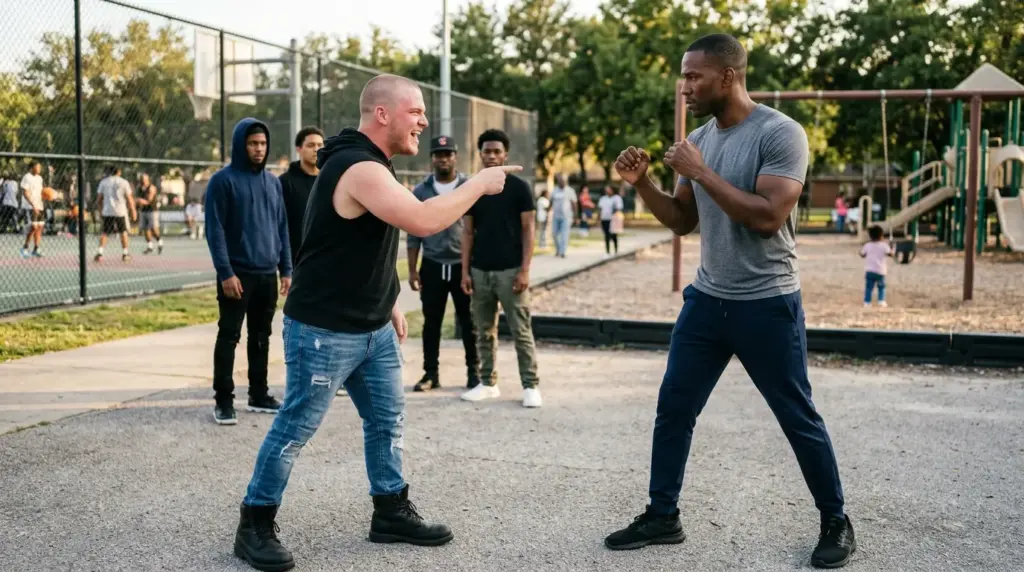
It was the closest thing they had to a place where Nicole still existed in the present tense.
So when Marcus first heard that Victor Cross intended to demolish most of Riverbend Park to build a luxury apartment complex, he went home, sat at the kitchen table for a long time, and opened his laptop.
Marcus was not someone who attended city meetings.
He was not the type to circulate petitions.
He was not the kind of man who put himself in the middle of public disputes.
But he typed a one-page summary of the development plan, printed copies, and left them at every business on Main Street with a note asking people to sign if they wanted to stop it.
Within six weeks, he had more than six hundred signatures.
Within eight, he had filed a formal objection citing inconsistencies in Cross Development’s environmental impact report.
Victor Cross noticed.
And Dylan Cross, who had watched his father notice, decided to handle the mechanic personally.
The first time Dylan’s group showed up at the park, Marcus assumed it was coincidence.
Five young men in their early twenties, loud and careless, drifting toward the duck pond like they owned it.
Dylan was easy to identify, not because Marcus had met him before, but because he moved through the world the way people do when they have never once been told to stop.
One of Dylan’s friends started throwing stones into the water near the ducks.
Ava looked up from her notebook.
“You’re going to scare them,” she said quietly.
She was not rude.
She was eight years old, and she had spent weeks tracking which species nested on the far bank. She said it the way a child says something true before learning that some adults do not care about true things.
Dylan picked up her notebook from the bench.
He looked at it like he was reading it.
Then he dropped it into the mud near the water’s edge.
Marcus was on his feet before the notebook hit the ground.
He walked across the grass at a pace that was unhurried but absolute.
“I’d like you to step away from my daughter,” Marcus said.
Dylan smiled.
“You going to make me?”
Then, louder, for his friends.
“What are you going to do? Hit me in front of your kid?”
Marcus picked up Ava’s notebook, wiped the cover with his sleeve, checked the pages, and handed it back to her.
“We’re leaving,” he said.
Ava followed him without a word.
Before they reached the path, Dylan walked over to the campaign sign Marcus had staked near the garden and kicked the post until it leaned sideways and fell.
“You can’t protect this park,” Dylan called after him. “You couldn’t protect anything that mattered.”
Marcus kept walking.
He did not turn around.
But the words reached him the way cold water reaches a wound.
Not because they were true.
Because they landed exactly where he had never fully stopped blaming himself.
Nicole’s accident.
The two-lane highway.
The phone call at 11:15 on a Tuesday night.
Grief does not need logic to be devastating.
Marcus knew he could not have prevented what happened to his wife.
He knew it in the front of his mind.
But knowing and feeling were two different countries, and some nights he still lived in the wrong one.
That evening, Marcus opened a fresh notebook and began recording everything.
Dates.
Times.
What was said.
Who was there.
Faces he recognized.
Faces he did not.
He was methodical about it.
Not emotional.
Thorough.
The next morning, he took his notes to the Riverbend Police Department and filed a report.
The officer on duty was polite and unhelpful in a way that suggested he already knew whose son Dylan Cross was.
He said there was not enough to act on.
He suggested Marcus try to avoid further contact.
Marcus went home and kept the notebook.
Over the next two weeks, things escalated.
Not loudly enough to force action.
Just enough to make the message clear.
The front tires of his truck were flat one Monday morning.
Someone spray-painted a crude message across the community garden’s entrance sign overnight.
A series of comments appeared on the garage’s business page, using language Marcus would never repeat in Ava’s presence.
Then one afternoon, a customer mentioned casually that he had seen someone taking photographs of Ava outside her school.
That changed something in Marcus.
Not fear exactly.
Something colder.
A version of fear with teeth.
Then came the phone call.
The voice on the other end was male, unfamiliar, and unhurried.
“If you withdraw the petition, all of this stops.”
Marcus said nothing.
The voice continued.
“Men in your position — single fathers, hourly workers, people without resources — sometimes make the mistake of thinking they are protected by the same rules as everyone else.”
Then the line went dead.
The meeting with Victor Cross happened in the parking lot of City Hall three days after the council session where Marcus presented the six hundred signatures.
Victor was tall, polished, and calm in the way powerful men are calm when they believe every room eventually bends toward them.
He shook Marcus’s hand with enough pressure to make it a statement rather than a greeting.
Then he made an offer.
He said he would retire the garage’s debt.
He said he would establish an education fund for Ava.
He said there were better neighborhoods, better schools, better opportunities, all of which could be arranged quietly and quickly if Marcus understood the petition had run its course.
Marcus listened without interrupting.
Then he said no.
Victor’s expression did not change.
It simply stilled, the way a room goes quiet before a storm.
“One mistake,” Victor said gently, “and you could lose a lot more than this park.”
Within forty-eight hours, an anonymous report was filed with Child Protective Services.
The report claimed Marcus had a volatile temper, a history of violence, and a daughter living in fear.