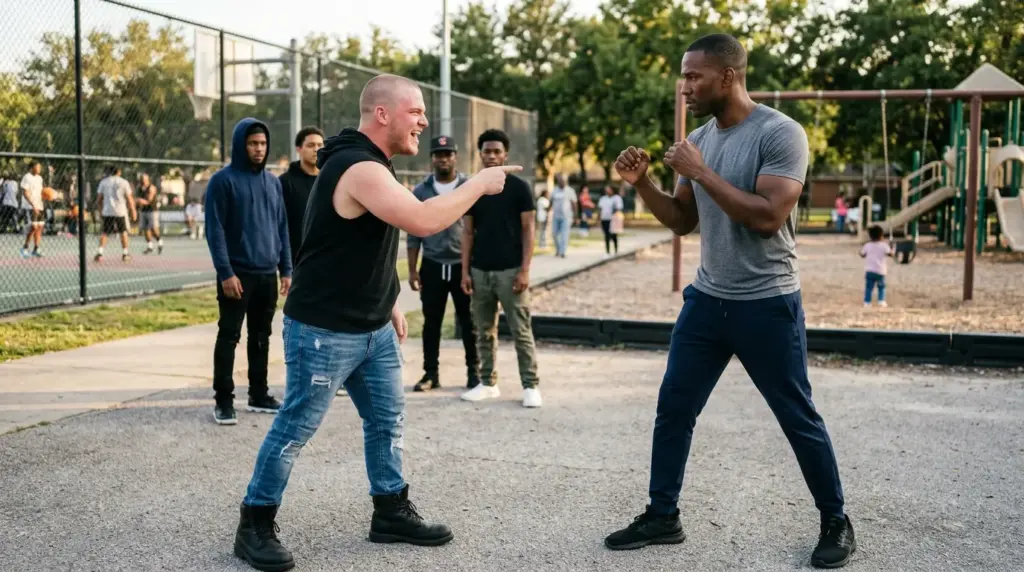
Around the same time, a rumor began circulating among parents at Ava’s school that the quiet mechanic at the garage had once done time for assault.
Marcus sat with that information for a full evening before making a phone call.
The number had not changed in eleven years.
It rang four times before Elijah Brooks picked up.
Same voice.
Same unhurried baritone.
The man who had trained Marcus six days a week in a converted warehouse outside Columbus, back when The Quiet Storm was still a name people whispered before fights.
Marcus told Elijah what was happening.
Not everything.
Enough.
Elijah was quiet after Marcus finished.
Then he said, “I need you to understand something. You’re not walking into that park to win a fight. You’re walking in to bring your daughter home safe. That is the only thing that matters.”
They made arrangements.
Elijah drove to Riverbend that weekend. The two men spent Saturday in Marcus’s garage, not training in any dramatic sense, but preparing.
Elijah helped him set up a small camera inside his jacket with a backup audio recorder that uploaded automatically to a cloud server every fifteen minutes.
They talked through exit routes.
Scenarios.
Techniques designed to control without causing lasting damage.
Before Elijah left, Marcus wrote three sentences on a piece of paper and placed it on the kitchen counter.
Protect Ava.
Don’t retaliate.
Use only what is necessary.
He read those sentences every morning.
Not because he had forgotten them.
Because repetition is a form of commitment.
Dylan Cross was not stupid.
That was what made him dangerous.
He had watched Marcus walk away from every provocation without breaking. He understood that a man like that could not be handled through simple insult.
You could not make him swing first by getting in his face.
You could not rattle him by mocking his past.
Marcus Reed had already decided how far he was willing to go.
So Dylan stopped aiming at Marcus.
He aimed at what Marcus could not walk away from.
Ava’s route home from school was only four blocks. One afternoon, she told Marcus a car had driven slowly beside her for most of Orchard Street, keeping pace until she turned onto their block.
She did not recognize the car.
She said she had not looked directly at it because something told her not to.
Marcus listened.
Nodded once.
The next morning, he arranged a different dismissal plan with the school.
He did not tell Ava why.
He added the date and description to his notebook.
Then the bird feeder Ava had built for her school project was found snapped in half near the garden.
Blue and yellow balsa wood, broken clean at the post.
Ava stood in front of it, holding the pieces.
She did not cry.
She was eight years old, and she had already learned that some things that break do not come back, so there was not much point crying about wood.
That night, she asked if maybe next Tuesday they could go somewhere else.
Somewhere that was not the park.
Marcus told her they would talk about it in the morning.
Then came the drawings.
Someone reached the poster board Ava had mounted near the community garden, the one with her species count and migration notes, and drew over it with a thick black marker.
Marcus took it down before Ava saw what had been drawn.
The same week, Ava received an anonymous video message.
It was just footage of the duck pond at night.
Silent.
Dark.
A red circle had been drawn digitally around the tree where her wildlife camera was mounted.
The morning after that video, Ava found a rubber duck painted entirely red sitting on the ground beneath her wildlife camera, positioned so that it faced the lens.
Marcus removed it without touching it directly, sealed it in a plastic bag, and added it to the growing folder on the high shelf in the hall closet.
Photographs.
Timestamps.
Police reports.
The anonymous CPS complaint.
Everything organized in clear plastic sleeves.
By then, the folder was thick enough that it needed a binder clip to stay closed.
Ava started waking up in the middle of the night.
Sometimes Marcus would find her sitting in the kitchen with the light on, drawing birds in her sketchbook because, she said, it helped her brain slow down.
One night, with the strange honesty children sometimes have at four in the morning, she told him she kept dreaming she came home from school and he was not there.
Marcus sat across from her.
“That’s not going to happen,” he said.
Ava looked at him steadily.
“I know.”
Then she went back to her drawing.
Marcus genuinely considered stepping back from the petition.
Not because of what it would cost him.
Because Ava’s sense of safety was eroding in ways a petition could not fix.
The decision changed on a Thursday evening.
Ava was supposed to be upstairs reading. Marcus was at the kitchen table reviewing the council meeting agenda when she came down quietly and stood in the doorway.
He realized she had overheard the call he had taken twenty minutes earlier.
Someone at the council office had mentioned that Victor Cross already had excavation equipment on standby for the morning after the final vote.
Ava had heard enough.
She stood in the kitchen doorway in her pajamas and said, with the kind of steadiness that sometimes appears in small people who have already lost something enormous, “If we leave because we’re scared, other kids will have to leave too.”
Marcus looked at his daughter for a long moment.
Then he closed the agenda and told her to go to bed.
He did not touch the withdrawal letter he had been drafting on his laptop.
He closed that too.
Dylan chose the following Tuesday deliberately.
The park would have its usual mid-afternoon foot traffic. Enough witnesses to create pressure. Not so many that his group could not control the perimeter.





