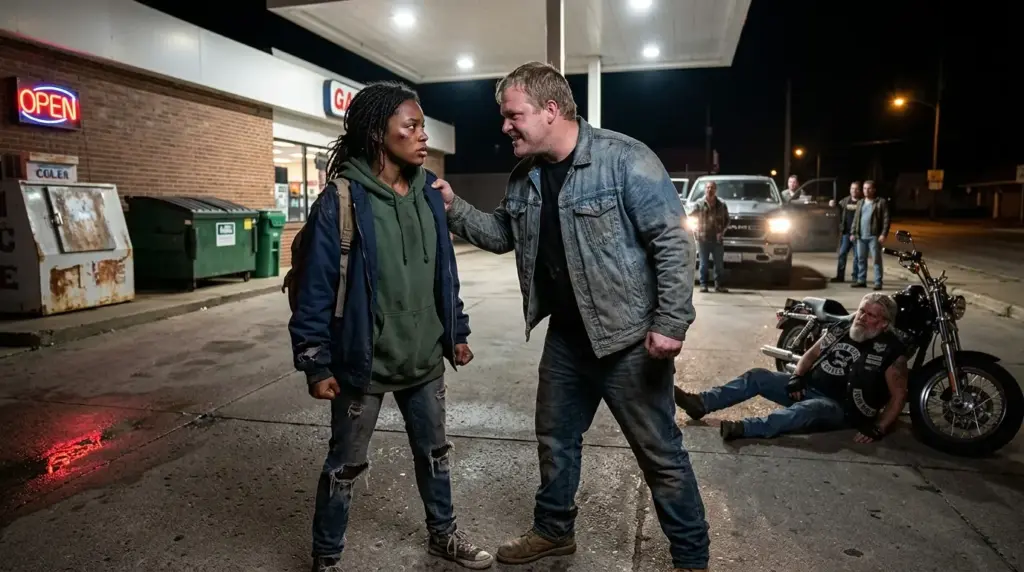
Bryce Fletcher stepped out of the shadows behind the gas station and faced five men twice her size.
She was nineteen years old.
Homeless.
Black.
Ninety-three pounds on a good day.
The kind of girl people looked past on sidewalks, stepped around near dumpsters, and forgot the second she disappeared from sight.
Behind her, an old man groaned on the asphalt, one hand pressed to his ribs, blood running from his nose into his gray beard.
Craig Dutton laughed and shoved Bryce backward.
“Look at this,” he said. “He’s begging a street rat for help.”
The old man struggled to breathe.
“Please,” he gasped. “I can’t—”
Craig turned and lifted his boot.
Bryce moved before she thought.
She stepped between them.
“Touch him again,” she said, voice low and shaking with fury, “and see what happens.”
Craig stared down at her.
Then he grabbed the front of her jacket and yanked her close.
“Who do you think you are?”
Bryce smelled beer on his breath. Saw the other four men closing around her. Saw the neon sign flickering red across the pavement. Saw the old man on the ground, helpless.
And something inside her refused to run.
She had spent three years running.
From foster homes.
From locked refrigerators.
From fists in hallways.
From men who thought no one would care if a girl like her vanished.
Not tonight.
Bryce swung first.
Twelve hours earlier, the sun had not even cleared the tree line when Bryce crawled out from under the Cedar Falls overpass.
She stuffed her sleeping bag into a torn black garbage sack and shoved it behind the concrete pillar where no one would look unless they already knew how to be invisible.
Three years on the street had taught her one law above all others.
Leave no trace.
She walked two miles to the gas station on Route 9.
Not for gas.
For the dumpster behind it.
The morning shift threw out expired sandwiches around six. If Bryce got there first, she ate. If someone else beat her to it, she didn’t.
That morning, she was second.
A man twice her age had already torn open the good bag. When he saw her, he clutched the food against his chest.
“Back off, girl.”
Bryce did not argue.
Arguing wasted energy, and energy was food.
She circled to the side dumpster, the one nobody checked because it mostly held cardboard. Months of hunger had taught her that sometimes a bruised apple, crushed granola bar, or sealed drink slipped through.
Today she found half a protein bar and a bottle of water with the cap still sealed.
A good morning.
That was life on the streets.
You measured days by what you found before somebody else found it first.
Bryce had been out there since she was sixteen.
Before that, there had been seven foster homes.
The first family forgot her name within a week. The second locked the refrigerator at night. The third had a son who liked to throw things and adults who called it “roughhousing.” By the fourth home, Bryce had stopped unpacking her bag.
The last home was the Turners.
Gerald Turner did not just yell.
He used his hands.
When Bryce told her caseworker, the woman sighed and said she would look into it.
Two months passed.
Nothing changed.
So Bryce climbed out the bathroom window one January night with forty dollars and a backpack.
She was sixteen.
Nobody came looking.
At eighteen, the system officially closed her case by mailing a letter to an address where she no longer lived.
That was it.
No phone call.
No follow-up.
Just a paper telling a vanished girl she had been released.
The street sharpened her.
It taught her how to sleep with one eye open, how to wake at footsteps, how to read trouble from the way a man walked. It taught her that the first clean punch mattered more than size. It taught her to strike before fear made her freeze.
The drifters under the overpass learned quickly.
The skinny Black girl hit fast.
She was not strong.
But she was quick.
And she never hesitated.
By noon, she walked into Cedar Falls.
Cedar Falls was small enough that strangers became news before sunset. One main street. Two churches. A hardware store. Donna’s Diner. A gas station where the cashier looked at Bryce like she had dragged something dead inside.
She set two quarters and three dimes on the counter.
“Cheapest water you got.”
Kyle, the teenage cashier, glanced at the coins.
“That’s not enough.”
“It was enough last week.”
“Price went up.”
He did not sound sorry.
Bryce picked up the coins and left.
No argument.
No scene.
Making noise got you remembered. Getting remembered got you run out of town.
Outside, a motorcycle sat in the lot.
A big one.
Chrome pipes. Leather saddlebags. Custom paint that probably cost more than every dollar Bryce had ever held.
Its owner stood beside it checking tire pressure.
He was an old white man with silver hair pulled into a low ponytail, a thick gray beard, and a leather vest covered in patches. Bryce did not know what the patches meant. She did not know the largest one across his back read:
IRON WOLVES
PRESIDENT EMERITUS
She did not know that Walt Caldwell had once commanded the loyalty of more than a thousand riders across three states.
To her, he was just an old man with a motorcycle.
To him, she was just a thin girl sitting on the curb fifteen feet away, chewing half a protein bar like it was a feast.
He glanced at her once.
Nodded.
Then went back to his bike.
Neither of them spoke.
In eight hours, she would save his life.
But right then, they were just two strangers sharing the same patch of afternoon sun.
Night fell on Cedar Falls like a curtain.
Behind the gas station, there were no streetlights, only the hum of a broken cooler and the red flicker of the neon sign bleeding across the pavement.





