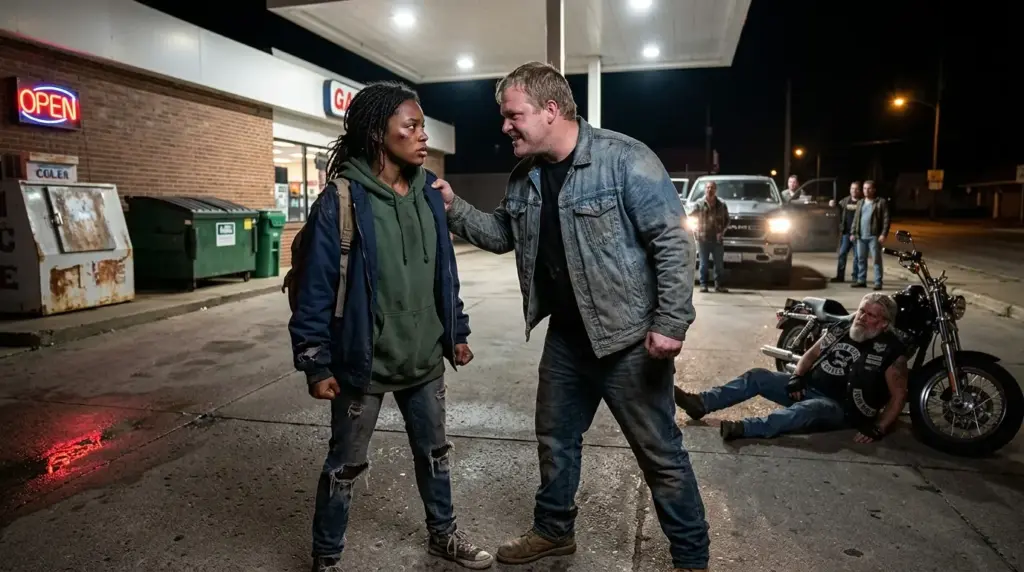
Reed picked up on the second ring.
“Walt,” he said. His voice was deep, calm, the kind that filled a room without trying. “Been a while.”
“I need help, Reed.”
“Tell me.”
Walt told him everything.
The parking lot.
The girl.
The fight.
The arrest.
The petition.
The lawyer who could not take the case because Donna’s family had half the town by the throat.
He told it straight.
No embellishment.
The way a man talks when he is out of options.
When he finished, the line went quiet.
Then Reed said, “If you say she’s family, she’s family.”
A pause.
“Give me forty-eight hours.”
Then he hung up.
Reed Garrison had been president of the Iron Wolves for five years. Before that, he had been Walt’s vice president for a decade. He ran a construction company out of Des Moines, employed sixty people, and managed twelve Iron Wolves chapters across Iowa, Nebraska, and Missouri.
When Reed called, people answered.
Within six hours, every chapter president in the network had received the same message.
One of ours was attacked.
The girl who saved him is in a cell.
We ride Saturday.
No debate.
No vote.
A brother had called.
The pack answered.
But Reed was not only building an army.
He was building a case.
He called Hank Morrison, the quiet man with tattooed forearms who had shaken Bryce’s hand two weeks earlier.
Before joining the Iron Wolves, Hank had spent fourteen years as an IT systems engineer. He had built security networks for banks, hospitals, and government buildings.
Finding deleted gas station footage was, as he put it, “a Tuesday afternoon.”
Hank drove to Cedar Falls Thursday night.
The local copy of the video had been deleted. Officer Tate had written “camera malfunction” in his report.
But the gas station used a cloud-backed security system.
The store owner could erase the local file.
Small-town politics could bend a report.
But the cloud did not care who Donna Prescott was.
By Friday morning, Hank had everything.
The footage was clean.
Timestamped.
Unedited.
Craig and his friends pulling into the lot.
Walt walking toward the store.
Craig blocking his path.
Craig throwing the first punch.
Walt hitting the pavement.
Five men kicking him.
Bryce running in from the shadows.
The fight.
The sirens.
The pickup fleeing.
Self-defense.
Clear as glass.
Then Hank found something else.
At the 11:47 mark, twenty-three minutes after the attackers fled, Craig Dutton placed a call on speakerphone with his truck windows down.
The security microphone caught enough.
“Aunt Donna, we got a problem.”
Donna’s voice came back, controlled and cold.
“Calm down. I’ll handle it. Just keep your mouth shut.”
That was enough.
Enough to prove she knew the truth before she started the petition.
Enough to prove her campaign was not civic concern.
It was a cover-up.
Walt took the files to Sheriff Ed Barnes at the county office.
Not the Cedar Falls police station.
Not Officer Tate.
Barnes had thirty years in law enforcement and did not owe Donna Prescott a thing.
He watched the footage twice.
He listened to the call three times.
Then he made two phone calls.
The first released Bryce Fletcher from custody, all charges dropped.
The second opened a criminal investigation into Craig Dutton, Tyler Voss, Derek Earl, Donna Prescott, and Officer Tate.
Walt stood in the sheriff’s lobby when Bryce walked out.
She looked smaller than he remembered.
Two days in a cell with bad food and no sleep had hollowed her out.
“Let’s go home,” Walt said.
Bryce nodded.
Then whispered, “You came back for me.”
Walt’s face tightened.
“Kid, I was never leaving.”
Saturday morning broke clear and cold over Cedar Falls.
By seven, the first rumble echoed off the hills east of town.
By eight, Main Street was vibrating.
They came from Des Moines.
Omaha.
Kansas City.
Lincoln.
St. Joseph.
They came in packs of twenty, fifty, a hundred, rolling down Route 9 in staggered formations. Harleys, Indians, custom choppers with ape-hangers and straight pipes that rattled every window on Main Street.
The people of Cedar Falls heard them before they saw them.
By nine o’clock, a thousand motorcycles lined Main Street from the Baptist church to the water tower.
A thousand riders stood beside their machines.
Men and women in leather vests.
Arms crossed.
Faces calm.
They did not shout.
They did not threaten.
They simply filled every inch of available space and waited.
Reed Garrison had set up a flatbed truck across from Donna’s Diner.
On it sat a projector, speakers, and a screen large enough to be seen from three blocks away.
A local news van parked at the corner.
A county reporter stood in the crowd.
Someone was live streaming.
Walt drove up Main Street with Bryce in the passenger seat.
She wore a plain black leather jacket Helen had bought her the day before. No patches yet. Her hands were folded tightly in her lap.
“You don’t have to get out,” Walt said. “You can stay in the truck.”
“No.”
She opened the door.
“I’m done hiding.”
She stepped out.
A thousand riders turned to look at the girl they had come for.
Most had never met her.
But they knew she had bled for Walt.
And that was enough.
Nobody clapped.
Nobody cheered.
They just nodded.
One by one.
A thousand quiet nods from a thousand strangers.
It was the quietest thunder Bryce had ever felt.
Reed climbed onto the flatbed.
“My name is Reed Garrison,” he said into the microphone. “I’m president of the Iron Wolves Motorcycle Club. We are twelve hundred members across three states. We are veterans, mechanics, teachers, engineers, nurses, and fathers. We are not a gang. We are a family.”
The street was silent.
“Two weeks ago, a nineteen-year-old girl, homeless and alone, watched five men beat a sixty-three-year-old man in a parking lot. She didn’t walk away. She stepped in. She fought. She bled. And she saved his life.”
He pointed to the screen.





