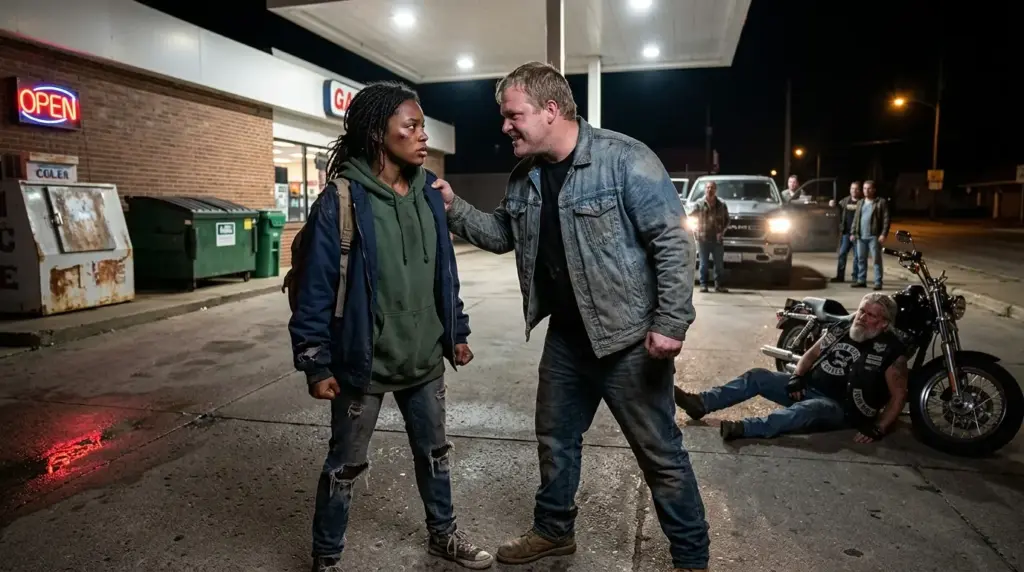
Then she smelled bacon.
Helen stood at the stove in a blue cotton robe, flipping strips in a cast-iron skillet. She looked over her shoulder and smiled like a homeless girl bleeding on her couch was just another Tuesday morning.
“How do you take your eggs?”
Bryce stared at the table.
It was set for three.
Three plates.
Three forks.
Three glasses of orange juice.
She had not sat at a table set for her since she was eleven.
“Scrambled,” she said.
Walt came down the hall in jeans and a flannel shirt, moving slowly. His ribs were taped beneath the fabric.
They ate in silence.
Not awkward silence.
The kind that comes when people do not need to perform for each other.
Bryce cleaned her plate and forced herself not to ask for more.
In foster homes, asking for seconds got you noticed.
Getting noticed got you hurt.
Helen put another scoop of eggs on her plate without being asked.
Bryce looked up.
Helen only smiled and returned to the stove.
After breakfast, Walt led her to the garage.
It was massive. Two bays, tool walls, a hydraulic lift, and three motorcycles in various stages of repair. The air smelled like engine oil, metal shavings, and purpose.
“You know anything about bikes?” Walt asked.
“No.”
“Good. Means you don’t have bad habits.”
He handed her a wrench.
“Hold this. I’ll show you the rest.”
For two hours, Bryce learned the anatomy of a Harley-Davidson Softail.
Carburetor.
Clutch cable.
Primary chain.
Walt explained each piece once.
She remembered.
He did not have to repeat himself.
“You’re quick,” he said.
“I’ve always been quick.”
She meant more than mechanics, and he knew it.
That afternoon, Walt asked her about family.
Bryce tensed the moment the question came.
“Don’t have one,” she said.
“Foster care?”
She nodded.
“Aged out when?”
“Year and a half ago.”
“And before that?”
She put down the wrench.
“Seven homes. None of them worked out.”
Walt did not say the useless things people say when they want to sound kind without doing anything.
He did not say, I’m sorry.
He did not say, That must have been hard.
He simply pulled out his phone, stepped to the other side of the garage, and made a quiet call.
When he returned, Bryce asked, “Who was that?”
“A friend.”
That was all he said.
Later, he took her into town for lunch.
Donna’s Diner sat on Main Street, the kind of place where everyone knew the waitresses by name and outsiders were noticed the second the bell above the door rang.
A dozen heads turned when Walt and Bryce walked in.
Donna Prescott stood behind the register, mid-fifties, bleached hair stiff with spray, reading glasses on a beaded chain. She owned the diner, sat on the town council, and ran the Fourth of July parade.
In Cedar Falls, Donna’s approval was currency.
She looked Bryce up and down like she was something stuck to a shoe.
“Walt,” Donna said, forcing a smile. “Who’s your friend?”
“This is Bryce. She’s staying with us.”
“Staying with you?” Donna’s smile thinned. “How nice.”
Then she lowered her voice and pulled Walt aside.
Bryce heard every word.
“Walt, honey, I don’t know what you’re doing, but you can’t just bring people like that in here.”
“People like what, Donna?”
“You know what I mean. She looks like trouble. She’ll scare off my regulars.”
“She saved my life last night.”
Donna blinked.
“I’m sure she did, but this is my establishment and I have a right—”
“Seat us or don’t,” Walt said. “But choose your next words carefully.”
Donna seated them at the table nearest the bathroom.
Then she called Officer Ryan Tate.
He arrived thirty minutes later with a badge too shiny and eyes that went straight to Bryce.
“We had a complaint about a disturbance,” he said.
“She’s sitting in a booth,” Walt replied. “That’s not a disturbance.”
“I understand, sir, but—”
“Are you charging her with something?”
Officer Tate shifted.
“No, sir.”
“Then we’re done here.”
Walt put a hand gently on Bryce’s shoulder and guided her out.
She wanted to flinch.
She didn’t.
In the truck, Walt gripped the steering wheel and stared through the windshield.
“This town’s about to learn a lesson.”
Bryce did not ask what he meant.
But something in his voice made her believe him.
Two weeks passed.
Fourteen mornings of waking up in a bed instead of on concrete.
Fourteen breakfasts she did not have to fight for.
Bryce fell into a rhythm at the Caldwell house.
Mornings in the garage with Walt, rebuilding engines and learning the difference between a good weld and one that would kill you at seventy miles an hour.
Afternoons in the kitchen with Helen, chopping onions, seasoning cast iron, and pulling biscuits from the oven at exactly the right second.
“You’ve got good hands,” Helen told her one evening. “Steady.”
“They’ve had practice,” Bryce said.
She did not explain what kind.
Walt started teaching her to ride.
Bryce took to it like she had been born on two wheels.
By the third day, she could handle the Softail on back roads without wobbling. By the fifth, she leaned into curves with natural instinct.
“Absolute natural,” Walt muttered.
A few Iron Wolves members stopped by during those weeks.
Big men and women with thick leather vests, road-worn faces, and patches that made people in town look away.
They came to check on Walt.
One by one, they met Bryce.
One by one, they heard the story.
None of them looked at her the way Donna had.
They shook her hand.
They called her little sister.
A tall, quiet man named Hank Morrison, with tattooed forearms and calm eyes, told her, “Anyone who bleeds for one of us is one of us.”
Bryce smiled.
A real smile.
Helen saw it from the kitchen window and turned away so no one would see her cry.
But the nights were still hard.





