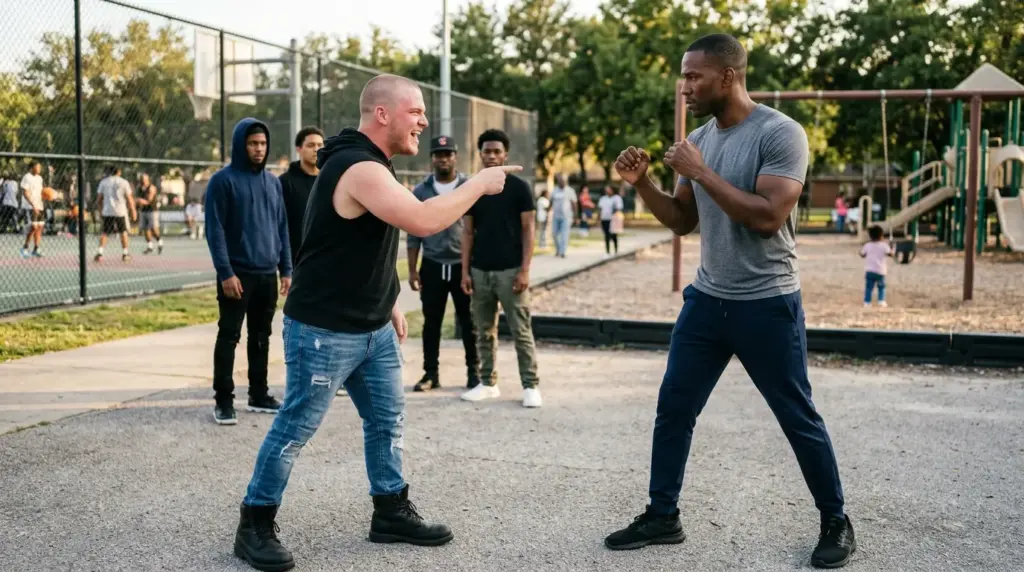
“Look at that,” Dylan Cross said, smiling like he had already won. “Brave little dad showed up.”
Marcus Reed stood on the grass at Riverbend Park with both hands open at his sides.
Five young men surrounded him near the duck pond.
Behind them, his eight-year-old daughter, Ava, was struggling to breathe.
Her backpack had been pulled off her shoulder. Her notebook had fallen near the path. Her small blue inhaler was in another man’s hand, being held up like a joke.
“My inhaler’s in there,” Ava said, her voice thin and broken. “Please.”
The young men laughed.
Marcus did not.
He looked at Dylan Cross, the twenty-two-year-old son of the most powerful developer in Riverbend, Ohio.
“Give her the bag,” Marcus said.
Dylan tilted his head toward Cole, the friend holding Ava’s backpack.
“This one?” Dylan asked. “Think we’ll hold on to it.”
Ava’s breath hitched.
Marcus heard it immediately.
That tight, frightening whistle in her chest.
The sound that had sent him running across playgrounds, classrooms, parking lots, and grocery aisles ever since she developed asthma at six years old.
“She can’t breathe,” Marcus said.
Dylan stepped closer and shoved him into the wooden slats of a park bench.
“Then do something.”
Around them, people had started watching.
Some from the walking path.
Some from benches.
Some with phones already raised.
Dylan knew exactly what he was doing.
He wanted witnesses.
He wanted footage.
He wanted Marcus Reed, the quiet mechanic with six hundred signatures against his father’s luxury apartment project, to lose control in public.
“Hit me,” Dylan whispered. “Show them what you really are.”
Marcus looked past him at Ava.
Her small hand clutched her chest.
Her eyes were wide.
Terrified.
And in that moment, Dylan Cross made the same mistake men like him often make.
He mistook silence for surrender.
He mistook restraint for weakness.
He believed the man standing in front of him was just a mechanic, a single father, someone easy to break.
What Dylan did not know was that Marcus Reed had already survived things Dylan Cross could not imagine.
And before the next minute was over, everyone in Riverbend Park would learn the difference between a violent man and a controlled one.
Every Tuesday afternoon, Marcus packed two granola bars, a thermos of hot coffee, and a small notebook into his canvas bag before heading to Riverbend Park.
The routine had started three years earlier as a way to get Ava outside after school.
Somewhere along the way, it had become the steadiest thing in both their lives.
Ava would crouch near the water with her binoculars, scribbling notes about which ducks had returned that week, while Marcus sat on a nearby bench and watched her the way most people watch a sunset.
Like he knew it would not last forever.
Like he was trying to memorize every second.
Marcus was not a man who talked much about himself.
At the garage where he worked on the east side of Riverbend, the other mechanics knew him as the guy who stayed late without complaining, never missed a day, and kept a laminated photo of his daughter tucked inside his toolbox.
They knew he was raising Ava alone.
They knew his wife, Nicole, had died when Ava was three years old.
A rainy night.
A two-lane highway.
A truck that crossed the center line.
Beyond that, Marcus offered no details.
Nobody pushed.
Some men carry grief the way they carry a bad knee, quietly, every single day, without expecting anyone to notice.
What nobody in Riverbend knew was that Marcus Reed had once been someone else.
Not dangerous in the way people fear a large, quiet man.
Dangerous in the way a locked door is dangerous because something serious lives behind it.
Before Ava, before Nicole, before the garage and the Tuesday afternoons and the granola bars, Marcus had fought professionally under the name The Quiet Storm.
Twenty-seven wins.
Two losses.
Regional welterweight champion.
He was never the kind of fighter who won by brute force. His coaches used to say he could read a man’s body like a sentence. He knew what was coming before the other man had finished thinking it.
When Marcus controlled someone, he did it without rage.
That was what made him so effective.
And that was what made walking away so easy when the time came.
He had never needed violence.
He had only needed discipline.
After Nicole died, Marcus packed his championship belt, gloves, and every newspaper clipping into an old trunk and carried it down to the basement.
He did not throw any of it away.
He simply locked the lid and did not open it again.
Ava knew her father had done some kind of fighting when he was younger. She had never pressed for more than that, and Marcus had never volunteered it.
Some things, he believed, belonged to a version of himself that no longer needed to exist.
What existed now was the man who packed an extra inhaler in his jacket whenever he took Ava anywhere.
The man who taught himself to braid hair from a YouTube video at two in the morning because Ava had once asked if he could make it look like her friends at school.
The father who adjusted his shift schedule every week so he could pick her up himself, who read science homework with her at the kitchen table, who let her talk about birds for thirty minutes straight without checking his phone.
Riverbend Park was where all of that felt most real.
The community garden on the west side of the park still had Nicole’s name on a small wooden marker near the rose bushes. She had helped plant them the spring before the accident.
Marcus walked past it slowly every week without stopping.
Ava had learned not to point it out.
The duck pond, the oak trees, the winding path, the rose garden — all of it had become something more than a park.