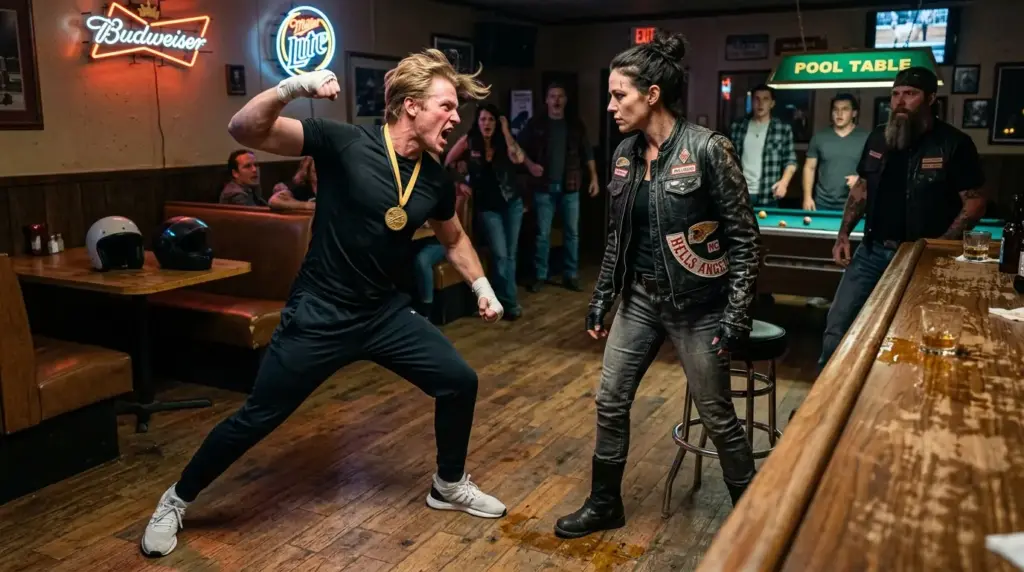
There is a specific sound a man makes when he realizes the world does not play by the rules of his foam-padded dojo.
It is not a battle cry.
It is not the sharp yell he practices in front of mirrors.
It is a wet, choking gasp.
The kind that comes when pride leaves the body before the air does.
Logan Cross thought he was picking a fight with a tired biker woman.
He did not know the woman in cracked leather had once been a ghost in Tel Aviv.
The Brass Knuckle sat on the edge of the Nevada desert, halfway between a dry highway and nowhere worth naming. The air inside tasted like old pennies, stale beer, cigarette smoke, and the sour sweat of men who worked sixty-hour weeks and drank like silence was chasing them.
Ceiling fans pushed the smoke around in slow, lazy circles. The floorboards were sticky with spilled beer. The walls were crowded with faded motorcycle posters, broken neon signs, and photographs of men who looked like they had outlived either prison, war, or both.
It was the kind of bar where the bartender kept a sawed-off shotgun beside the ice bin and nobody asked about the patched cuts worn by the regulars.
Logan did not belong there.
He stood out like a sore thumb wrapped in a clean white bandage.
He was twenty-four years old, high on cheap adrenaline and convinced the night itself had been built to applaud him. He wore a fitted black athletic shirt that clung to his heavily defined chest. His gym bag hung over one shoulder. Around his neck, resting against his collarbone, was a gold medal from the West Coast Regional Karate Championships.
He had won it three hours earlier.
First place.
Three rounds.
No serious challenge.
Now the medal felt like proof that he had crossed some invisible line between talented and untouchable.
He walked through the crowded bar with three friends behind him, carrying the smell of expensive citrus cologne and fresh laundry detergent into a room that smelled of gasoline, sweat, ammonia, and old regret.
“Three rounds, man,” Wyatt shouted over the jukebox. “You didn’t even let him breathe.”
Wyatt was Logan’s favorite kind of friend: loyal, impressed, and easy to lead.
Logan smirked.
“He dropped his guard,” he said loudly enough for the nearest tables to hear. “You drop your guard with me, you go to sleep. Basic physics.”
He bounced lightly on the balls of his feet as he walked, a habit built from years on padded mats where men bowed before they tried to kick each other in the head.
At the far end of the bar, sitting completely still, was Leah.
She did not look like a killer.
She looked like someone who had driven three hundred miles of bad road and wanted to be left alone.
Her leather jacket was heavy, cracked, and dusted with desert grime. On the back was the winged death head of the local Hells Angels charter, the patch worn with the kind of history that did not need polishing. Her dark hair was pulled into a rough knot. Her fingernails were short, jagged, and rimmed with engine grease. A half-empty glass of rail whiskey sat on the chipped bar in front of her.
She was not paying attention to Logan.
Her mind was somewhere else.
Halfway across the world.
Anchored to the smell of burning tires in a narrow alley in Beirut, the metallic click of a jammed firing pin, and the dry heat of the Levant sun baking moisture out of her skin.
She had been stateside for two years, buried deep undercover, tracing weapons logistics through outlaw motorcycle clubs. She had a name that was not hers, a motorcycle that was not registered to her, and enough lies in her pocket to pass through six different lives without leaving fingerprints.
The Mossad did not give out medals.
They gave out new identities, ulcers, and dreams that smelled like cordite.
Logan, drunk on ego and two shots of bad tequila, bumped hard into the back of Leah’s stool.
The heavy glass of whiskey wobbled, tipped, and spilled across the bar.
Amber liquid pooled in the carved wood and dripped onto Leah’s scuffed leather boot.
She did not flinch.
She did not curse.
She stared down at the whiskey soaking into the leather.
Then she took a slow breath.
Deep.
Controlled.
From the diaphragm.
A grounding technique.
Control the breath, control the room.
“Whoa, easy there, sweetheart,” Logan laughed without turning around. He slapped one hand on the bar. “Jess, get us four drafts and whatever the lady in the costume dropped.”
Leah turned her head.
Her eyes were dark, flat, and entirely empty of the irritation Logan expected to see.
No nervousness.
No social discomfort.
No flustered anger.
Just a clinical appraisal so still it should have warned him.
“It’s not a costume,” Leah said.
Her voice was quiet and raspy from dust, cigarettes, and too many nights spent pretending to be less dangerous than she was. Somehow, it cut straight through the low hum of the bar.
Logan turned.
He looked her up and down.
He saw a woman in her early thirties, dusty, seated alone, wearing a biker jacket. He saw someone smaller than him. He saw someone his friends would laugh at if he embarrassed her. He saw a civilian.
He saw an audience.
“Right,” he said, smirking. “The biker gang thing.”
He leaned against the bar and crossed his arms.
“Cute. You ride on the back of someone’s Harley, or do they let you drive the support van?”
The regulars at the bar went dead silent.
A massive man two stools down from Leah, gray-bearded and thick through the chest, slowly set his beer down. A spiderweb tattoo crawled up the side of his neck. His name was Dutch, and he had broken men for less than that.
Leah lifted two fingers.
Small.
Barely visible.





