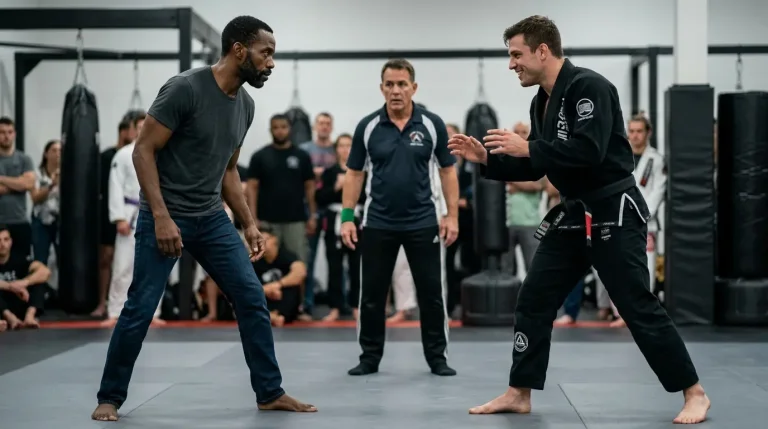
Grant Cross, owner of half the dealerships in the valley, came through the clinic doors wearing a tailored polo shirt and fury like aftershave.
“What happened?”
Logan looked up.
For a second, he wanted to tell the truth.
Then pride reached him before honesty could.
“Some biker woman jumped me.”
Wyatt looked at him.
Tyler looked away.
Grant’s face hardened.
“She still there?”
“No.”
“You get her name?”
Logan hesitated.
“No.”
Grant turned to Wyatt.
“You?”
Wyatt swallowed.
“People called her Leah.”
“Last name?”
“Nobody said.”
Grant pulled out his phone.
“We’ll find her.”
For one moment, that should have comforted Logan.
Instead, he felt something cold in his stomach.
He remembered Leah’s voice.
Let them ask.
I’m a ghost.
The next day, Grant Cross called police, attorneys, and two men he used when dealership problems needed to disappear quietly. He wanted the woman found. Charged. Sued. Made an example of.
The story should have gone that way.
A rich father.
A damaged son.
A biker woman.
A local bar full of people who knew better than to get involved.
But the Brass Knuckle was not a country club.
Its regulars did not love outsiders, and they loved rich outsiders even less.
When deputies came asking questions, Jess gave them the security footage.
All of it.
Not the cropped version Logan wanted.
The full version.
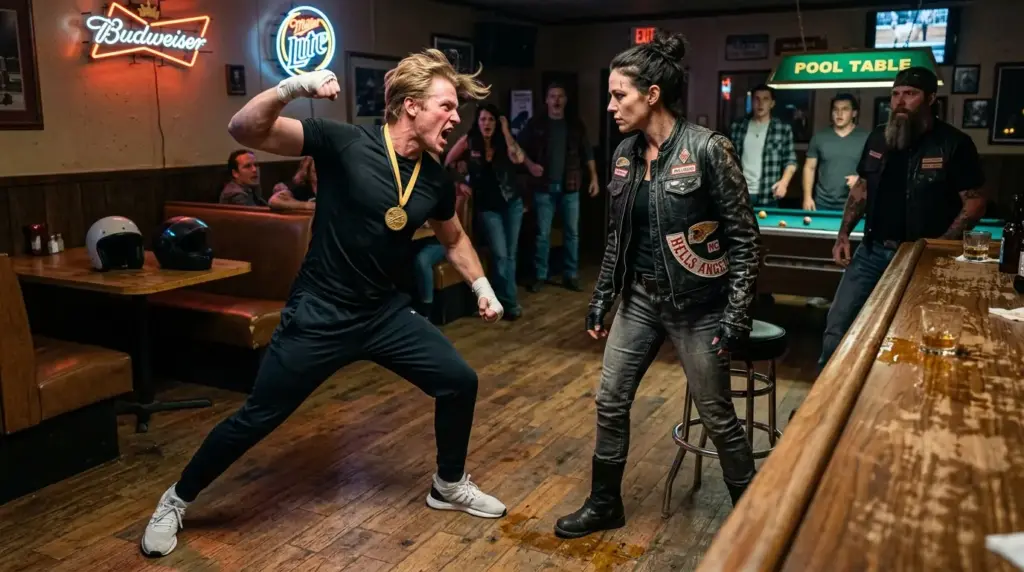
Logan bumping Leah’s stool.
Logan mocking her patch.
Logan reaching for the jacket.
Logan launching the first kick.
Logan throwing the spinning backfist.
Logan falling because he did not know how to fall outside a dojo.
The deputies watched it twice.
Then they watched the part where Leah told Wyatt to get Logan up before he went into shock.
One deputy sighed and closed the laptop.
“Your son started it,” he told Grant.
Grant went red.
“My son is injured.”
“Yes.”
“And she did that.”
“After he attacked her.”
“He’s a champion.”
“That’s not a legal defense.”
The report went nowhere.
The lawsuit never came.
Grant’s private men made one trip to the Brass Knuckle and left after Dutch and three other bikers stood up at the same time without saying a word.
Logan spent the next six weeks in a brace.
Then surgery.
Then rehab.
He could not punch.
Could not block.
Could not grip properly.
He sat on the edge of the dojo while other students practiced forms he had once performed better than anyone in the room. His instructor told him patience was part of discipline. Logan nodded like he believed it.
But inside, something rotten had begun to split open.
He did not miss fighting.
He missed being feared.
He missed walking into rooms convinced he was dangerous.
He missed the old certainty that physical skill made him superior.
At night, when pain kept him awake, he replayed the bar.
Not the fall.
Not even the wrist.
The moment before it.
Leah looking at him like he was not a threat.
Like he was a problem she already knew how to solve.
That was what haunted him.
Not that she beat him.
That she measured him correctly.
Three months after the fight, Logan returned to the Brass Knuckle.
Not with friends.
Not with a medal.
Not in a fitted athletic shirt.
He wore jeans, a plain hoodie, and a brace under his sleeve.
He sat in his truck for fifteen minutes before going inside.
The bar smelled the same.
Old beer.
Smoke.
Sweat.
Metal.
Jess looked up from behind the bar.
“No.”
Logan froze.
“I didn’t say anything.”
“You don’t need to. No.”
“I’m not here to cause trouble.”
“Then leave before you do.”
Dutch turned from two stools down.
His eyes narrowed.
Logan swallowed.
“I wanted to ask about Leah.”
The bar went very still.
Jess leaned forward.
“Wrong question.”
“I just want to know if she’s okay.”
Dutch let out a humorless laugh.
“That’s not what boys like you ask.”
Logan looked at him.
“What do boys like me ask?”
“Where she is. How to find her. How to get even.”
Logan lowered his eyes.
“I thought about all that.”
“At least you’re honest.”
“I’m trying to be.”
Jess studied him.
His face was different.
Not good yet.
But less certain.
Sometimes less certain is where change begins.
“She’s gone,” Jess said.
“Where?”
“Gone means gone.”
Logan nodded slowly.
He turned to leave.
Then stopped.
“I’m sorry about that night.”
Nobody responded.
The apology hung there, awkward and thin.
Dutch took a drink.
“Apologizing to us is easy. She’s not here.”
Logan looked back.
“I know.”
“Then what are you doing?”
He did not have an answer.
That was the first honest thing he had all day.
“I don’t know.”
Dutch stared at him for a long moment.
Then nodded toward the back room.
“Pool table’s jammed. You want to be useful, fix it.”
Logan blinked.
“What?”
“You heard me.”
“I don’t know how to fix pool tables.”
Dutch shrugged.
“Then you can start by shutting up and looking.”
That became the beginning.
Not redemption.
Not yet.
Just beginning.
Logan started coming by once a week.
At first, nobody trusted him.
They should not have.
He swept.
Carried cases.
Cleaned broken glass from the parking lot.
Listened more than he spoke, which was hard for him and therefore useful.
The regulars told him nothing about Leah.
But they taught him other things.
That Dutch had lost two brothers and most of his patience in the same year.
That Jess had once been a nurse before burnout and divorce turned her life sideways.
That the bar was full of people the polished world crossed the street to avoid, even when those people were the only ones likely to stop if a stranger broke down on a desert road.
One night, six months after the fight, Logan found a folded envelope taped under the bar where Leah had sat.
Jess watched him find it.
The envelope had his name on it.
LOGAN.
He opened it with his left hand because his right still hurt when the weather changed.