Inside was a single sheet of paper.
No greeting.
No signature.
Just three lines.
You trained to win.
You did not train to understand violence.
Start over.
Logan stared at it for a long time.
Then he looked at Jess.
“How long has this been here?”
“Long enough.”
“You knew?”
Jess wiped a glass.
“She said you’d either never come back or come back different.”
Logan looked back at the paper.
“Where is she?”
Jess shook her head.
“Still asking the wrong question.”
So Logan started over.
He quit competing for a year.
His instructor called it a mistake.
His father called it weakness.
His friends stopped calling as much.
He started training differently.
Not in a tournament gym.
At a small self-defense school outside Reno run by a retired paramedic and a former Marine who taught escape, de-escalation, falling, weapon awareness, and the first rule Logan had never truly learned.
Leave if you can.
He hated it at first.
There were no medals.
No applause.
No clean point system.
No fantasy that skill made him untouchable.
He learned how quickly a knife changes distance.
How badly hardwood punishes arrogance.
How little a high kick matters in a crowded hallway.
How much responsibility comes with knowing you can hurt people.
Most of all, he learned what Leah had known the moment he bounced in front of her.
Violence is not performance.
It is consequence.
Two years passed.
Logan’s wrist healed, though never completely. It clicked in cold weather. It ached when he gripped too hard. It reminded him, whenever he wanted to be stupid, that bodies keep receipts.
He did fight again eventually.
But he was different.
He stopped humiliating opponents.
Stopped celebrating over anyone on the floor.
Stopped confusing domination with mastery.
Before every beginner class, he told new students the same thing.
“The first responsibility of learning how to hurt someone is learning when not to.”
Some listened.
Some did not.
He knew which one he had been.
Leah remained a ghost.
Every few months, someone claimed to have seen her.
At a gas station near Elko.
Crossing into Arizona.
Standing beside a black Harley outside a border-town motel.
Once, Dutch received a postcard with no return address.
It showed a desert road at sunset.
On the back, in small handwriting, were five words.
Still breathing. Keep the boys honest.
Dutch pinned it behind the bar.
No one asked if that meant Logan.
Everyone knew it did.
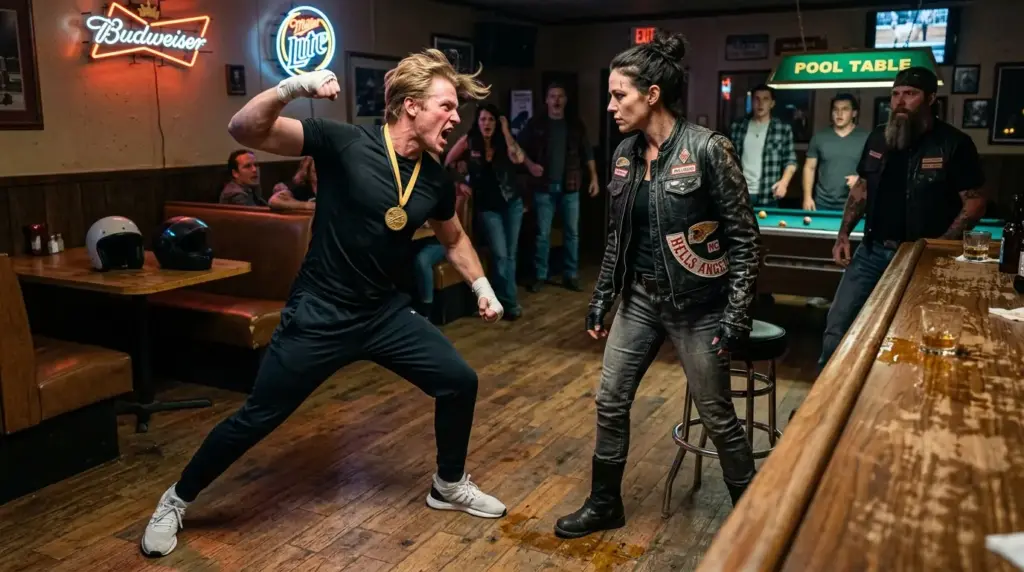
Years later, people still told the Brass Knuckle story in a simple way.
A cocky karate champion picked a fight with a biker woman.
He learned too late that she was Mossad.
She broke him in seconds.
He never saw the world the same again.
It was a good story.
Sharp.
Satisfying.
Easy to repeat.
But Logan eventually understood that the real story was not about Leah’s secret identity.
It was not about Mossad.
Not about Krav Maga.
Not about Tel Aviv, Beirut, Gaza, or whatever battlefield had shaped her into a woman who moved like smoke and struck like a door slamming shut.
The real story was simpler and more humiliating.
He had thought some people were safe to disrespect.
That was the disease.
Leah was only the cure.
He had believed a woman alone in a bar was an easy target.
He had believed a biker patch made her less human.
He had believed a gold medal meant he understood danger.
He had believed violence was something he could start for entertainment and stop when it stopped flattering him.
He was wrong every time.
The world did not care about his belt.
The floor did not care about his tournament record.
Pain did not care about his father’s money.
Leah did not care about his confidence.
And violence, real violence, did not care how pretty his technique looked under fluorescent lights.
That was the lesson.
Not that he picked the wrong woman.
That he believed there was a right woman to pick.
Leah rode on through the desert, nameless in most places, necessary in some, carrying old ghosts beneath cracked leather. She did not become Logan’s mentor. She did not return to forgive him. She did not soften into a lesson made for someone else’s growth.
She remained what she had always been.
A survivor.
A weapon hidden in plain sight.
A woman who wanted whiskey, silence, and enough space to breathe without being tested.
Logan became quieter.
Not weak.
Not broken.
Quieter.
He learned that quiet can be stronger than swagger.
That restraint can be harder than impact.
That courage is sometimes walking away before your ego writes a check your body cannot cash.
And every time his wrist clicked, he remembered the sticky floor of the Brass Knuckle, the smell of stale beer, the flat darkness of Leah’s eyes, and the sound he made when the padded world disappeared beneath him.
A wet, choking gasp.
The sound of arrogance meeting consequence.
The sound of a boy who thought he was dangerous learning that danger does not announce itself.
Sometimes it sits at the end of a bar in cracked leather, drinking rail whiskey, asking for nothing, waiting to be left alone.
And if you are wise, you let her be.





