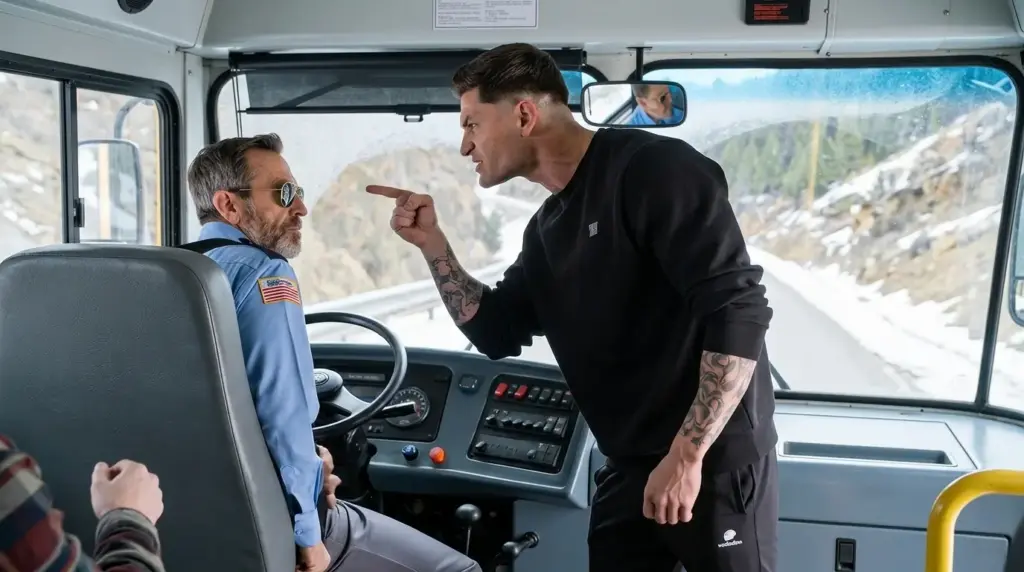
Then back at Arthur.
His face hardened.
He crouched beside Trent and pulled out cuffs.
Trent’s eyes widened.
“What are you doing? I’m the victim.”
Carlson leaned close.
“Listen carefully, Trent. You do not know who you swung at.”
Trent spat, “He’s a bus driver.”
Carlson’s eyes did not move.
“His name is Arthur Hayes.”
The bus went quieter, though no one knew yet what the name meant.
Carlson continued, voice low.
“Before he drove this route, he was Commander Arthur Hayes, United States Navy. He ran special operations teams in places you cannot pronounce without reading them off a map. He spent years doing close-quarters work in combat zones while you were still learning how to tie your shoes. The only reason you are breathing clearly enough to complain is because he decided to let you.”
Trent looked past Carlson toward the front of the bus.
Arthur had taken off his sunglasses and was wiping snowmelt from the lenses.
For the first time, Trent saw his eyes.
There was no anger in them.
No pride.
No excitement.
Only distance.
A thousand-yard stare tucked behind the face of a municipal bus driver.
Carlson secured Trent’s uninjured wrist.
“You’re going to the hospital,” he said. “Then you’re going to jail. And you’re going to pray Commander Hayes doesn’t decide to make this worse for you than you already made it for yourself.”
The hospital smelled of disinfectant, wet coats, and bad coffee.
Trent lay on a stiff emergency-room gurney with his right wrist cuffed to the rail. The adrenaline was gone now, leaving deep throbbing pain through his arm, shoulder, and pride.
Cody was down the hall, groaning while doctors examined his injured leg.
Deputy Carlson stood near the door with a paper cup of coffee.
“You should be thanking him,” Carlson said.
Trent stared at the ceiling.
“For what?”
“For restraint.”
Trent gave a bitter laugh.
Carlson did not smile.
“I’m serious. You think he went hard because it hurt. He did not. He went soft because you are still talking.”
Trent’s jaw clenched.
“I want a lawyer. I’m suing the city, the transit authority, all of them. That old freak used excessive force.”
Carlson laughed once, dry and humorless.
“Kid, we have statements from twelve passengers, including Chloe Sanders, the girl you cornered and threatened. We have internal bus footage. Clear enough. It shows you underpaying, threatening the driver, harassing a passenger, ignoring commands, advancing on a municipal employee, and throwing first.”
Trent said nothing.
“You are not suing anyone,” Carlson said. “You are looking at assault, battery, public endangerment, and whatever else the prosecutor decides to add after watching you turn a bus full of civilians into your personal stage during a blizzard.”
Three days later, the Route 42 footage leaked.
It did not have audio.
It did not need it.
The video spread across Oak Creek first, then across regional MMA forums.
People watched Trent Lawson, the undefeated prodigy, the loud gym owner, the man who spoke constantly about dominance and real fighting, get handled in seconds by a limping bus driver in a Transit Authority uniform.
The fallout was immediate.
Apex Striking and Grappling emptied almost overnight.
Parents pulled their teenagers from classes.
Sponsors for Trent’s upcoming regional fights backed out.
Gym friends stopped posting with him.
Greg and Liam, who had cowered in the back of the bus with their hands up, stopped answering his messages.
The aura vanished.
And for men like Trent, aura had been half the armor.
Desperate, angry, and humiliated, Trent hired Bradley Jenkins, the most aggressive defense attorney in the county.
He walked into Bradley’s office with his arm in a sling and a swollen face, still trying to carry himself like the man he had been before Route 42.
“I want everything on him,” Trent said. “Military record, medical history, whatever. If he’s got PTSD, if he snapped, if he has a violent past, we use it.”
Bradley Jenkins listened with the patient expression of a man who had already watched enough video to know his client was in trouble.
A week later, Bradley called him back.
A thick folder sat on the lawyer’s desk.
Bradley did not look pleased.
Trent sat down awkwardly.
“Well?”
Bradley removed his glasses.
“Trent, you are a complete idiot.”
Trent bristled.
“Excuse me?”
“I pulled what I could on Arthur Hayes. Most of it is sealed or heavily redacted.”
“And?”
Bradley tapped the folder.
“He is not just a veteran. He was a special operations commander. He served in Panama, Somalia, Afghanistan, and Iraq. During one operation in Ramadi, his unit was pinned inside a building under heavy fire. Hayes cleared an extraction route for wounded men under conditions you cannot imagine.”
Trent’s face changed.
Bradley opened the folder and slid forward a photocopied commendation letter.
“He was awarded the Navy Cross.”
Trent stared at the page.
The words blurred.
Bradley leaned forward.
“You attacked a decorated American veteran who was driving a bus full of civilians through a blizzard. You harassed a nineteen-year-old woman on that bus. You threatened a municipal employee. You threw the first punch. If we try to paint you as the victim, the district attorney will put Arthur Hayes on the stand. The jury will see him, and then they will see you.”
He let that sit.
“They will bury you.”
Trent’s throat tightened.
For the first time, the full depth of the water beneath him became visible.
He had thought he was standing in a shallow pool.
He had walked into the ocean at night.
“What do I do?” he asked.
His voice cracked on the last word.
Bradley’s expression softened only slightly.
“You drop the lawsuit fantasy. You plead to the lesser charges if the prosecutor offers them. You take probation, community service, restitution if ordered, and you pray Arthur Hayes does not decide to read a victim impact statement.”
That night, Trent sat alone in his apartment.
His black belt hung over the back of a chair.





