He had always loved seeing it there.
A symbol.
A warning.
A proof of identity.
Now it looked like cloth.
Nothing more.
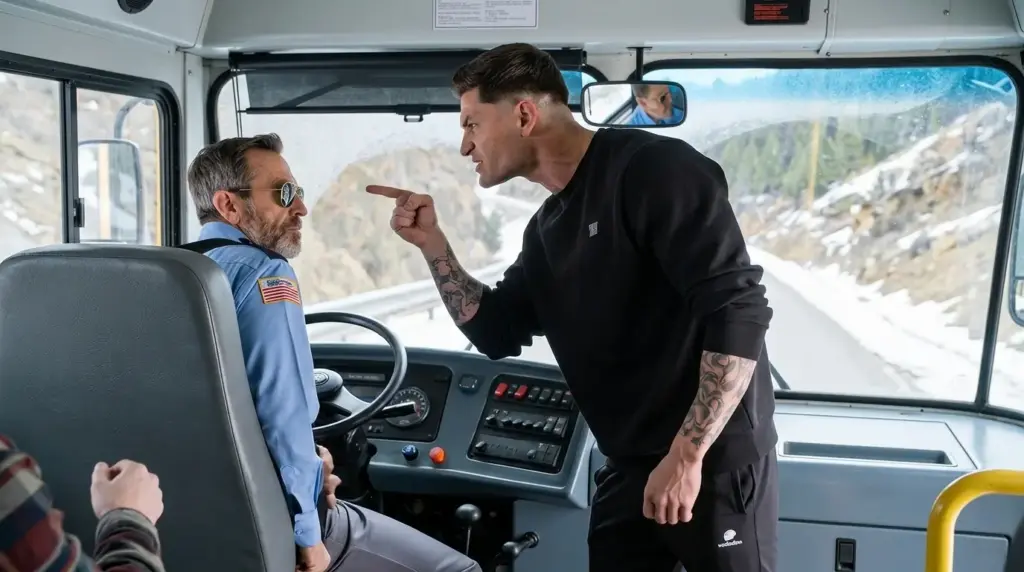
He opened his laptop and watched the leaked bus footage again.
Then again.
Then slower.
Quarter speed.
He had watched fight tape his whole adult life, studying dropped hands, sloppy footwork, shifted hips, openings to exploit. But watching Arthur Hayes move was different.
Arthur did not move like a fighter trying to win.
He moved like a man managing a danger.
No wasted motion.
No anger.
No drama.
No desire to prove anything.
That was what sickened Trent most.
Arthur had not fought him.
Arthur had dealt with him.
Like a driver steering out of a skid.
Like a mechanic tightening a loose bolt before the engine failed.
Trent closed the laptop and looked again at the belt.
For years, he believed it meant he was a warrior.
Now, sitting in a silent apartment with his arm throbbing and his career falling apart, he understood something he should have learned much earlier.
He had been an athlete.
A talented one.
A dangerous one under rules.
But he did not know the first thing about being a warrior.
Three weeks later, on a gray Thursday morning, Trent stood outside the chain-link fence of the Oak Creek municipal transit depot.
Snow had begun to melt into dirty slush along the curb. His arm was still in a sling. His gym had closed the day before. The mats were rolled into storage. The heavy bags had been sold. The lease was broken.
In three days, he would stand before a county judge and plead guilty to two misdemeanors.
His professional fighting career was effectively over before it had really begun.
At 6:15 a.m., a battered silver pickup pulled into the lot.
Arthur Hayes stepped out wearing his familiar gray uniform and carrying a metal thermos.
He walked with the same slow limp.
The same calm.
The same invisibility.
Trent’s heart hammered.
Every instinct told him to leave.
Instead, he stepped forward.
“Mr. Hayes.”
Arthur stopped.
Turned.
His eyes moved briefly to the sling, then back to Trent’s face.
He did not reach for anything.
Did not change stance.
He waited.
“I’m not here to start anything,” Trent said quickly, lifting his good hand. “I just… I need to talk to you.”
Arthur took a slow sip from his thermos.
“You’re trespassing on city property, son. Depot doesn’t open for another hour.”
“I know. I’ll leave in a second.”
Arthur said nothing.
Trent swallowed.
He had rehearsed twelve speeches.
All of them disappeared.
Finally, he asked the question that had been eating him alive.
“Why didn’t you warn me?”
Arthur looked at him.
“On the bus,” Trent said. “When I was running my mouth. When I threatened you. Why didn’t you just tell me who you were? Tell me you were a SEAL. Tell me you could put me down. I would’ve backed off.”
Arthur studied him for a long moment.
The depot hummed behind them.
Diesel engines warming.
Snowmelt dripping from roof edges.
Then Arthur said, “A man who has to tell you what he is usually isn’t it.”
Trent looked down.
Arthur stepped closer, but not threateningly. He leaned one shoulder against the fence and looked out at the gray morning.
“You thought you were tough because you can make people tap on a padded floor,” Arthur said. “You thought violence was a currency you could spend to buy respect.”
Trent said nothing.
“True violence is not a sport,” Arthur continued. “It is a tragedy. It is ugly, fast, and it ruins everyone it touches.”
His voice stayed steady, but something distant entered his eyes.
“I spent years doing things in the dark so other people could live in the light. I lost friends. I took men away from families. I have dreams that still wake me up sweating. I did not tell you what I was because I am not proud of the violence I am capable of. It is not a costume. It is not a brand. It is a burden.”
Trent’s eyes burned.
Arthur looked back at him.
“You got on my bus looking for someone to make small. I gave you chances to sit down and be a man. You chose to become a threat. So I stopped the threat.”
There was no anger in the words.
No pleasure.
That made them worse.
Trent’s voice broke.
“I lost my gym.”
Arthur said nothing.
“My sponsors dropped me. My friends won’t talk to me. Everything I built is gone.”
Arthur looked at him.
“Good.”
Trent’s head snapped up.
Arthur’s expression did not change.
“You built it on arrogance and bullying. It was made of glass. Better it shatters now while you are young enough to sweep up the pieces.”
Trent stared at him, wounded and listening.
“A black belt does not make you a man,” Arthur said. “Protecting people who cannot protect themselves makes you a man. Having the power to destroy and choosing restraint makes you a man.”
Arthur turned toward the depot doors.
“Wait,” Trent said.
Arthur paused.
“I want to apologize to you. And to Chloe. I’m pleading guilty Monday. I’m taking the punishment.”
His voice trembled.
“I’m sorry.”
Arthur did not turn around.
But he nodded once.
“Do the work, kid,” he said. “Build something real this time.”
Then he walked into the depot.
The heavy metal door closed behind him.
For the first time in Trent Lawson’s life, he did not feel the need to be the toughest man in the room.
He felt empty.
Terrified.
And strangely peaceful.
The ego that had driven him for years was dead.
Not because Arthur had destroyed his body.
Because Arthur had shown him the truth of it.
There had been nothing strong underneath.
Three years passed.
Oak Creek mostly forgot the Route 42 incident.
Towns do that.
They remember loudly for a while, then move on to new scandals, new storms, new gossip.





